
The Best Gold ETF Is SPDR Gold Shares (GLD): Here's Why I'm Holding It in 2026
Key Points
Gold ETFs are a good way to protect your portfolio from some of the effects of inflation.
ETFs that hold instruments to reflect the spot price of gold can be less volatile than those holding derivatives.
The SPDR Gold Shares ETF is the asset I use to get exposure to the metal.
I hold SPDR Gold Shares (NYSEMKT: GLD) and contend that it's the best gold exchange-traded fund (ETF) for most people. Per its latest filing, it held 32,314,227 ounces of gold bullion, which was worth about $130.1 billion on June 30, making it the biggest gold fund.
Here's why I have it, and why I'll probably buy more of it relatively soon.
Missed Nvidia in 2009? This Rare Signal Is Flashing Again. In 2009, a "Double Down" signal flashed for a little-known chipmaker called Nvidia. For the first time in years, that same "Total Conviction" signal is flashing for a company 1/100th the size of Nvidia. Continue »
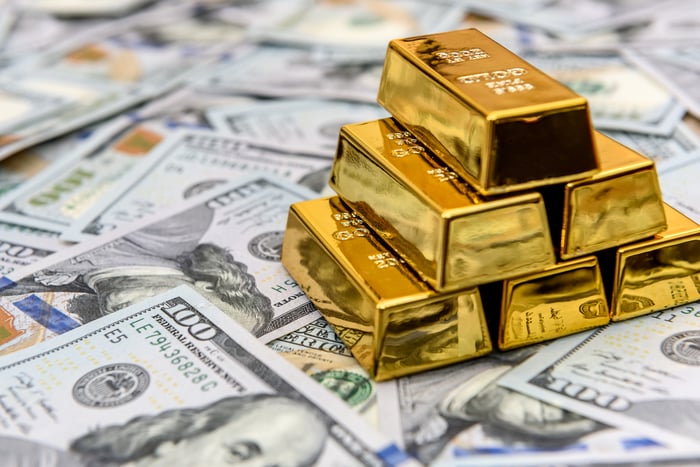
Image source: Getty Images.
This is one of the most widely available funds of its kind
Central banks bought a record 289 metric tons of gold in the second quarter of 2026, per the World Gold Council.
Such institutional buyers tend to accumulate their target assets even during price declines, which is a big part of what makes gold bullion one of the most widely trusted long-run inflation hedges around. If everyone consistently believes that something is valuable over time, it's very easy to believe that you'll be able to convert your holdings of that thing into a meaningful amount of purchasing power relative to the time when you purchased it.
Being the biggest gold ETF is what makes the fund a reference instrument for the financial sector. It's the fund whose size and performance people quote when they discuss the general topic of demand for gold and its drivers. That also means it's accessible to investors around the world, and that it's available through most brokerage accounts, and even many retirement accounts.
Its shares trade on the NYSE Arca in the U.S., and they're also listed in Hong Kong, Mexico, Singapore, and Tokyo. For reference, its sibling fund, SPDR Gold MiniShares, is only listed in two places, which is a common problem with other gold ETFs as well.
Another useful feature is that you can easily check on the metal that backs the fund. The ETF publishes a full list of the serial numbers of the gold bars it holds on every business day, and third-party verifiers validate its holdings two times per year.
What about the expense ratio?
The weak point about this ETF specifically is that it charges more in management fees than every other large fund backed by physical gold. Its expense ratio is 0.4%. The SPDR Gold MiniShares, for instance, only charges 0.1%.
Nonetheless, an annual fee of 0.4% is just $40 a year per $10,000 held, which is a very small toll on a long-term position. The fund stacks up especially well when comparing that cost to the fees associated with buying physical gold and holding it yourself. USAGOLD, a bullion dealer, calculated in March 2026 that the premium on a one-ounce American Gold Eagle coin was nearly 5%.
Especially in times of elevated inflation, like right now, gold is a segment of my portfolio that I think deserves a decent allocation.
I currently hold close to 4% of my portfolio's value in this fund. If by some chance its price declines substantially from here, you can bet that I'll be accumulating more of it -- but not an excessive amount, because my expectations are not for it to grow dramatically faster than an index fund tracking the stock market over the long term.
Alex Carchidi has positions in SPDR Gold Shares. The Motley Fool has no position in any of the stocks mentioned. The Motley Fool has a disclosure policy.