
The trillion-level “arms race” has entered a period of full expansion! From chips to software, 65 core US AI concept stocks, who is burning the most money?
The Zhitong Finance App learned that an unprecedented wave of corporate capital expenditure is quietly unfolding in the core area of the technology industry. From wafer-level chips to cloud-based data centers, and from network devices to security software, more than 65 tech companies are turning cash into the “productivity infrastructure” of the AI era at an unprecedented speed. This investment frenzy, driven by AI demand, is redefining the value chain pattern from chip manufacturing to enterprise software.
Trillion-dollar capital torrent: nine major cloud vendors spend 886.7 billion US dollars in 2026
According to the latest statistics from TrendForce Jibang Consulting, the total capital expenditure of the world's nine largest cloud service providers — including Google, Amazon, Meta, Microsoft, and Oracle, as well as Chinese manufacturers ByteDance, Tencent, Alibaba, and Baidu — will exceed 886.7 billion US dollars in 2026. The five largest businesses in North America together account for nearly 90%. TrendForce has previously raised the total capital expenditure estimates for the four major US CSP companies to around US$830 billion for the whole year, increasing the annual growth rate from 61% to 79%.
The 26Q2 capital expenditure of the four largest US CSPs (Microsoft, Google, Amazon, Meta) alone increased 86% year over year and 27% month over month. Microsoft has raised its 2026 capital expenditure outlook to $190 billion, an increase of about 130% year over year, of which approximately $25 billion can be attributed to rising component costs. Amazon's 26Q1 capital expenditure increased 77% year over year to 44.2 billion US dollars, maintaining the same annual guideline of 200 billion US dollars. Meta raised its 2026 capital expenditure guidelines to $125 billion to $145 billion. Alphabet raised the guidelines from US$1750-185 billion to US$180-1900 billion, an increase of more than 100%.
The scale of this investment wave has far surpassed any period in history — the five largest enterprises will invest more than 670 billion US dollars in infrastructure in 2026, accounting for a share of the US economy even greater than the railroad expansion era in the 1850s. UBS expects the capital expenditure of the top five hyperscale cloud vendors to rise further to $1.116 trillion in 2027.
Investment density differentiation: from “burning no money” to “steady and steady”
According to the latest statistics, capital expenditure data from 65 companies reveals extreme differentiation in the AI investment chain — this is not an evenly distributed investment feast, but a “winner-take-all” capital consumption war.
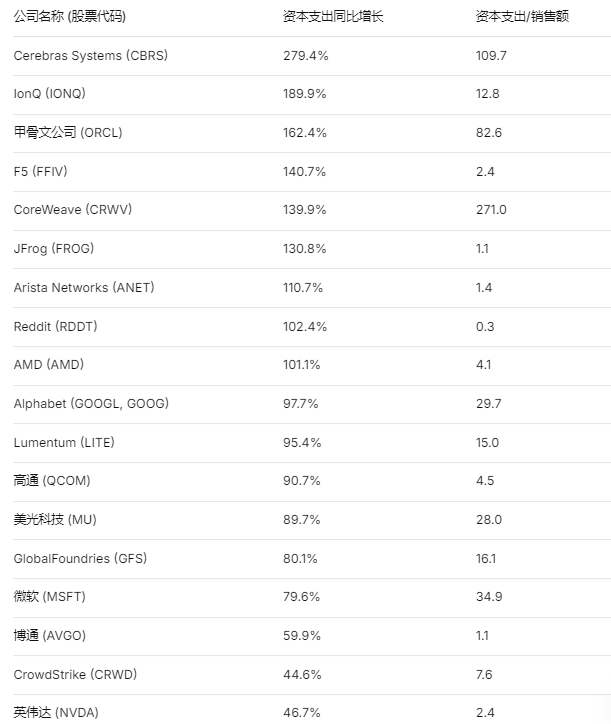
The broader screening covered 65 companies in selected industries. Notable companies with positive capital expenditure growth include Micron, Nvidia, AMD, Broadcom, SiTime, Twilio, Microchip, Lattice Semiconductor, MKS, Reddit, MACOM, Ciena, Alphabet, Marvell, Lumentum, Okta, CrowdStrike, Fortinet, Cisco, Microsoft, Astera Labs, Palo Alto Networks, Arista Networks, JFrog, Lam Research, Applied Materials, Rubrik, Cloudflare, Semtech, DigitalOcean, F5, KLA, Analog Devices, Motorola Solutions, Meta Platforms, Teradyne, VeriSign, Gen Digital, Oracle, Ubiquiti, ServiceNow, GoDaddy, Monolithic Power Systems and Qualcomm et al.
First tier: “super money burners” whose capital expenditure far exceeds revenue
CoreWeave (CRWV.US) topped the list with 271% capex to revenue ratio, and capital expenditure increased 139.9% year over year. Capital expenditure for the second quarter reached $9.4 billion, or 3.6 times revenue. Cash outflows from investment activities over the past six months reached US$14.9 billion, mainly for large-scale expansion of GPU clusters and infrastructure.
Cerebras Systems (CBRS.US) capital expenditure increased 279.4%, and CAPEX/sales ratio was 109.7%. The company's revenue forecast for the full year 2026 was raised to US$880 million to US$890 million, but the remaining performance obligation (RPO) reached US$25.4 billion.
Oracle (ORCL.US) capital expenditure increased 162.4%, and CAPEX/sales ratio was 82.6%. Capital expenditure for the 2026 fiscal year reached US$55.7 billion, exceeding the previous estimate of US$50 billion. The company predicts that capital expenditure will rise to $70 billion in fiscal year 2027. Free cash flow was negative US$23.7 billion, and the annual issuance of debt of US$43 billion and equity of US$5 billion was issued.
The second tier: the giants' “structural heavy warehouse”
Meta Platforms (META.US) has a CAPEX/sales ratio of 39.1%, Microsoft (MSFT.US) is 34.9%, and Alphabet (GOOGL.US) is 29.7%. The three giants' CAPEX/sales ratio is over 29%, indicating that AI investment has become the core capital allocation direction for these companies. Microsoft's capital expenditure increased 79.6%, while Alphabet increased 97.7%.
The third tier: chipmakers' “capacity competition”
Memory chip giant Micron (MU.US)'s CAPEX/sales ratio was 28.0%, and capital expenditure increased 89.7%. Intel (INTC.US) was 21.2%, Texas Instruments (TXN.US) was 17.0%, and GFS.US (GFS.US) was 16.1%. The International Semiconductor Industry Association (SEMI) predicts that in 2026, global investment in 300mm wafer manufacturing equipment will exceed 50 billion US dollars for the first time, an increase of 29% to 52 billion US dollars.
Financing Map: From Internal Cash Flow to Wall Street Debt Machine
The financing structure of this investment frenzy is undergoing fundamental changes. As capital expenditure far exceeds internal cash flow, technology companies are shifting to the bond market at an unprecedented rate. Since 2026, US hyperscale companies have issued $220 billion in bonds to fund AI infrastructure, which is more than double the total amount in 2025.
Oracle raised $43 billion through debt in fiscal year 2026, raised $5 billion through stocks, and plans to raise an additional $40 billion in fiscal year 2027. Nvidia holds 47.9 billion US dollars of stock shares in private companies and has promised to allocate an additional 18 billion US dollars for equity investment. The five largest enterprises have issued $159 billion in bonds globally in 2026 — compared to just $17 billion for the full year of 2024.
J.P. Morgan previously predicted that the total capital expenditure of AI hyperscale data center operators will reach about 5.5 trillion US dollars by 2030, of which about 4.1 trillion US dollars will come from debt financing.
Market Implications: The shift in valuation from “capital expenditure” to “capital efficiency”
The impact of this investment frenzy on capital markets is shifting from “narrative driven” to “data verification.” The ECB has clearly warned that the expansion of US tech giants in the Eurozone bond market “may drive up borrowing costs for all industries and may spill over into the sovereign bond market.”
From an investment perspective, the current AI capital expenditure cycle shows several key characteristics:
First, investment intensity determines valuation differentiation. CoreWeave and Cerebras have a CAPEX/sales ratio of over 100%, which means they are still in the early stages of “burning money for growth,” and the valuation depends more on the visibility of future orders than on current profits. And although giants such as Meta, Microsoft, and Alphabet have also increased their investments significantly, cash flow from their core business can still provide a buffer.
Second, semiconductor equipment companies are “definitive beneficiaries.” Global semiconductor companies' capital expenditure in 2026 is expected to increase 32% year over year to US$227.2 billion, and wafer factory equipment (WFE) revenue is expected to increase 27% to US$165 billion.
Third, “capital efficiency” is becoming a new valuation anchor. When AI investment moves from “whether you want to invest” to the stage of “can you make it back”, the market's focus on return on capital expenditure (ROIC) will surpass the growth rate of capital expenditure itself. Signs such as Oracle's free cash flow of negative US$23.7 billion and Alphabet's free cash flow turning negative for the first time in the second quarter are pushing “capital efficiency” to an unprecedented extent.
The surge in AI capital spending is being transmitted across the industrial chain. From 279% of Cerebras to 140% of CoreWeave, from 162% of Oracle to 98% of Alphabet — behind every capital expenditure is an order for chips, devices, data centers, and network infrastructure. This trillion-dollar AI infrastructure competition is reshaping the global technology industry's capital allocation pattern at an unprecedented speed.
When CoreWeave's capital expenditure reached 271 times revenue, when the big four cloud vendors burned 750 billion US dollars a year, and when AI capital expenses swallowed up 93% of the company's operating cash flow, the sustainability of this infrastructure frenzy is facing increasingly severe torture. As warned by Nomura Securities, when the return on AI investment falls short of expectations may be the real variable that will determine when this feast ends.