
The yen bears are starting to loosen up! Capital backflow+arbitrage transactions closed positions or set off a “reversal of the market”
The Zhitong Finance App learned that just six weeks ago, the exchange rate of the yen against the US dollar just hit its lowest point in 40 years. Now, the combination of factors has finally caused aggressive bears that have been betting on the depreciation of the yen for many years to falter, and the yen, which has been declining for a long time, is ushering in a turning point in fate.
Although the Bank of Japan's interest rate hike and record exchange rate intervention have failed to provide lasting support for the yen before, new variables such as capital return, arbitrage settlement, and political pressure from the US are forcing speculators who have shorted the yen to re-examine their long-term strategies.
“The market's psychological expectations of the yen seem to be changing,” said Rong Ren Goh, fixed income portfolio manager at Eastspring Investments. Investors are increasingly reluctant to aggressively short the yen. In particular, the prospect of the Bank of Japan's interest rate hike in September has added new risks to such transactions.”
The market generally expects the Bank of Japan to raise the benchmark interest rate by 25 basis points this month, but some traders have begun to absorb expectations of 50 basis points or continuous rapid rate hikes over the next few months. However, under the consistent prudent leadership of Governor Ueda Kazuo, the 50 basis point rate hike in September is still regarded as an extremely low probability event.
The shift in market sentiment has been confirmed by capital flows. According to Citigroup data, since the beginning of August, yen positions have changed from net short to net long; interbank capital flow data also showed that leveraged funds, banks, and real money investors were net buyers of yen this week.
The resonance of central bank policies, capital flows, and speculative positions is exacerbating exchange rate fluctuations. The yen is expected to rise 2.3% against the US dollar this week, the biggest weekly gain since the joint intervention of the US and Japan at the end of July. Stephen Jen, CEO and co-chief investment officer of Eurizon SLJ Asset Management, warned that the risk of large-scale liquidation of Japanese yen arbitrage transactions is rising, similar to the situation where banks and hedge funds were forced to quickly deleverage when long-term capital management companies (LTCM) went out of business in 1998.
“When a currency is extremely undervalued and positions are extremely crowded, such fluctuations will occur more frequently before the big market hits,” Jen said. It's like an earthquake — the tectonic plates are rubbing against each other under tremendous pressure.”
Interventions and the Federal Reserve: Policy Synergies Emerge
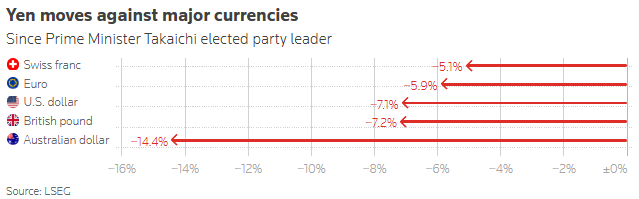
The years-long depreciation trend of the yen has further accelerated this year, mainly because the market is concerned about the fiscal sustainability of Japanese Prime Minister Takaichi Sanae's stimulus plan, and at the same time, it is widely believed that the Bank of Japan “lags behind the curve” in terms of monetary tightening. Between April and May, when the Japanese yen fell below the 160 to 1 dollar mark, the Bank of Japan unilaterally intervened on a record scale.
The key turning point in the yen's trend came from July to August — after the yen fell to 163.99 (the lowest level since 1986), the US rarely joined hands with Japan to carry out a joint intervention. US Treasury Secretary Scott Bessent has long argued that raising interest rates is the correct solution to curbing the weakening yen. He put pressure on the Bank of Japan again during the G20 finance ministers meeting this week. Subsequently, Bank of Japan deliberator Hajime Takata — the sole opponent of July's resolution to keep interest rates unchanged — delivered a speech, implying that a 50 basis point rate hike or faster continuous rate hikes may be adopted.
“His remarks about continuous rate hikes and more drastic adjustments are extremely impactful,” said Yoshio Iguchi, chief strategy director at Traders Securities. If this becomes a consensus, it will be a game changer for the yen.”
According to Tokyo Tanshi (Tokyo Tanshi) data, the probability that the market is betting that the Bank of Japan will raise interest rates by 25 basis points to 1.25% in September has risen to 97%, far higher than 52% a month ago. Furthermore, the probability of interest rate hikes in October is 27% compared to 56% in December.
Accelerated return of capital: a signal for domestic institutions to “return home”
Meanwhile, there are signs that yields on Japanese treasury bonds have suddenly risen to historic highs, prompting domestic institutional investors to withdraw their capital to the mainland. In July of this year, the Japanese government revealed that its $1.8 trillion government pension investment fund (GPIF) may shift the focus of asset allocation back to the country. This news has caused shocks in the global market. According to official data, Japanese investors are reducing their holdings of foreign bonds at the fastest rate in four years.
“The immediate factor behind the strengthening of the yen was market speculation that the Bank of Japan's interest rate hike might exceed expectations, which clearly attracted everyone's attention,” said Bart Wakabayashi, head of the Tokyo branch of State Street Bank. But looking back, the single biggest factor is that Japanese investors prefer to invest in domestic assets, including monetizing overseas assets.”
Wakabayashi pointed out that according to State Street's own data, the net short and low balance positions of real money investors against the yen have risen to the highest level in five years, paving the way for a “return” of positions to neutral or even excessive.
The Federal Reserve is also one of the key variables. After Federal Reserve Governor Waller made dovish remarks, traders lowered their expectations for the US interest rate hike this month, which created room for the Bank of Japan to narrow the spread between the US and Japan — the main driver of the weak yen. The narrowing of overseas interest rate advantages will also push arbitrage transactions to close positions, that is, investors borrow low-cost yen and invest in high-yield overseas assets.
A reversal of short positions could trigger a sharp market. J.P. Morgan estimates that since Takaichi Sanae took office as prime minister in October last year, the total number of short positions in the yen has reached about 17 trillion yen (about 108.74 billion US dollars).
“If this position is completely closed, the USD/JPY exchange rate may fall to the 142-146 range,” J.P. Morgan analysts Junya Tanase and Ikue Saito wrote in the report.