
Tim Cook Just Left Apple With a Massive Problem to Solve
Tim Cook just left the building at Apple (AAPL).
Fifteen years later, he turned $347 billion into $4.7 trillion, and his run as one of the greatest CEOs in corporate history is now officially over.
Today, the keys to the kingdom belong to John Ternus, a hardware guy stepping into a software fight he's never had to win before.
But the transition isn’t as smooth as the last one. Cook built an empire, but he's also leaving behind a mess Apple still needs to clean up. Siri is running on Google's brain now. Not exactly the finish line anyone imagined.
So that leaves long-term investors like me with a crucial question: is it time to take some chips off the table and wait to see which direction the wind blows, or is it time to double down on Apple and bet that its best days are still ahead?
Tim Cook's Apple: From $347 Billion to $4.7 Trillion
Before we look at what the future might hold, we need to look at the past: how Tim Cook led the company through arguably its biggest period of growth.
Under his leadership, Apple broadened its iPhone lead into other premium devices while opening new revenue streams through services, successfully expanding the company’s ecosystem in both products and recurring services.
This diversification came just in time. Smartphone sales began to plateau across the industry in the mid-2010s as the technology matured and upgrade cycles lengthened.
So rather than relying solely on customers upgrading to the latest iPhone, Cook steered Apple toward a services-centric strategy, bundling offerings like iCloud storage, Apple Arcade, and Apple News+ into an increasingly sticky subscription ecosystem.
As a result, the Services segment grew from a modest contributor to one of the company's most profitable divisions - and its revenue was mostly immune to the inherent cyclicality of hardware sales.
At the same time, Cook expanded Apple's footprint into wearables and accessories, turning the Apple Watch and AirPods into billion-dollar product lines in their own right.
These strings of successes helped grow the company from its $347 billion roots to $4.7 trillion today, beating the S&P 500 Index ($SPX) by thousands of percentage points in the process.
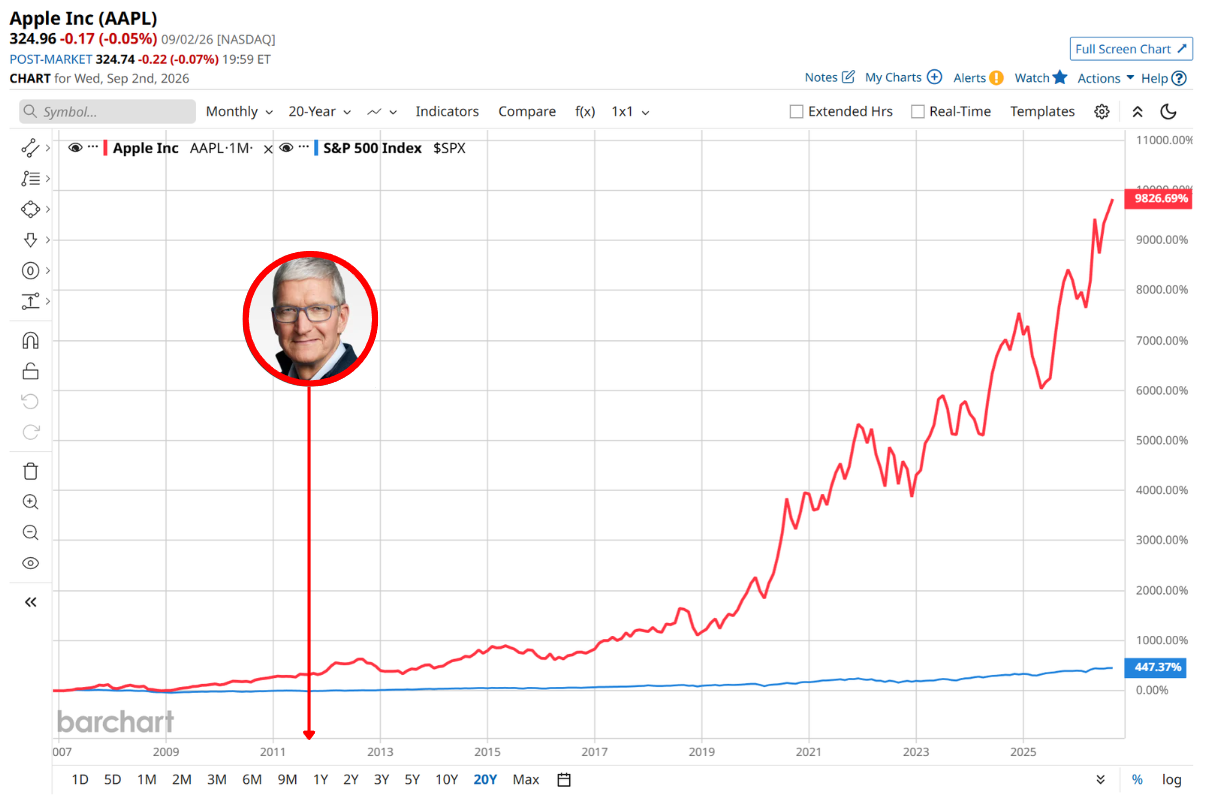
That’s a 13.5x growth in Apple's market cap - which is even more impressive considering that Apple was already one of the most valuable companies in the world at the time.
The Silicon Gamble That Paid Off
Cook also oversaw one of Apple’s most consequential technological shifts: designing its own chips.
The roots of this transition trace back over a decade, to Apple's early work building A-series chips for the iPhone and iPad, which consistently outpaced competitors on efficiency. That track record gave Cook's team the confidence to bring the same custom-silicon approach to the Mac.
And on June 22, 2020, Apple formally announced its shift away from Intel (INTC) CPUs to its own ARM-based silicon.
This marked the second major change in silicon architecture; the first was the 2005 switch from PowerPC to Intel, announced by founder Steve Jobs.
Now, the most recent transition itself was staged with the kind of caution Cook was known for throughout his career. Apple gave developers a two-year runway, starting with the M1 in late 2020 and finishing with the Mac Pro in 2023 - the last machine that ran on Intel.
To bridge the gap, Apple leaned on two tools: Rosetta 2, which translated Intel-based apps to run on Apple Silicon with minimal performance loss; and Universal Binaries, which let developers ship a single app that ran natively on both architectures.
For older Apple enthusiasts, this would have sounded familiar, as it was the same playbook Apple used during the PowerPC-to-Intel transition, updated for a much larger and more demanding ecosystem.
And the result? The highly successful M1 chip, launched in November 2020, built on a 5-nanometer process with an 8-core CPU and unified memory architecture. The chip outperformed most Intel-based Macs on raw benchmarks while using a fraction of the power, according to Geekbench.
From there, Apple scaled the design across the lineup. First came the M1 Pro and M1 Max in 2021, followed by the inevitable M2, M3, and M4 generations. Each CPU line pushed the Mac’s capabilities to encompass tasks that usually needed a dedicated CPU and GPU setup. Now, you can use Macs for video editing, 3D rendering, and machine learning inference with little to no issue.
There’s a reason why Macs sell like hotcakes, even at a premium - they just work.
And now, the company owns the entire design and integration process for Macs. It’s the same strategy that made the iPhone so wildly profitable.
Now, one man can’t claim the transition’s success, but Cook's real contribution in all of this - the operational discipline to handle such a massive change - was proof that his brand of leadership could reshape the business for the better, all without losing ground to competitors.
Apple Maps and the Cost of Getting It Wrong
But of course, no one is perfect and gets everything right, except maybe for… well. Let's stay on topic.
First came the catastrophic release of Apple Maps in 2012, a mistake Cook himself repeatedly owned and even referenced in his April 2026 town hall meeting, calling it his “first really big mistake.”
If you were there, you’d remember how Maps warped the landscape, misplaced landmarks, and even sent some users into the middle of nowhere. It was almost a horror film in the shape of a failed app launch. It got so bad that Apple had to ask users to temporarily stop using it. Oops.
The fallout was even worse. Apple fired Richard Williamson, head of Maps, on the spot. Tim Cook apologized.
Then there was the self-driving car. Now, this blunder might not be as bad as the Maps failure, partly because it never got off the ground.
Apple invested significantly in the project only to cancel it after 10 years, most likely as a result of the product not being well-aligned with Apple's ecosystem. Employees from the failed car initiative moved to AI, which neatly leads to the next, and likely most consequential, mistake of Tim Cook's career.
Why Apple Intelligence Became Cook's Biggest Regret
Apple Intelligence came out in 2024 as a suite of features running on the company’s own AI model, to be included in iPhones, iPads, Macs, and other accessories. The feature promised a few ideas, like a smarter, more responsive Siri.
Yet two years later, Apple Intelligence still doesn't always work when or the way I need it to.
Apple's Worldwide Developers Conference (WWDC) in 2024 attempted to demo features before they really worked, and then quietly pulled them from the following year’s planned updates. It was clear Apple couldn't get them to work as they wanted. Perhaps it was similar to the self-driving car.
And while all that was happening, the AI landscape changed faster than we could ever imagine. ChatGPT, Gemini, and Claude have already become the de facto leaders in consumer AI. Millions of people adopted these platforms into their work processes and, in many cases, for their everyday use.
Now, that’s not to say that Apple has given up. At WWDC 2026, the company announced Siri AI:
These new capabilities are powered by the next generation of Apple Foundation Models, custom-built in collaboration with Google and its Gemini models for deeply integrated Apple Intelligence experiences. These latest models run on device and on servers using Private Cloud Compute.
Every facet of the new Apple Intelligence architecture is built privacy-first, from the latest Apple Foundation Models to the core operating system technologies that integrate these models deep into Apple’s platforms. Apple Intelligence uses on-device processing and Private Cloud Compute to help protect users’ privacy. Private Cloud Compute gives users access to frontier-level intelligence, while extending the privacy and security of iPhone into the cloud.
It’s certainly… something, but it's not the Apple Intelligence promised two years ago.
And there’s an even more damning piece of wording there that highlights Apple’s biggest failure here: “...custom-built in collaboration with Google and its Gemini models.”
Essentially, Apple, under Tim Cook’s leadership, is admitting that it couldn’t make its proprietary AI model work well enough to launch it with a new and improved Siri. Instead, it had to outsource it to Google.
For a company that built its reputation on shipping finished experiences, Apple Intelligence has become a clear sign of how far the company has fallen behind in the AI race.
And so, we arrive at the crossroads.
What Apple Is Today: Revenue, Margins, and Market Cap in 2026
Tim Cook’s stint as CEO is over, leaving behind a notable string of accomplishments marred by the shadow of Apple Intelligence’s failure. He’s handing the keys to John Ternus, for better or worse, who is now left to steer Apple’s ship into the AI market.
But a company is more than the sum of its successes and failures. So exactly what kind of business is Cook leaving behind?
Let’s look at the fundamentals to answer that.
At $4.7 trillion, Apple remains one of the most valuable companies in the world. For a brief moment in July 2026, it even overtook Nvidia (NVDA) as the most valuable company.
Now, if we compare Apple’s fundamentals to the top five most valuable companies in the world right now, a few differences immediately pop out.
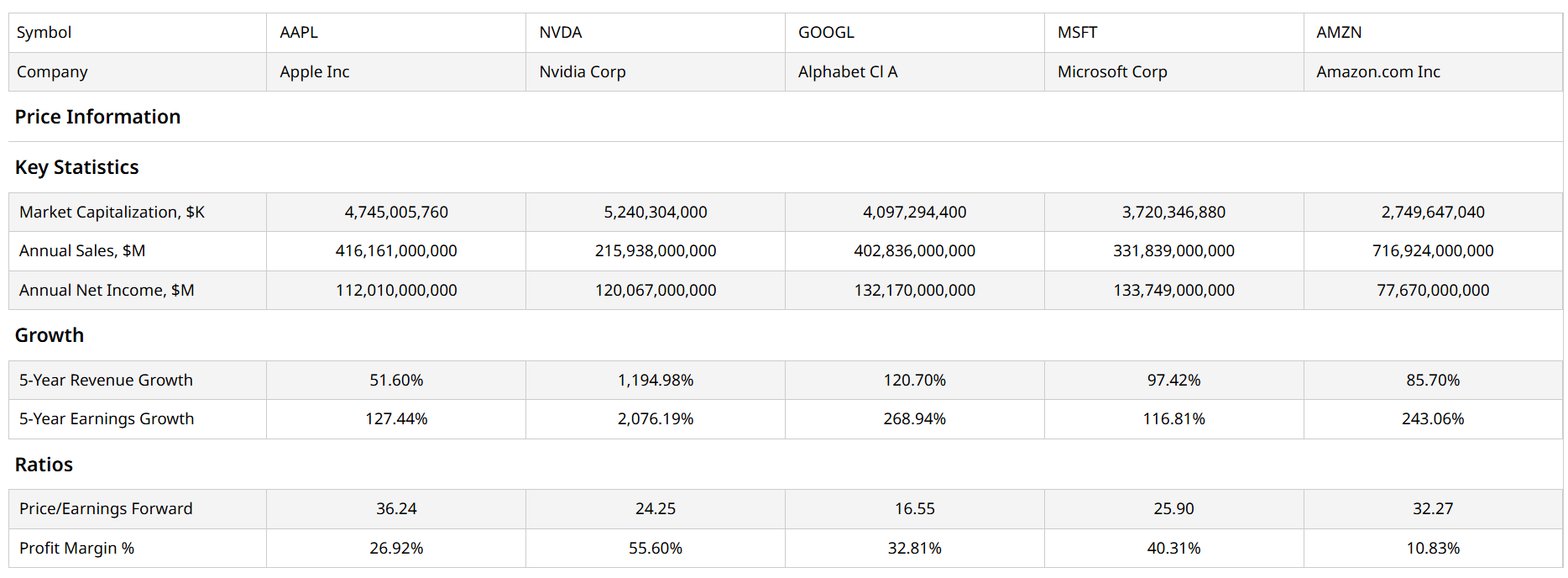
First, Apple has the second-highest latest annual revenue at $416.2 billion, next to Amazon’s massive $716.9 billion.
Now, you can sit there and say that that’s a good thing, but when we look at profitability, the picture reverses. Amazon (AMZN) and Apple have the lowest net margins, in the same order. Even worse, Apple now has the highest forward price-to-earnings multiple at 36x.
This shows a deep disparity between Amazon, Apple, and the rest on this list, which can be explained by how these companies actually do business.
Nvidia doesn’t need much explanation. It’s selling the chips powering this entire AI revolution, resulting in quadruple-digit growth over the last five years and margins that make every investor cry happy tears.
Meanwhile, Alphabet (GOOG) (GOOGL) and Microsoft (MSFT) now generate a big chunk of their revenue through high-margin advertising, cloud, and software businesses. AI is a big part of their narrative because it’s becoming the major growth engine across both companies.
More importantly, these two are now monetizing their AI features through products and infrastructure that they already sell, allowing them to create more revenue streams without relying on customers buying new hardware every cycle.
In Amazon’s case, the majority of its business is still tied to retail. That means high volumes but low margins. It does have a stake in cloud and AI infrastructure through Amazon Web Services (AWS), but that remains the smaller piece of the business - at least for now.
And Apple? It remains a hardware company first. It doesn’t have a cloud infrastructure to lease out. It doesn’t have an AI feature to monetize. Heck, its self-designed chips are only used in-house to protect its hardware’s competitive edge. And that makes Apple’s hardware-centric approach a double-edged sword.
Because, sure, Apple devices sell extremely well in almost every important global market, easily driving revenue higher.
However, hardware sales tend to be lumpy and cyclical, tied to the fortunes of and excitement around the next big iPhone or Mac release.
And despite impressive growth in the last few years, Apple's Services segment is still the secondary money engine. It's also mostly built on top of the company's hardware ecosystem, which exposes Apple to a slow-motion, dual-risk nightmare scenario: if hardware sales weaken, the user base stalls, and services growth eventually follows.
Now, I’m not saying that Apple is a weak business. Far from it. A 27% net margin is still considered elite by almost any standard. The company still makes more money per dollar of revenue than nearly every other company on earth that isn’t selling digital ad space, renting out cloud computing, or selling AI chips.
But there’s only so much growth you can squeeze out of selling phones, accessories, and laptops once or twice a decade. The quality is great, sure; but at the same time, it’ll be one of the reasons why those same customers won’t buy Apple’s new products.
Heck, I’ll admit it; I love Apple products. I've owned several Macs, MacBooks, Apple TVs, etc. – and once this is published, I’ll be reading it on my iPhone 17 Pro. They’re durable machines, and I’ve had virtually no problems using them every single day, and that on its own is actually worth more to me than the price tag.
Not only that, I'll happily upgrade about every other year as the products come out. After all, Apple products have a tendency to keep their value.
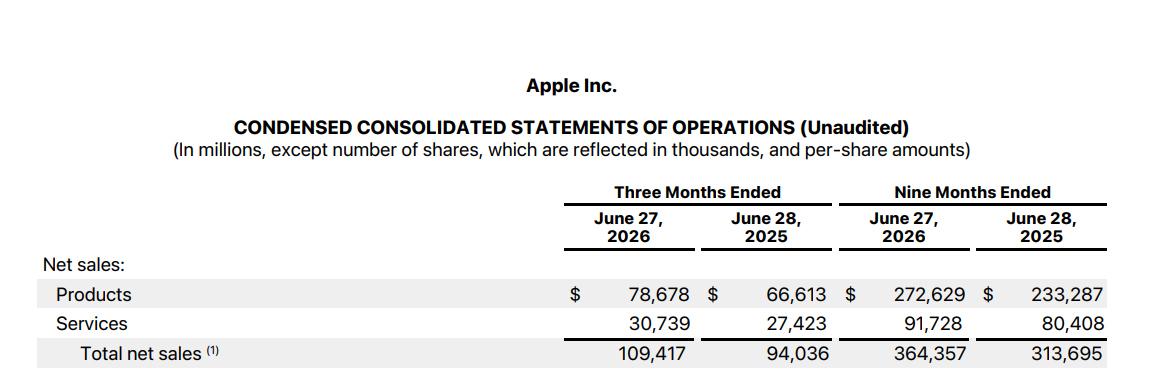
That’s the structural ceiling that Tim Cook is leaving behind for John Ternus to solve. Services was supposed to be the escape hatch from that ceiling, and to Cook's credit, it worked better than almost anyone expected. As of Q3 FY26, Services represents 28% of total revenue and is growing at a steady pace.
That being said – every subscription, every iCloud tier, every App Store transaction still assumes someone bought an iPhone, Mac, or another Apple device first. I mean, sure; people don’t necessarily need an Apple device to sign up for Apple TV+ and Apple Music, but the vast majority of Apple's services revenue still comes from the hundreds of millions of people already living inside its hardware ecosystem.
Those are the people paying for iCloud storage to keep their photos, upgrading to Apple One for a bundle deal across all their devices, or renewing App Store subscriptions to keep the premium experience intact. These services are excellent for consistent revenue, but they’re not really growth drivers in the way that attracts “new” customers. These people have to be already operating within the Apple ecosystem before they can use these services.
In the future, I’d like to see more developments in the direction of Apple TV+ and Music - the ones that can exist independently outside of an iPhone, iPad, or Mac. Those cross-platform pushes widen the company’s reach.
But right now, they’re the exception, not the strategy.
If Apple wanted Services to become a real second growth engine rather than a very profitable trailer hitched to its Hardware segment, it would need to treat cross-platform availability as the default, not the afterthought.
That means putting Apple Music and TV+ available on, perhaps front and center on Android, smart TVs, and gaming consoles the way Spotify (SPOT) or Netflix (NFLX) do, instead of quietly supporting those platforms while marketing everything toward existing device owners.
That's a real strategic shift, though, and it's hard to see Cook - or Ternus, for that matter - making it anytime soon. Because why would they cannibalize the upsell when they’ve got millions of loyal fans to work with, anyway? If non-Apple device users can get access to the company’s premium TV and Music content on their Android, why would they even consider switching to Apple?
So for now, that catch-22 frames how Services will keep growing the way it has for the past decade: a monetization layer stacked on, and inextricably tied to, Apple’s much larger Hardware segment.
Can John Ternus Fix What Tim Cook Couldn't?
Now, I’ve mentioned CEO John Ternus a couple of times now, but what does he actually bring to the table?
Ternus has been part of Apple since 2001, working in the product design team. After 12 years, he was promoted to vice president of Hardware Engineering, and after eight years, he became senior vice president of Hardware Engineering. His CEO profile further emphasizes his “focus in areas like reliability and durability.”
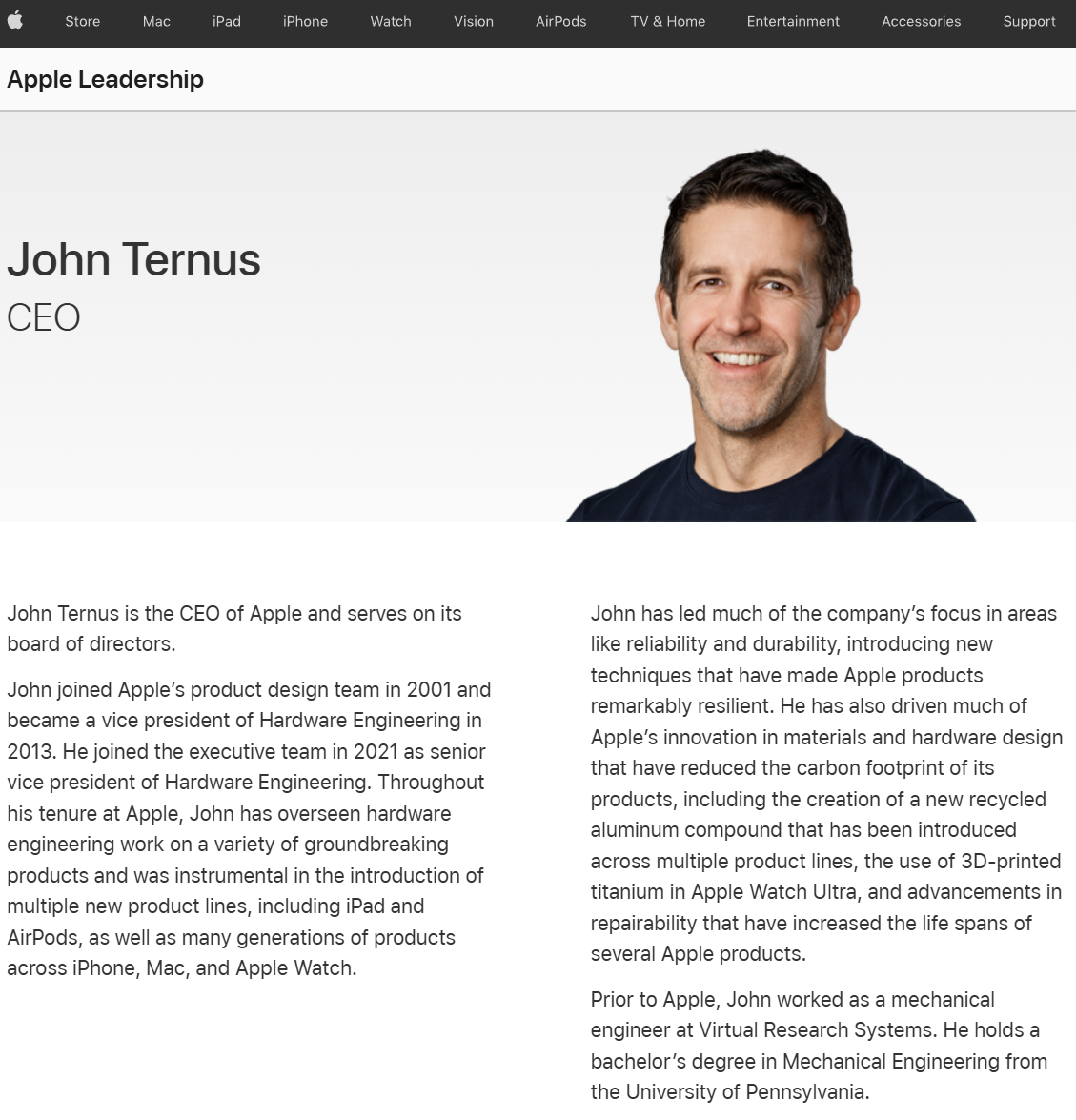
That immediately differentiates him from Tim Cook, who was famously “never a products guy” and was more focused on supply chain management and operational efficiency - the two biggest contributors to Apple’s recent success. I can argue that Cook’s contribution actually made Steve Jobs’ original vision for the company scalable and repeatable.
Ternus is the opposite kind of executive: someone who's spent 25 years actually building the things Apple sells. His fingerprints are on more of Apple's current lineup than almost anyone outside the design studio. He was instrumental in bringing the iPad and AirPods to market as new product categories, and he's overseen engineering across the iPhone, Mac, Apple Watch, and Apple Vision Pro.
More importantly, he helped execute the Apple Silicon transition - arguably its most successful pivot to date - which gives me a lot of hope now that he’ll be handling the company’s AI catch-up strategy.
Now, to address the elephant in the room: Ternus is still untested. He's never run a company before (let alone a $4.7 trillion goliath), never answered to shareholders on an earnings call, and never had to make the kind of decisions Tim Cook made routinely, where he'll be balancing quarterly performance against multi-year bets. Leading hardware engineering is awesome, but it’s nothing compared to being the face of Warren Buffett's biggest portfolio holding.
And, regardless of what many people might say, John Ternus isn’t stepping into the role with a stable, well-oiled machine underneath him. No, he’s getting on as CEO mid-crisis.
The Apple AI bet hasn’t panned out yet, while its competitors have successfully monetized their AI investments and are looking to expand them through multi-billion-dollar capex plans that stretch for years.
From a business perspective, that’s fine. Again, Apple is hardware first.
But consider this: ChatGPT is now a verb. Gemini is now part of Search and Android. And the Copilots - yes, all 80 products with that name - are now successfully embedded into Microsoft’s productivity and cloud ecosystem.
With the market narrative increasingly focused on AI, Apple’s lack of wins in that department gives participants the distinct impression that the company is falling behind. This couldn’t have been more different than when Tim Cook stepped into Steve Jobs’ shoes.
What the September Apple Event Means for the New CEO
That being said, I’m excited. The September Apple Event is right around the corner.
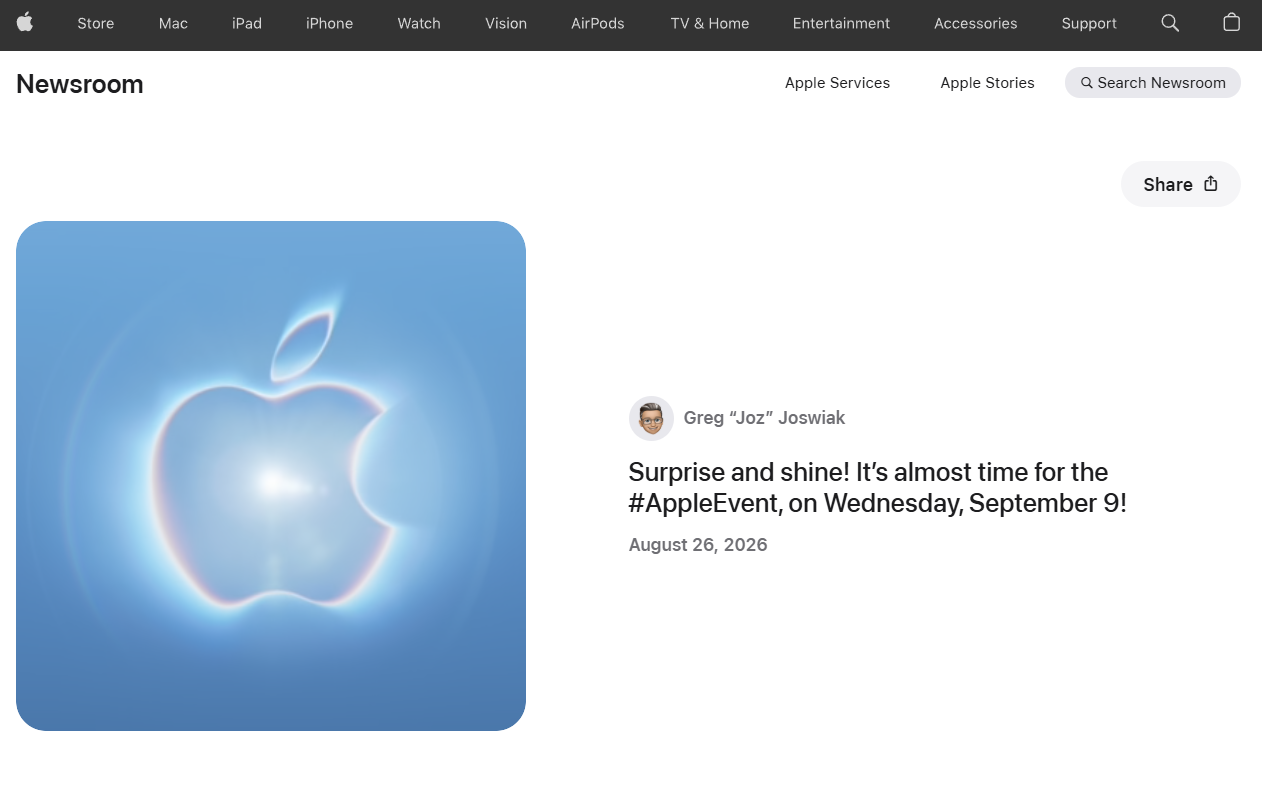
Enthusiasts expect the announcement of the foldable iPhone and a broader rollout of Siri AI on the day. And honestly, Apple - and John Ternus - need both a win.
The foldable iPhone could give the company a much-needed new hardware category to sell, while a genuinely capable Siri could finally give Apple a credible answer to the AI products dominating the conversation today. Sure, it’s still built on Google’s Gemini platform, but it’s a step in the right direction.
That's exactly why September 9 matters more than a typical fall keynote. It's the first major stage appearance of Ternus's tenure as CEO, coming just eight days after he formally took over from Cook, and it's his big chance to make an early impression.
But I don't think Ternus needs to start his tenure with a bang. It would be nice, but not necessary.
Right now, he needs to prove that Apple can still identify a major technological shift, execute on it, and turn it into something consumers actually want. The foldable iPhone would test his ability to push a new hardware category, while Siri would test whether Apple can finally execute on its AI ambitions.
Both fronts have been in the pipeline for quite some time now, but people aren’t going to consider that. They’ll judge Ternus on what Apple delivers under his watch, regardless of how much of the work was actually started before he took the reins.
And you know what? To me, that sounds fair.
A new CEO doesn’t get to choose the starting conditions, but he does get to choose what happens next.
But where does that leave long-term investors like me?
Is Apple Stock Still a Buy After Tim Cook's Exit?
I’m still very bullish on Apple, and I'm not unloading my position I've owned for about a decade. The company changing hands doesn’t materially affect the strengths and weaknesses that I outlined in this article. At least, not as early as this.
Apple is still an incredible business with an enormous installed base, a powerful ecosystem, some of the strongest customer loyalty in the world, and a balance sheet that gives it plenty of room to invest in whatever comes next. None of that disappears just because Tim Cook is no longer CEO.
But bullish doesn’t mean I have to be blindly bullish.
At these valuations, I think it makes sense to acknowledge that a lot of Apple's future success is already reflected in the stock price. And with Ternus stepping into the CEO role during a period of uncertainty, I don't want to make the mistake of treating every future catalyst as a guaranteed win.
So, personally, I’m taking a little money off the table.
That way, if Ternus knocks it out of the park, I still have upside exposure. But if things don’t go according to plan, I’ll have some dry powder to bring down my average.
Ultimately, I want to see Apple deliver on its promises. I want to see proof that the company can still innovate, compete in the AI landscape, and that John Ternus can turn Apple’s enormous resources into the next generation of successful products.
On the date of publication, Rick Orford had a position in: MSFT , GOOGL , AMZN , AAPL . All information and data in this article is solely for informational purposes. For more information please view the Barchart Disclosure Policy here.