
Is Brookfield Wealth Solutions (BNT) Fully Valued After Its Just Group Deal?
Brookfield Wealth Solutions stock reaction to Just Group deal
Brookfield Wealth Solutions (BNT) is back in focus after its acquisition of Just Group widened the company’s footprint in the UK retirement and pension market, a move closely watched by investors assessing long-term insurance exposure.
At a share price of US$40.41, Brookfield Wealth Solutions has seen its share price return fall 13.43% year to date and 10.74% over the past month, even as the Just Group deal feeds into a three year total shareholder return of 81.73% that still signals stronger longer term momentum.
Compare Brookfield Wealth Solutions with a hand picked group of insurers and retirement stocks using the 79 resilient stocks with low risk scores to identify which businesses combine relatively steady risk profiles with long term potential.
After Brookfield Wealth Solutions shares fell in recent months even as the Just Group deal reshaped the business, the key issue now is whether most of the value reset is already behind the stock or still ahead.
Price-to-Earnings of 115.6x: Is it justified?
On current numbers, Brookfield Wealth Solutions trades on a P/E of 115.6x compared with a US Insurance industry average of 11.4x and a peer average of 13.7x. This points to a much richer valuation at the recent $40.41 share price.
The P/E multiple compares what investors are paying for each dollar of reported earnings. For insurers and retirement specialists such as Brookfield Wealth Solutions, this often reflects how the market views the quality and durability of current profits as well as expectations for future earnings, rather than just one year of results.
BNT has reported high quality earnings and earnings growth of 30.6% per year over the past five years. However, profit margins fell from 5.5% to 1.1% over the last year and earnings declined sharply. With that backdrop, such a high P/E suggests investors are paying a premium price for those earnings compared with both direct peers and the broader insurance sector.
The comparison is stark. A P/E of 115.6x for Brookfield Wealth Solutions sits far above the US Insurance industry average of 11.4x and the peer group at 13.7x. The gap implies the market is assigning a far higher value to each dollar of BNT earnings than to most insurers, leaving less room for disappointment if results or sentiment shift.
See what the numbers say about this price — find out in our valuation breakdown.
Result: Price-to-Earnings of 115.6x (OVERVALUED)
However, Brookfield Wealth Solutions still faces risks if earnings stay weak relative to its P/E ratio and if the Just Group integration fails to deliver the expected operational benefits.
Find out about the key risks to this Brookfield Wealth Solutions narrative.
Another view on Brookfield Wealth Solutions valuation
The P/E ratio paints Brookfield Wealth Solutions as expensive, yet the SWS DCF model points in a different direction. At a share price of $40.41, BNT is trading above the estimated future cash flow value of $32.62, which suggests the stock screens as overvalued on this second measure as well. How comfortable are you paying above that figure?
Look into how the SWS DCF model arrives at its fair value.
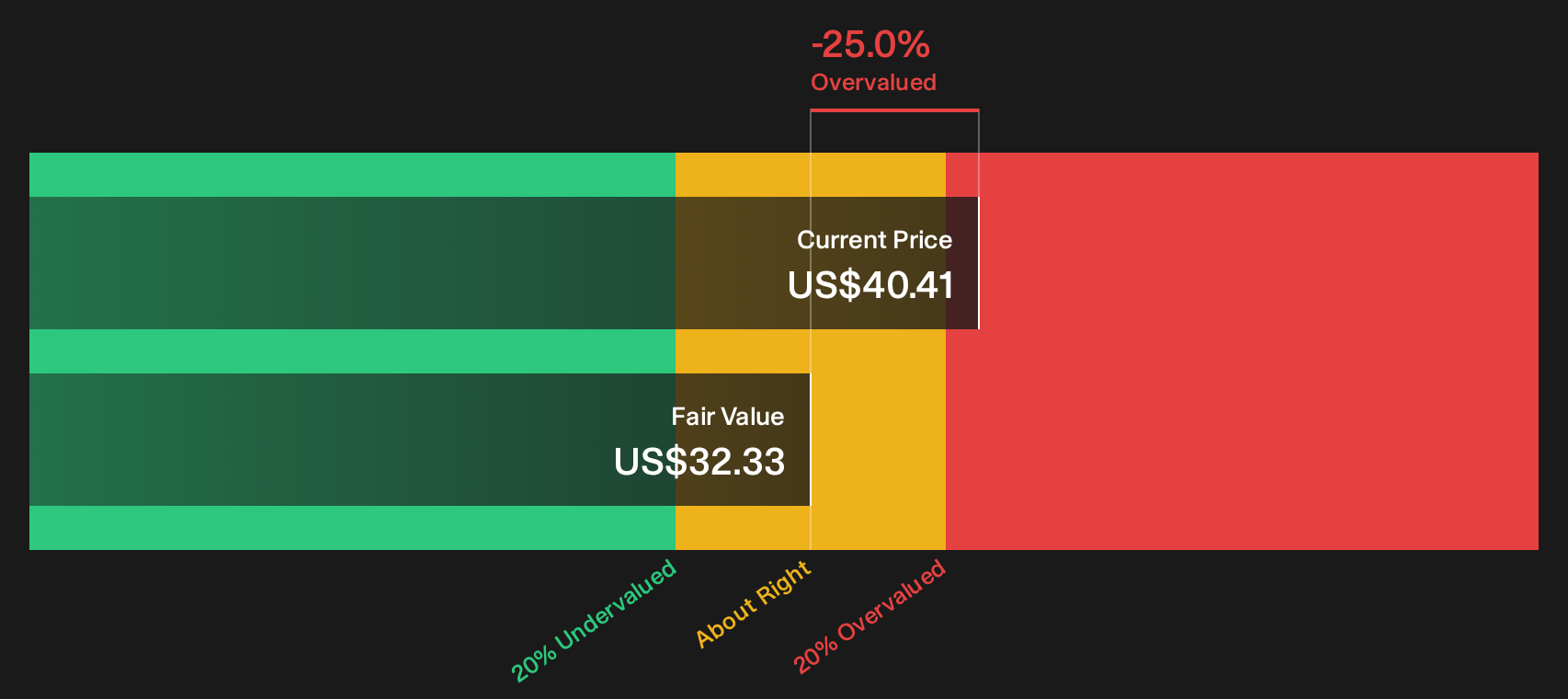
Simply Wall St performs a discounted cash flow (DCF) on every stock in the world every day (check out Brookfield Wealth Solutions for example). We show the entire calculation in full. You can track the result in your watchlist or portfolio and be alerted when this changes, or use our stock screener to discover 52 high quality undervalued stocks. If you save a screener we even alert you when new companies match - so you never miss a potential opportunity.
Next Steps
Given how mixed the picture around Brookfield Wealth Solutions looks today, it makes sense to review the numbers yourself and move quickly to shape your own view using the 2 important warning signs.
Looking for more Brookfield Wealth Solutions sized investment ideas?
If Brookfield Wealth Solutions has sharpened your focus on valuation and risk, do not stop here. Use the Simply Wall St Screener to spot other opportunities early.
- Focus on quality potential and use the 52 high quality undervalued stocks that filters companies combining strong fundamentals with attractive pricing.
- Prioritise resilience and scan the list of solid balance sheet and fundamentals (53 results) so you can quickly narrow in on businesses with stronger financial footing.
- Seek out future frontrunners and review the 21 high quality undiscovered gems before those opportunities become crowded.
This article by Simply Wall St is general in nature. We provide commentary based on historical data and analyst forecasts only using an unbiased methodology and our articles are not intended to be financial advice. It does not constitute a recommendation to buy or sell any stock, and does not take account of your objectives, or your financial situation. We aim to bring you long-term focused analysis driven by fundamental data. Note that our analysis may not factor in the latest price-sensitive company announcements or qualitative material. Simply Wall St has no position in any stocks mentioned.
Have feedback on this article? Concerned about the content? Get in touch with us directly. Alternatively, email editorial-team@simplywallst.com