
Building Better Stock and Option Income – Part 6 Position Sizing - The Foundation of Consistent Returns
Dual Edge Research publishes two powerful newsletters that work great individually — and even better together. The Bull Strangle Newsletter focuses on stocks and options, combining stock ownership with premium-selling strategies to generate consistent income and market-beating returns. The Smart Spreads Newsletter specializes in seasonal commodity futures spreads, offering a diversified approach with low correlation to equities. Together, they deliver a complete investment perspective — one focused on income, the other on diversification — all under one simple subscription.
Introduction
Over the past several articles, we've focused on identifying high-quality stocks and selecting appropriate options. Those decisions are critical, but they're only part of building a successful Bull Strangle portfolio. Before placing a trade, one additional question must be answered: How much capital should be committed?
Many traders answer this question based on confidence or emotion. They invest more in trades they particularly like and less in those they view as marginal opportunities. The Bull Strangle Strategy takes a very different approach. Position size is determined by a structured process that is designed to produce consistency over hundreds of trades rather than trying to maximize the outcome of any single position.
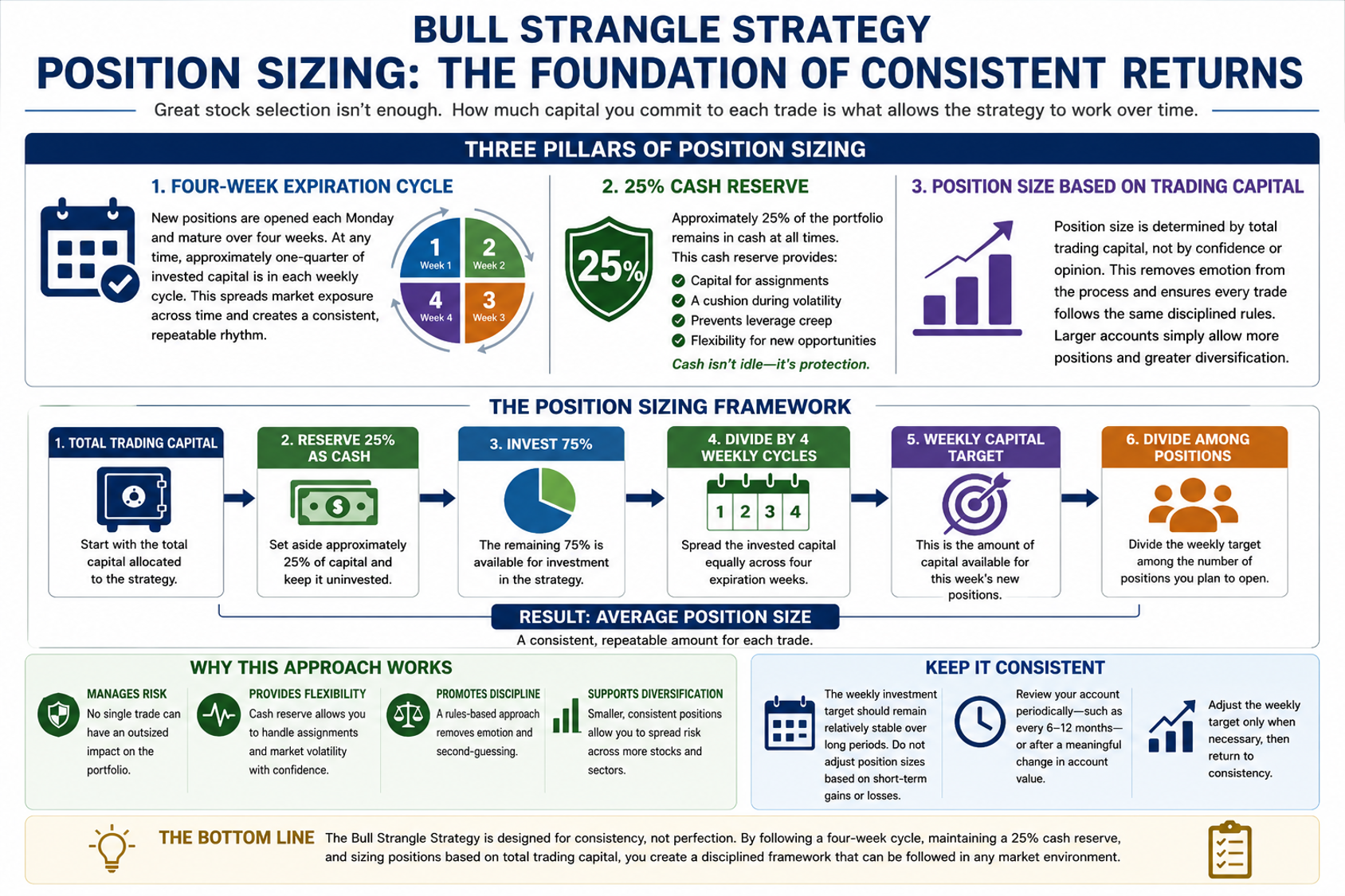
Three principles form the foundation of that process: the four-week expiration cycle, maintaining a 25% cash reserve, and sizing positions based on the total trading capital available.
The Four-Week Expiration Cycle Creates a Natural Capital Structure
The Bull Strangle Strategy is built around a four-week expiration cycle. New positions are established each Monday while positions entered four weeks earlier reach expiration. Over time, the portfolio develops into a ladder where approximately one-quarter of the invested capital is allocated to each weekly expiration.
This structure provides far more than an organized trading schedule. It creates a natural framework for capital allocation. Instead of deploying large amounts of capital all at once, investments are spread across four separate entry dates. Every week, one group of positions expires, capital is released, and a new group of positions is established. The result is a steady, repeatable rhythm that keeps exposure balanced while avoiding large swings in portfolio composition.
Because the same amount of capital is allocated to each weekly cycle, the strategy remains remarkably consistent from month to month. Rather than making large portfolio adjustments, only one-quarter of the invested capital is refreshed each week.
Why 25% Cash Is an Investment, Not Idle Capital
One of the most distinctive features of the Bull Strangle Strategy is that it intentionally leaves approximately 25% of the portfolio uncommitted. At first glance, this may appear inefficient. After all, idle cash doesn't generate returns.
In reality, that cash reserve is one of the strategy's most important risk management tools. It provides the flexibility to handle stock assignments without creating unnecessary stress, cushions the portfolio during periods of increased volatility, and prevents the gradual increase in leverage that often occurs when investors continually reinvest every available dollar.
More importantly, maintaining a cash reserve allows decisions to remain objective. New opportunities can be evaluated on their own merits rather than being influenced by whether capital must first be freed from another position. The objective isn't to maximize capital deployment every day. The objective is to maximize the strategy's ability to operate consistently through changing market conditions.
Position Size Begins with Trading Capital
Once the four-week structure and cash reserve have been established, determining position size becomes a straightforward exercise.
The process begins with the total trading capital allocated to the strategy. Approximately 75% of that capital is designated for investment, while the remaining 25% is held in reserve. The invested portion is then divided equally across the four weekly expiration cycles, producing a target amount of capital for each week's new positions. Finally, that weekly allocation is divided among the number of trades planned for that cycle, creating an average position size that fits naturally within the overall portfolio.
This process allows the strategy to scale as account size changes. Larger accounts can support more positions and greater diversification, while smaller accounts may simply hold fewer positions without changing the underlying philosophy. The rules remain the same regardless of account size.
Consistency Is More Important Than Precision
One aspect of position sizing that is often overlooked is that the weekly investment target should remain relatively stable. While the account value naturally rises and falls over time, the strategy does not adjust position sizes in response to every short-term gain or loss.
Instead, the weekly capital target serves as a stable reference point that is reviewed only periodically. Allowing temporary market fluctuations to dictate position size creates unnecessary variability and gradually changes the portfolio's risk profile. By maintaining a consistent investment target for extended periods, traders avoid constantly recalculating trade sizes and allow normal gains and losses to be absorbed by the portfolio's cash reserve.
Only after meaningful changes in account value—or during a scheduled portfolio review—should the weekly investment target be increased or decreased. This deliberate approach keeps position sizing objective and prevents routine market volatility from driving unnecessary changes to the strategy.
Conclusion
Successful investing isn't simply about finding the best opportunities. It's about building a portfolio that can apply those opportunities consistently over time. The four-week expiration cycle, the 25% cash reserve, and disciplined position sizing work together to create a framework that is both repeatable and resilient.
Stock selection determines what enters the portfolio. Position sizing determines how much is committed. Together, they form the foundation for the consistent, rules-based approach that defines the Bull Strangle Strategy.
Other Articles in the Series
Part 1 - How the Process Works
Part 2 - From 5,000 Stocks to 20 Candidates
Part 3 - Why We Avoid Earnings
Part 4 - Choosing the Right Option
Part 5 - Objective Strike Selection
Want to build a more complete trading toolkit?
The Bull Strangle Newsletter focuses on stocks and options, combining stock ownership with disciplined option-selling techniques designed to generate consistent income while managing risk.
The Smart Spreads Newsletter focuses on seasonal commodity spreads, a historically proven approach that seeks opportunities across agricultural, energy, metal, and financial futures markets.
Each strategy is designed to stand on its own, but together they provide a diversified approach that can perform across a wide range of market environments. For traders looking to deepen their education, The Bull Strangle Strategy and Trading Commodity Spreads are both available on Amazon.
Visit BullStrangle.com to subscribe for just $1 for the first month.
For a video overview of the Bull Strangle Newsletter
For a video overview of the Smart Spreads Newsletter
Darren Carlat
Dual Edge Research
(214) 636-3133
DualEdgeResearch@gmail.com
Disclaimer
This information is for informational purposes only and should not be considered as investment advice. Past performance is not indicative of future results, and all investments carry inherent risk. Consult with a financial advisor before making any investment decisions.