
Is SLB Stock Underperforming the S&P 500?
When you think about the energy industry, it is easy to picture oil rigs, drilling sites, and miles of pipelines. But behind that entire operation sits a massive technology and services ecosystem, and that is where SLB N.V. (SLB) comes in. Formerly known as Schlumberger, SLB has been part of the energy industry since 1926 and today operates as one of the world’s leading energy technology companies.
Based in Houston, Texas, the company helps oil and gas producers find, drill, develop, and produce resources more efficiently, combining engineering expertise with digital technology and specialized equipment. SLB’s offerings range from reservoir evaluation and drilling technologies to artificial lift, subsea systems, production equipment, and digital solutions. The company is involved in many of the critical steps that turn an underground energy resource into actual production.
That scale is also reflected in its market value. SLB currently carries a market capitalization of roughly $85.4 billion, putting it comfortably in the “large-cap” category. For investors, that hefty valuation reflects more than just size – it highlights SLB’s established position, global reach, and importance within the oil and gas equipment and services industry.
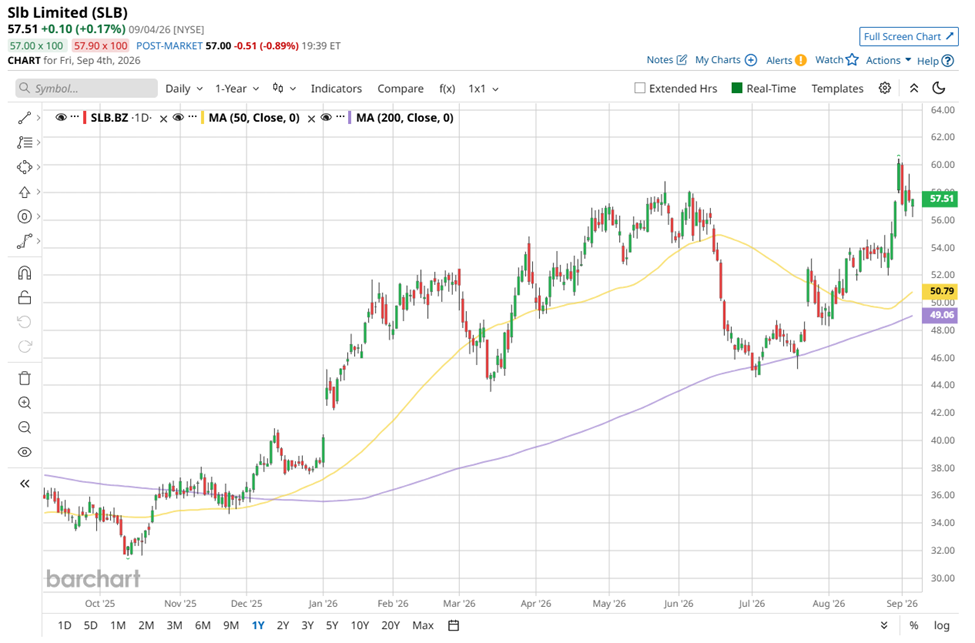
The stock’s recent performance gives investors a little more to talk about. SLB touched a 52-week high of $60.46 on Aug. 31 and, even after pulling back, remains only about 4.9% below that level. Over the past three months, however, the stock has moved slightly lower, trailing the &P 500 Index’s ($SPX) 1.8% gain.
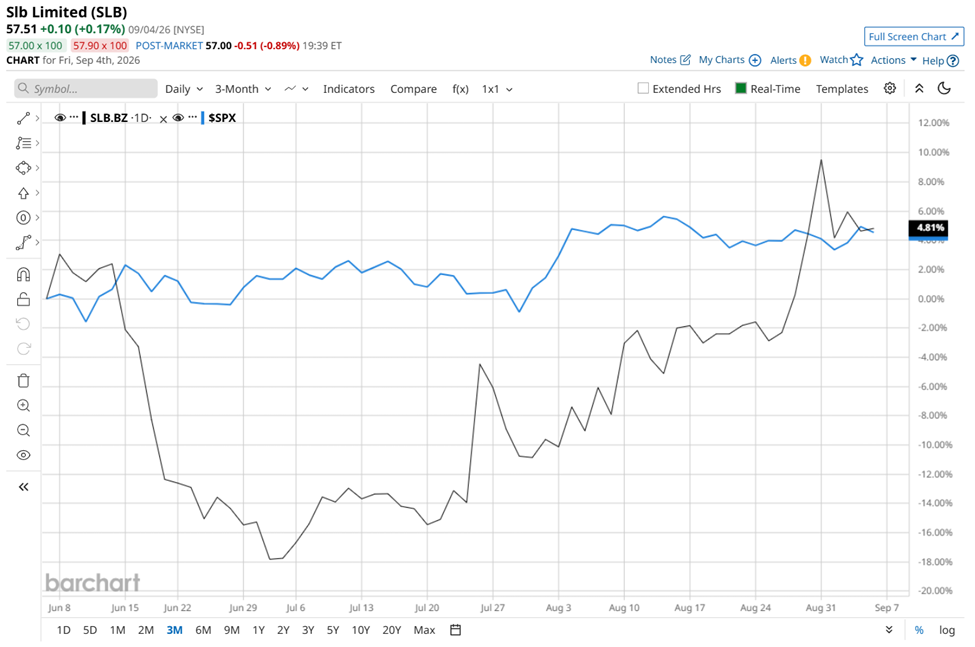
But zoom out, and the picture looks much stronger. SLB has jumped 59.7% over the past year, comfortably ahead of the S&P 500’s 18.7% advance, while its 49.8% gain so far in 2026 has also left the broader index’s 12.8% rise in the dust.
Technically, SLB’s momentum remains constructive, with the stock trading above both its 50-day and 200-day moving averages. The 50-day average offers a nearer-term gauge of momentum, while the 200-day average points to the longer-term trend.
So, what has been keeping SLB stock in the spotlight? For starters, stronger oil prices have given energy stocks a helpful tailwind. That was clear on Aug. 31, when SLB stock jumped 4.8% as crude prices climbed amid renewed Middle East tensions. But oil is only part of the equation.
SLB’s own business performance has been doing plenty of heavy lifting. On Jul. 24, the company reported better-than-expected second-quarter results, with revenue climbing 5% year over year (YOY) to $8.97 billion. Adjusted EPS of $0.55 topped Wall Street’s expectations, while $1.36 billion in operating cash flow and $716 million in free cash flow showed that the company was converting growth into solid cash generation. Strong international demand and a recovery in North America helped offset disruptions in the Middle East, giving investors another reason to remain optimistic.
Then there is the bigger picture. SLB is not simply betting on the next oil cycle. On Aug. 31, it announced an agreement to acquire Kelvion, a thermal-management specialist, as it expands its Data Center Solutions business. Combined with its growing partnership with NVIDIA (NVDA), the move gives SLB exposure to the booming AI infrastructure market. Management expects the combined data-center business to generate $4.5 billion to $5 billion in revenue by 2028.
Adding in successful acquisitions, margin expansion, international growth, and 36 consecutive years of dividend payments, it becomes easier to see why investors have been rewarding SLB with such strong gains in 2026.
Looking at SLB alongside its industry rivals, like Baker Hughes Company (BKR), the difference becomes even clearer. BKR stock has gained 37.1% over the past year and 39.4% on a year-to-date (YTD) basis. While those are solid returns, both figures still trail SLB’s stronger performance over the same periods.
Wall Street remains firmly in SLB’s corner. Of the 26 analysts covering the stock, the consensus rating is a “Strong Buy.” Meanwhile, the average price target of $62.46 points to roughly 8.6% upside from current levels, suggesting analysts still see room for SLB to push higher.
On the date of publication, Sristi Jayaswal did not have (either directly or indirectly) positions in any of the securities mentioned in this article. All information and data in this article is solely for informational purposes. For more information please view the Barchart Disclosure Policy here.