
German industrial output plummeted 1.1%, the biggest drop in nearly a year, and automobile industry output plummeted 9.2%
The Zhitong Finance App learned that Germany's industrial output recorded the biggest decline in nearly a year, which marks an unexpected setback in the recovery of Europe's largest economy. The German Federal Statistical Office said on Monday that output fell 1.1% in July, while economists had previously predicted a 0.2% increase. The June data initially showed a slight increase, but has now been revised to zero growth.
According to the German Statistical Office, the decline in output in July was mainly due to a 9.2% drop in production in the automobile industry. According to the German Association of Automobile Manufacturers (VDA), this was mainly affected by the shutdown that continued for several weeks.
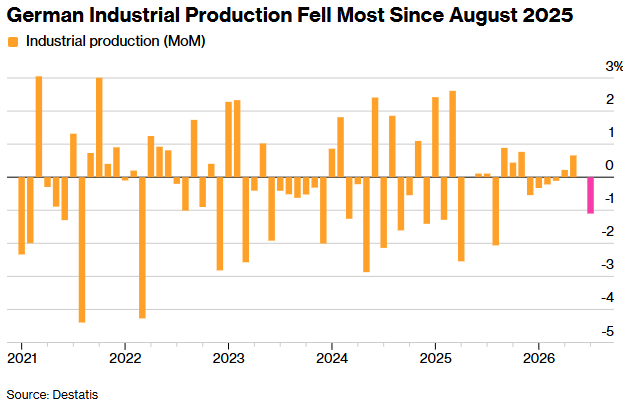
The decline in industrial production in Germany hit a new high since August 2025
Despite this, the less volatile 3-month average was 0.4% higher than the previous period.
The report shows that Germany must deal with this extremely bumpy path as it tries to overcome years of economic sluggishness. However, after a series of recent positive data, German Federal Bank President Joachim Nagel said last week that the economy may grow by 1% this year, and this rate has only doubled from what was predicted three months ago.
Supported by efforts to repair public infrastructure, rebuild the military, and invest in the country's digital future, growth in the second quarter was unexpectedly strong and is expected to accelerate further.
Factory orders increased for the third time in a row in July, which will boost this trend in the near future. Although ship, train, and aircraft manufacturers are particularly benefiting from increased demand, the automotive industry is still struggling.
The latest steps taken by Volkswagen to deal with declining sales in the Asian market, high costs, and insufficient utilization of factory capacity explain the seriousness of this crisis. The Supervisory Board last week endorsed a comprehensive restructuring plan, which included laying off an additional 50,000 employees — about half of them in mainland Germany.
The German Ministry of Economy said on Monday: “Although production in the manufacturing sector remained relatively steady in the second quarter despite rising energy prices, the consequences of the ongoing conflict in the Middle East appear to be taking an increasingly heavy toll. As a result, overall, prospects for a broader recovery in industrial activity for the rest of the year remain low.”
Commerzbank's chief economist Jörg Kramer also emphasized that if a single one-time factor in the automotive sector is excluded, industrial production continues to trade sideways at a low level.
He said, “As long as the federal government does not improve the country's hard-hit business environment and corporate investment does not pick up, there will be no strong economic recovery.”
Such challenges have fueled voters' support for far-right politicians. In Saxony-Anhalt in eastern Germany, the German Choice Party (AfD) easily defeated Chancellor Mertz's Christian Democratic Union (CDU) last weekend.