
IPO Outlook | First semi-annual profit report after listing. Is Zejing Pharmaceutical (688266.SH) closing the Hong Kong Stock Exchange successfully?
Recently, according to the Hong Kong Stock Exchange, Suzhou Zejing Biopharmaceutical Co., Ltd. (“Zejing Pharmaceutical” for short) has submitted a listing application to the main board of the Hong Kong Stock Exchange, with CICC acting as the sole sponsor. This is the second time the company has submitted a statement. If successfully listed, the company will become an “A+H” dual listed company.
At the operating level, in the first half of 2026, the company achieved its first profit in its semi-annual report since listing, reversing the continuous loss situation of many years before. However, if you dig deeper into its fundamentals, you will find that most of this profit stems from the technical license revenue of 662 million yuan agreed with AbbVie on the global development cooperation of the ZG006 project, which makes the market still have doubts about the company's self-hematopoietic ability.
Up to now, the company has four listed products. As the market opens up after inclusion in health insurance, rapid release is expected to improve the company's subsequent profit performance. In addition, the company is also very interesting in the research pipeline. ZG006 has received China's CDE breakthrough therapy certification and FDA orphan drug qualification, and ZG005's clinical progress is at the forefront of the world.
As of the closing of the market on September 4, 2026, the A-share price of Zejing Pharmaceutical (688266.SH) closed at 117.99 yuan, with a total market value of about RMB 31.2 billion.
Four marketed products gradually increase one-time BD benefits to help reverse losses
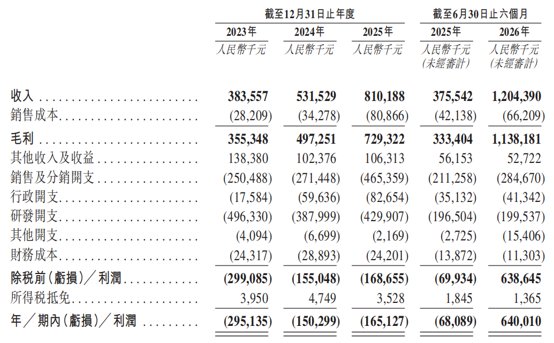
In terms of financial performance, starting with 302 million yuan in 2022, reaching 384 million yuan, 532 million yuan, and 810 million yuan (RMB, same) in 2023, 2024, and 2025, respectively, it further jumped to 1.24 billion yuan in the first half of 2026, with a year-on-year increase of 220.71%.
However, profit side performance was clearly divided: net profit losses continued from 2023 to 2025, which were -295 million yuan, -150 million yuan, and -165 million yuan respectively, of which the loss in 2025 increased 9.87% year-on-year, the sixth consecutive year of loss since listing; until the first half of 2026, thanks to 655 million head of state payments received through exclusive licensing cooperation with AbbVie, the company turned a loss into a profit, reaching 640 million yuan in the same period last year.
In terms of gross margin, it was 92.6%, 93.6%, 90%, and 94.5% respectively from 2023 to the first half of 2026. The increase in comprehensive gross margin in the first half of 2026 was mainly due to an increase in the share of high-margin licensing business revenue; the gross margin of pharmaceutical sales rose slightly to 89.6% from 88.8% in the same period last year, due to changes in the product portfolio.
The Zhitong Finance App learned that the company already has four commercial products, and changes in sales volume and price of each product reflect the impact of health insurance policies.
Zepsen® (donafinil toluene sulfonate tablets) is the first locally developed small-molecule multi-target drug for first-line treatment of advanced liver cancer in China. It was launched in June 2021. The gross margin remained stable during the reporting period, at around 94.5%.
Zeptinin® (recombinant human thrombin) is the only recombinant human thrombin developed and successfully commercialized using recombinant DNA technology in China. It was launched in January 2024. During the reporting period, Zepning's revenue increased 73.5% year-on-year, from 206,000 boxes to 384,000 boxes. Although the average sales price dropped from 332.4 yuan to 309.9 yuan per box due to the expansion of market coverage after inclusion in health insurance, large-scale production reduced unit costs, and gross margin increased from 62.5% to 78.9%.
Zepupin® (gikaxitinib hydrochloride tablets) is the first locally developed innovative JAK inhibitor to treat myelofibrosis in China and commercialized in May 2025. After commercialization of Zepupin, sales surged from 1,400 boxes to 33,600 boxes, but due to inclusion in the national health insurance catalogue in January 2026, the average selling price dropped sharply from 8266.2 yuan to 4279.0 yuan per box, and the gross margin dropped from 95.2% to 90.4%.
Zesunin® (injectable human thyrotropin beta) is the only recombinant human thyrotropin approved for post-operative follow-up diagnosis of patients with differentiated thyroid cancer in China. It was launched in January 2026. In the first half of the year, the drug had sales revenue of 9.6 million yuan, with a sales volume of 1,100 boxes. The average selling price was 91,53.8 yuan per box, and the gross margin was 66.2%.
Looking at the income structure, in the first half of 2026, Zepsen accounted for 23.2%, Zepning for 37.8%, Zepping for 20.8%, and Zesuning for 4.9%.
The expansion of performance was accompanied by continued growth in operating support. From 2023 to 2025, sales and distribution expenses increased from 250 million yuan to 465 million yuan, while R&D expenses remained above 388 million yuan. However, since 2025, total sales and marketing expenses have exceeded R&D expenses, and R&D expenses for the first half of 2026 were 200 million yuan.
In terms of liquidity, as of June 30, 2026, the company's bank deposits and cash equivalents were $2,0566 million, plus an unspent promised and unrestricted bank financing amount of $2,1006 million; in addition to the $100 million down payment from AbbVie, the company also received a milestone payment of 200 million yuan from Merck in February 2026, further strengthening its capital reserves.
Lay out a cutting-edge tumor pipeline and are developing two of the world's first varieties
Zejing Pharmaceutical has established a strategic hierarchical R&D pipeline composed of 10 drug candidates, covering 29 key clinical projects, and covering a wide range of oncology and autoimmune diseases, with a particular focus on a large number of indications that have not met medical needs. A number of advanced candidate products are already in the BLA/NDA stage or are undergoing key phase III clinical trials, and the pipeline is clear.
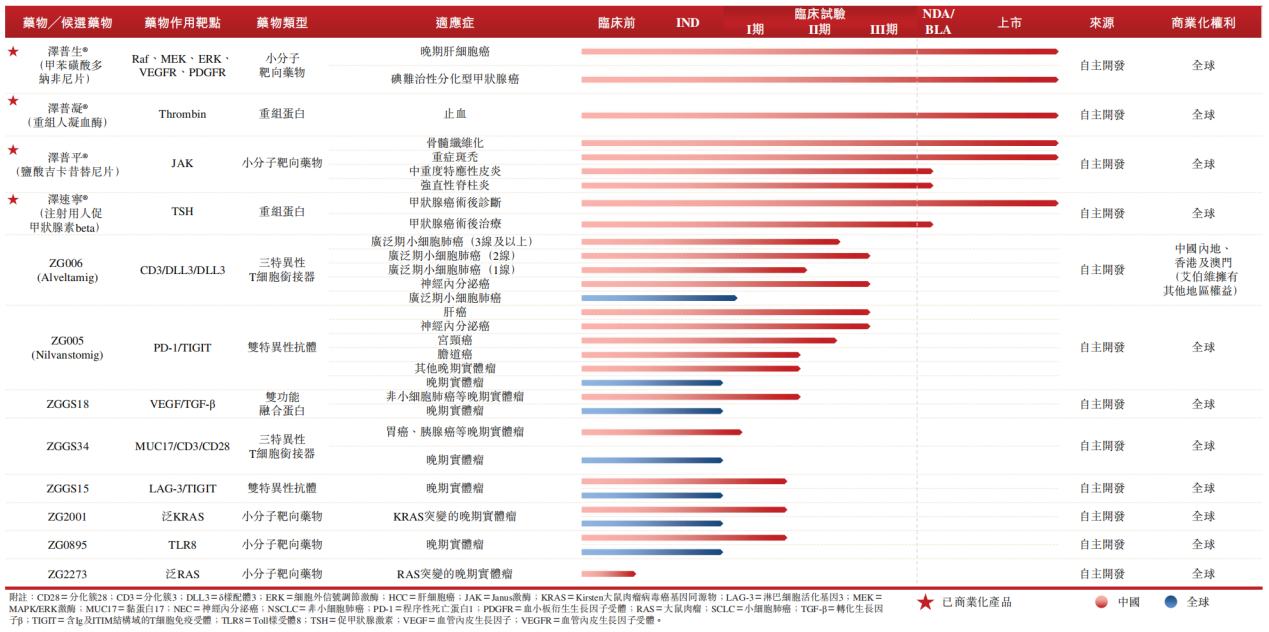
In terms of marketed products, Zepsen® (donafinil toluene sulfonate tablets) was approved as the first domestically produced small-molecule multi-target drug for first-line treatment of advanced hepatocellular carcinoma in China in June 2021. Its phase III clinical trial showed better survival benefits than sorafenib, and was the only monotherapy showing this advantage in similar head-to-head trials. In August 2022, the drug was further approved for progressive, locally advanced or metastatic radioactive iodine refractory differentiated thyroid cancer. Both indications have been included in the national medical insurance drug catalogue. With good efficacy and safety, Zepsen® has been recommended as a first-line treatment plan by 32 national diagnosis and treatment guidelines and expert consensus. The company continues to expand the coverage of hospitals and pharmacies, laying the foundation for sales growth.
Zepupin® is the first domestically produced JAK inhibitor approved to treat myelofibrosis in China. It can target both JAK and ACVR1. It has now been approved for both myelofibrosis and severe alopecia areata. The indications for moderate to severe atopic dermatitis and ankylosing spondylitis are in the BLA/NDA stage. This product spans the two major treatment fields of cancer and autoimmunity, but when it comes to treating atopic dermatitis with JAK inhibitors, there are many competitors on the market worldwide, and competition is also fierce in the field of topical formulations. The lucotinib cream introduced by Kangzhe Pharmaceutical was approved for vitiligo in January 2026, and its atopic dermatitis indications have also been included in the priority review. Faced with a competitive pattern where many pharmaceutical companies actively lay out multiple indications, Zejing Pharmaceutical, as a latecomer in the field of hematologic cancer and self-immunity, still has some uncertainty about its future progress.
Zesunin® (injectable human thyrotropin beta) is the only recombinant human thyrotropin approved for post-operative follow-up diagnosis of patients with differentiated thyroid cancer in China. It is suitable for whole-body imaging of radioactive iodine and serum thyroglobulin monitoring, filling the domestic clinical gap. The postoperative diagnostic indications for thyroid cancer have been marketed. The post-operative treatment indications are in the BLA/NDA stage, and recommended by the “Chinese Radioactive Iodine Refractory Differentiated Thyroid Cancer Guidelines” issued by the Nuclear Medicine Branch of the Chinese Medical Association in 2025. The company has signed an exclusive commercial cooperation with Merck's Swiss subsidiary ATSA to support the rapid penetration of products into the market.
Zeptinin® (recombinant human thrombin) is the only recombinant human thrombin developed and successfully marketed using recombinant DNA technology in China. It was approved in January 2024 and included in the national medical insurance catalogue in January 2025. The drug has been recommended by the 2025 “Expert Consensus on Hemostasis in Hip and Knee Replacement” and the 2026 “Blood Management Guidelines for Adult Perioperative Abdominal Surgery Patients”, and cooperation has been reached with Grand Life Science, which specializes in hemostasis and perioperative periods, to accelerate marketing. As the number of surgeries in China continues to grow and the demand for topical surgical hemostatic agents continues to rise, Zeptinin® is expected to further expand its market share with medical insurance advantages.
Among other products under development, ZG006 (Alveltamig) is the world's first three-specific T-cell connector targeting DLL3/DLL3/CD3. It has achieved a mechanical breakthrough through double DLL3 targeting design, which is expected to meet the effective treatment needs of intractable tumors such as small cell lung cancer and neuroendocrine cancer. The drug has been approved for clinical trials by the US Food and Drug Administration (FDA) and China National Drug Administration (NMPA), recognized by the NMPA Drug Review Center as a breakthrough treatment for recurrent or advanced small cell lung cancer and DLL3-positive neuroendocrine cancer, and has obtained orphan drug qualification granted by the US FDA, and has significant clinical value and market potential.
Zhitong Finance App learned that in order to accelerate global development, the company signed a cooperation and licensing option agreement with AbbVie in December 2025, granting it exclusive licensing options on a global scale outside of mainland China, Hong Kong and Macau. According to the agreement, Zejing Pharmaceutical will receive a one-time down payment of 100 million US dollars, and can also receive up to 60 million US dollars in recent milestone payments and license related payments based on clinical progress. If AbbVie exercises the license option in the future, Zejing Pharmaceutical will also be eligible to receive milestone payments of up to US$1,075 million, and can also collect tiered royalties from high single digits to medium double digits for the net sales of ZG006 related products in markets outside of Greater China. The total amount related to the agreement can reach up to US$1,235 million.
ZG005 (Nilvanstomig) is a recombinant humanized bispecific antibody targeting PD-1/TIGIT. It is a next-generation immunomodulator. No drug with the same mechanism has been approved worldwide, and this drug is also one of the fastest developing drugs with the same target. The product is currently undergoing phase III clinical trials for hepatocellular carcinoma and neuroendocrine cancer, and has broad potential for combined use with ZGGS18 to regulate the tumor microenvironment. Clinical trial applications for related combination therapies have been approved by the FDA and the National Drug Administration. Given that PD-1 monotherapy has problems such as limited response rate and drug resistance, ZG005 is expected to become the next generation of tumor immunotherapy and has significant market opportunities.
Overall, ZG006 (used for broad-stage small cell lung cancer third-line and above, second-line treatment, and neuroendocrine cancer) and ZG005 (for hepatocellular carcinoma and neuroendocrine cancer) are already in the critical/phase III trial stage, and it is expected that they will enter the commercialization stage one after another in the next few years. In addition, the company relies on a core technology platform to advance research and development from multiple dimensions such as tumor immunity, tumor microenvironment, tumor growth, drug resistance mechanisms and genetic mutations, and continues to expand the pipeline of innovative drug candidates, including ZGGS18 (VEGF/TGF-beta bifunctional fusion protein), ZGGS34 (CD3/CD28/MUC17 tri-specific T-cell connector antibody), ZGGS15 (LAG-3/TIGIT bispecific antibody), ZG2001 (novel oral pan-KRAS mutant inhibitor), ZG0895 (highly selective TLRR8) agonists) and a novel pre-clinical pan-RAS inhibitor. Among them, ZGGS18, ZGGS15, ZG2001, and ZG0895 have completed phase I dose escalation tests in China, ZGGS34 has entered phase I clinical trials in China, and the above five candidate products have all been approved by the US IND. Overall, they have the potential to become breakthrough treatments for solid tumors. The prospects for combined use are broad, and commercialization value can be expected.
Summarize
Relying on a revenue base built with four marketed products and an echelon pipeline composed of more than 10 drugs under development, Zejing Pharmaceutical has initially completed the transformation from an R&D drive to a mature commercial company. Core varieties such as Zepsen and Zeptin are expected to be covered by medical insurance catalogs for continuous release, while global or Chinese pioneering drugs such as ZG005 and ZG006 have successively received regulatory breakthroughs and endorsements from multinational pharmaceutical companies, showing differentiated clinical potential. Whether the company can continue to transform the advantages of technology platforms into market share in the future will be the focus of attention of market investors.