
The German stock market's “catch-up deal” comes to an end: MDAX outperforms DAX, and the 500 billion euro stimulus is difficult to achieve
The Zhitong Finance App notes that the weak performance of the German economy may seem unreasonable considering the large-scale stimulus measures injected by the government. But even the multi-billion euro spending won't address all investors' concerns, and Sunday's local election results only added to one of those concerns.
The German Federal Statistical Office said on Monday that output fell 1.1% in July, while economists had previously predicted a 0.2% increase. The June data initially showed a slight increase, but has now been revised to zero growth.
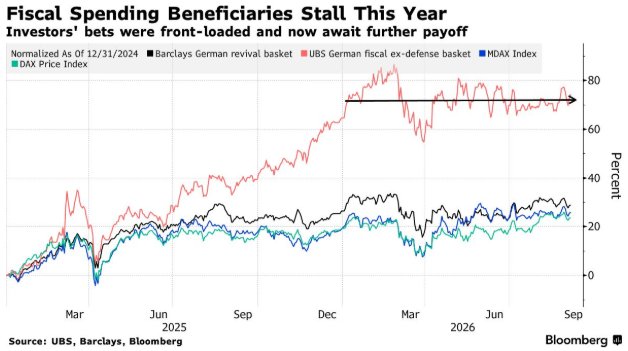
Last year's bullish logic made sense, and the market paid a premium in advance for this. The 500 billion euro (about 580 billion US dollars) spending plan proposed by the German government drove the mid-cap index MDAX to rise 20% in 2025 based on expectations alone, while a portfolio of stocks tracked by UBS Group excluding beneficiary expenses in the defense sector skyrocketed 65%.
However, this year's situation became an audit of the fanaticism of the time. The MDAX index rose by only 5.7%, lagging even behind the DAX index's modest increase of 6.4%. On the books, German mid-cap stocks are still relatively cheap, and the beneficiaries of fiscal spending have not shown any excess income. Trading to make up for gains in the German stock market has actually come to an end.
The first reality test is where the money actually went. The Ifo Institute for Economic Research (Ifo) estimates that 95% of the new debt allocated for expenditure last year was used to cover the daily budget deficit rather than additional investment. The city of Berlin plans to spend more than 2 billion euros of its share on planting 700,000 trees, while police stations and clinics are still awaiting renovation. As early as last year, economists warned that the fund was funding consumer projects rather than real investments.
According to a survey of economists, Germany's economic growth forecast for this year is 0.9%, compared to 1.1% in 2027. Although this is better than the stagnant GDP data for the past two years, it is by no means evidence of a strong economic recovery. Investors were originally given permission to build roads, railways, and power grids, but so far, they have only been redeemed accounts on the books.
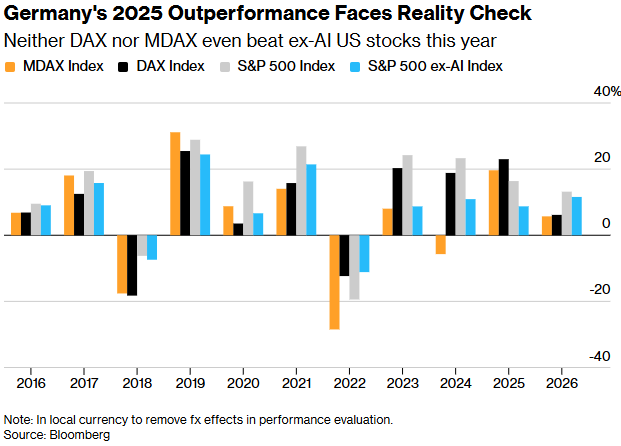
Germany's excess earnings forecast for 2025 faces a realistic test
The political capital that sustains the market's enthusiasm for this spending plan has almost been exhausted. Chancellor Mertz's approval rating fell to one of the lowest levels on record for the position, and the latest polls showed that public satisfaction with his job was only 15%.
Last Sunday, Saxony-Anhalt held a new parliamentary election. The far-right German Choice Party (AfD) won 44% of the vote, setting the party's best record in state elections, and is only one step away from an absolute majority. There will also be two more state elections in the next two weeks.
Jens Eisenschmidt, Europe's chief economist at Morgan Stanley, wrote in a report last week: “Although we still see the collapse of the ruling coalition as a tail risk, the likely outcome under this scenario is the emergence of a minority government rather than a direct early general election.” However, if Mertz achieves weak election results, it may trigger “leadership considerations.”
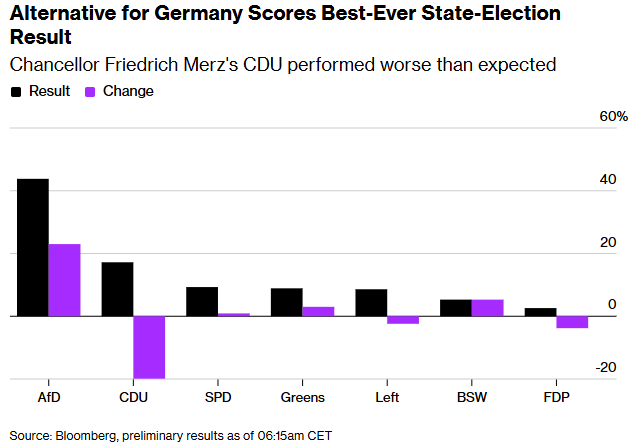
The German Choice Party achieved the best state election results in history
This was followed by a new round of energy shocks. As the Strait of Hormuz has actually been blocked and stocks are below seasonal standards, the European gas transaction price is close to 75 euros per megawatt hour, the highest level since January 2023, and more than double that at the beginning of this year. Even if prices fall somewhat, damage has already been caused, and higher inflation data is bound to erode actual income and spending intentions.
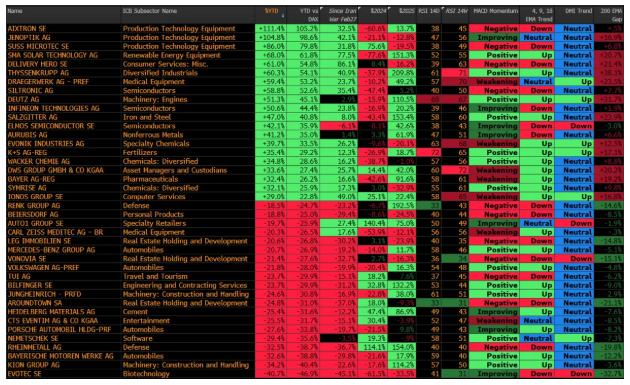
Areas where German stocks are performing well are concentrated in artificial intelligence and derivatives. The defense sector's market has peaked and declined, while Germany's traditional industrial core has become a loser. Volkswagen was even removed from the European Stoke 50 Index this month.
The downturn in the automobile industry has cast a shadow over local finances. The Mercedes-Benz Group and Stuttgart, where Porsche is located, have lowered their trade tax forecast for 2026 from a record level of over 1.6 billion euros in 2023 to 700 million euros. The city passed its first austerity budget since 2009. Other communities are facing similar restrictions, and their spending cuts have further exacerbated an already difficult economic situation.
Although Germany topped Europe's most popular market in the Bank of America fund manager survey this summer, capital inflows have remained sluggish. Germany is near the bottom of Morgan Stanley's ranking due to weak momentum, lower profit forecasts, and worsening management sentiment.
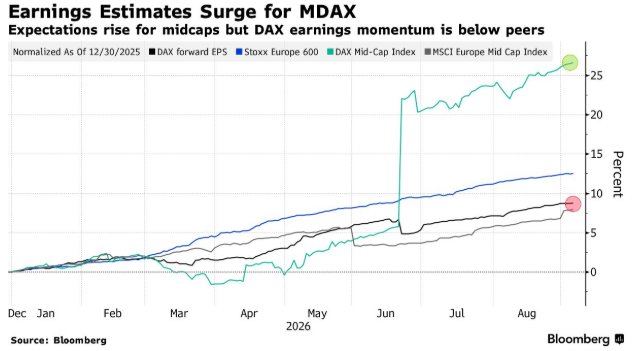
The strongest countermeasure to pessimism comes from the country's institutional support. The fiscal plan is anchored in the Constitution, and abolishing it requires a two-thirds majority that no faction has.
Andreas Rees, Germany's chief economist at UniCredit Bank, wrote: “Overall, we expect more political noise in the coming weeks, but Berlin will not fall into political paralysis. Some reform measures may be diluted or postponed until after the end of 2026, but broader reforms are expected to remain on track.”
As it stands, Germany still maintains its advantage of a debt-to-GDP ratio of 64%. However, with plans to add more than 200 billion euros in debt in 2027 alone, and rising interest rates, arguments about fiscal space are being weakened. Fortunately, the DAX index's international revenue structure means that Germany's own problems are not the same as the index's problems.
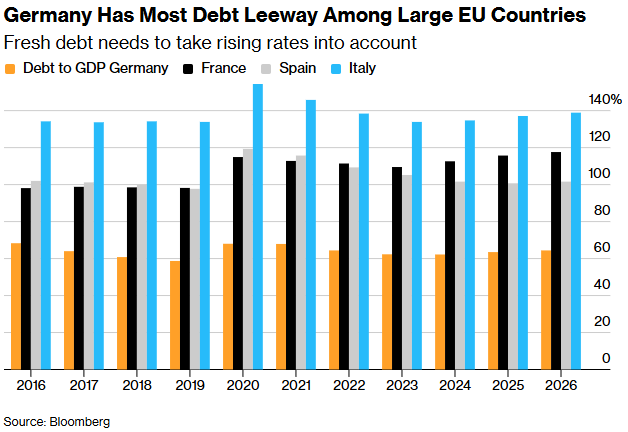
Among the major EU countries, Germany has the most room for debt maneuver
There is still potential to be tapped in terms of individual stock selection — including semiconductors, power grids, and areas where stimulus funds will eventually land. But the range of options is limited and deals are getting more crowded. Betting on Germany's broader market prospects requires investors to endorse compliance with a government that seems to be losing the trust of investors, to bet on a country that has been hostage to two wars over energy security, and an economy where core enterprises are falling into structural decline.
This is a patience-testing deal, even for optimists. Funding will not be available until 2027, and the challenges are already obvious. This is not so much a mistreated discount as it is that the risk-benefit ratio is playing its due role.