
Gushengtang (02273): A new cycle of full time restructuring of commercial base value revaluation begins
On August 28, Gushengtang (02273) released its 2026 interim results, which intuitively showed the capital market its accelerated release of profit quality and firm commitment to shareholder returns. During the period, the company achieved revenue of 1.65 billion yuan, an increase of 10.6% year on year; net profit reached 220 million yuan, a sharp jump of 44.2% year on year, showing strong profit elasticity. Supported by abundant cash flow, the company plans to distribute an interim dividend of 210 million yuan, compounded by a cash reserve of 1.19 billion yuan to establish a solid financial safety cushion.
However, behind this impressive financial questionnaire, what is more worth re-examining by the market is the structural change revealed by Gushengtang's interim report: the proportion of new doctors added in the first half of the year exceeded 40%, and the performance contribution of new doctors increased by 50% over the same period last year. This set of data indicates that Gushengtang is using a full time strategy as a fulcrum to fundamentally restructure its business base — transforming doctors' resources from relatively loose external cooperation to a closer endogenous growth engine. This active strategic upgrade enabled the company to accurately position the “15th Five-Year Plan” hierarchical diagnosis and treatment policy, and relied on the continuous increase in talent density to transform organizational capacity into valuation premiums, starting a new cycle of value revaluation driven by double clicking profit release and shareholder returns.
The proportion of self-owned doctors increased by 40% and the full-time paradigm was restructured to restructure the business base
According to Gushengtang's 2026 interim report, the company has surpassed the stage of large-scale accumulation of reliance on new store expansion. The basic market for endogenous growth has become more solid, and the number of same-store visitors has reached 12.9%.
The fundamental strength that supports this endogenous infrastructure stems from the company's systematic restructuring of its core human resources, the doctor team, and its ability to implement its full-time talent strategy has been fully verified in business data.
During the reporting period, the proportion of self-owned doctors among the company's new offline doctors surpassed 40.3% for the first time, marking a historic inflection point in the talent structure. This move means that Gushengtang is fundamentally reshaping the traditional Chinese medicine chain industry's long-term multi-career model. The establishment of our own doctor system not only effectively solved the industry pain points of service standardization and patient stickiness, but also achieved qualitative changes from improving operational efficiency to brand asset accumulation through an operating structure with controllable diagnosis and treatment processes, unified medical quality, and closed loop clinical data.
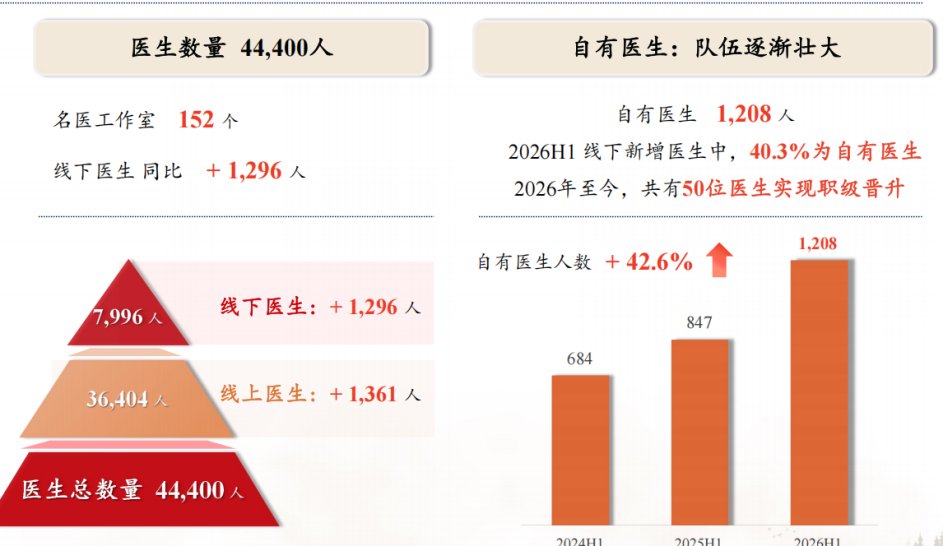
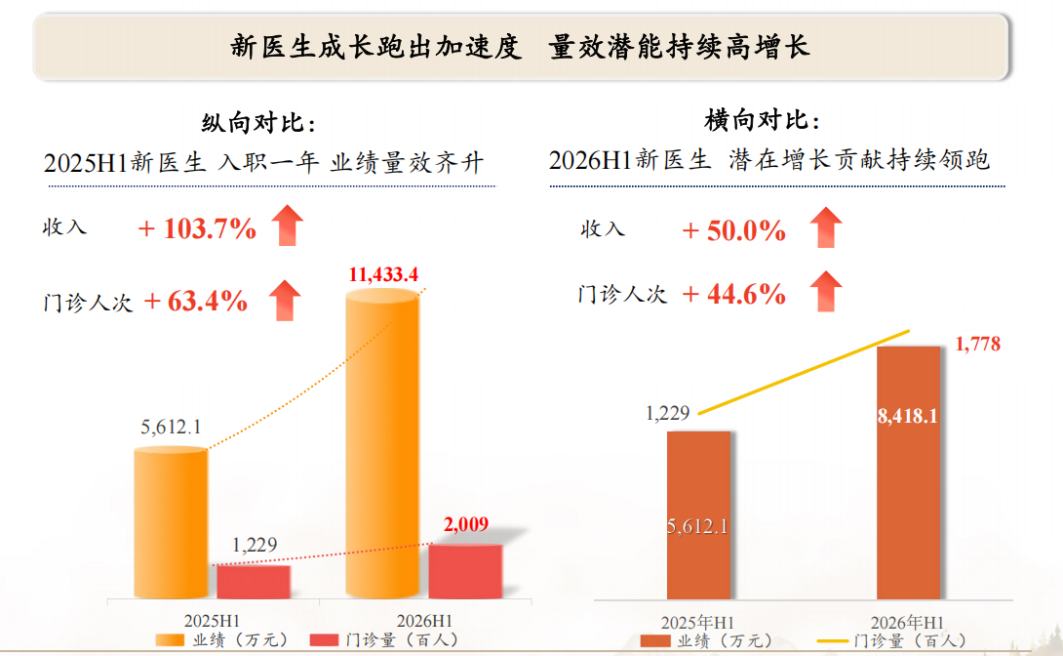
Qualitative changes in the talent structure have directly translated into strong performance increases. During the reporting period, compared with the previous issue of new doctors, the performance of new doctors in this period increased by 50%, which means that the ability to obtain medical treatment was further strengthened. However, the performance growth rate of new doctors who have been employed for one year was as high as 103.7%. These two data form a complete closed loop of commercial verification: the overall growth rate of 50% verifies that the full-time system has the ability to replicate on a large scale, while the mature growth rate of 103.7% indicates that once the integration and adaptation period has passed, the performance flexibility of the proprietary model will be strongly unleashed. The efficient transformation mechanism confirms that Gushengtang not only has the ability to introduce talents, but also has a mature talent empowerment system, which efficiently transforms human capital into continuous momentum for same-store growth.
In the end, the results on the talent side were concentrated on the store side. During the reporting period, the number of the company's offline outpatients increased by 17.5% year-on-year, of which up to 12.9 percentage points were contributed by the same store growth. The accelerated release of operating leverage in mature stores means that the single-store profit model already has significant cyclical resilience, laying a solid foundation for the continuous improvement of medium- to long-term profit margins.
Simply put, this is not a simple personnel restructuring; it is a restructuring of the underlying logic of the business model. In the context of an era where policies continue to favor the development of traditional Chinese medicine, Gushengtang is completing a value transition from a “chain model” to a “platform brand”. While the industry was still involved in the stock game of multiple practices, Gushengtang has reshaped its commercial base with a full-time talent system and locked in the main engine for the next stage of competition on the traditional Chinese medicine chain circuit.
Policy dividends, accurate card slots, grassroots leaders can enjoy hierarchical diagnosis and treatment dividends
If the construction of a full-time talent system is an internal skill practiced by Gushengtang, then the country's top-level design of primary care provides the most suitable implementation scenario for this set of internal skills. Gushengtang's strategic value lies in the fact that its accurate cards are leading to a wave of redistribution of medical resources driven by the country's top-level design.
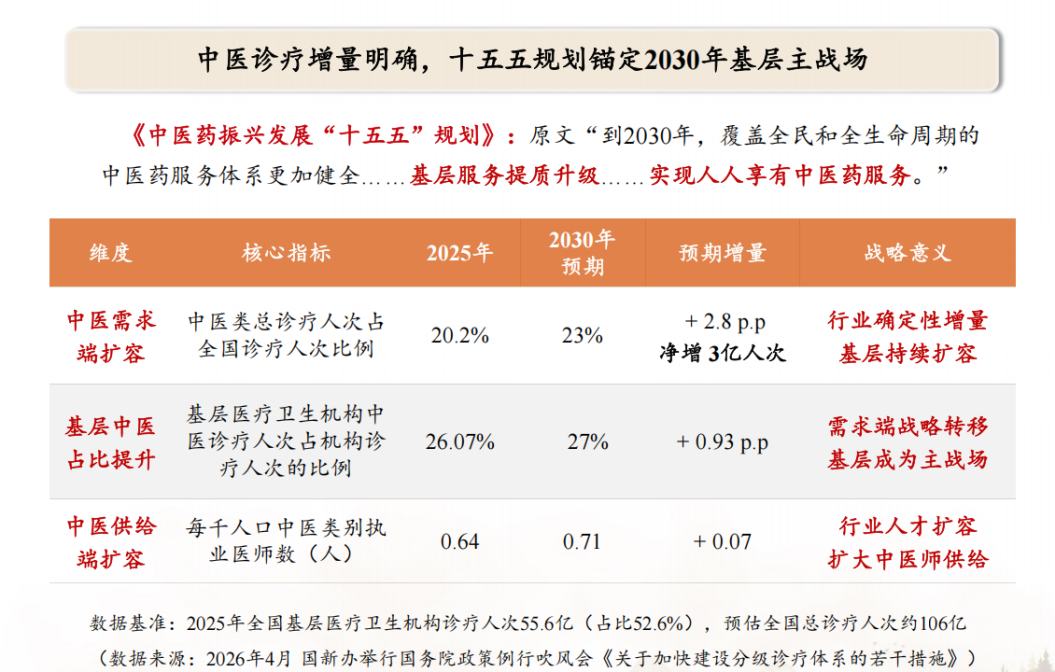
In April 2026, the General Office of the State Council issued “Certain Measures to Accelerate the Construction of a Hierarchical Diagnosis and Treatment System”, which clearly extends expert team general outpatient clinics to the grassroots level and implements differentiated medical insurance payments, providing institutional guarantees for the orderly transfer of outpatient traffic from tertiary hospitals to grass-roots communities. The “Fifteenth Five-Year Plan” for the Revitalization and Development of Traditional Chinese Medicine further anchors the definitive direction of traditional Chinese medicine at the grassroots level with quantitative goals: the proportion of total TCM patients increased from 20.2% in 2025 to 23% in 2030, a net increase of about 300 million; the proportion of primary Chinese medicine diagnoses and treatments increased from 26.07% to 27%; and the number of traditional Chinese medicine practitioners per 1,000 population increased from 0.64 to 0.71. The three indicators are simultaneously skewed towards the grassroots level — demand-side expansion clarifies incremental sources, supply-side decline provides service support, and payment-side slant opens up a closed loop of patients' decision-making. The triple forces resonate. The primary traditional Chinese medicine market has evolved from a policy direction to a definitive growth track with clear quantitative anchors, and the industry ceiling is being raised systematically.
Policy dividends have opened up traffic entrances at the grassroots level, and the key to receiving this wave of traffic lies in the competitive pattern on the talent supply side. Traditional community health service centers have long faced the structural dilemma of “not being able to retain people.” Gushengtang has restructured this logic with a market-based mechanism, creating a systemic competitive advantage over primary medical institutions.
In terms of expert resource density, the company brought together 8 masters of Chinese medicine, dozens of famous Chinese medicine practitioners, and hundreds of Qi Huang scholars to form an expert network that is difficult for private traditional Chinese medicine institutions to replicate. The famous doctor matrix not only built a barrier of trust on the patient side, but also formed a continuous “siphon effect” on high-quality young and middle-aged doctors.
On the job title promotion channel, 50 doctors have completed rank promotion in the first half of 2026, with a cumulative total of 141 promotions in the past three years. Against the backdrop of scarce promotion places in grass-roots public institutions, Gushengtang provided doctors with a predictable growth path with a clear corporate rank system. The total number of self-owned doctors increased by 42.6% year-on-year to 1,208.
In terms of the academic growth system, 152 famous medical heritage studios have provided a practical platform for studying with teachers; the “Gusheng Lecture Hall” has held 7 consecutive sessions, led by Chinese medicine masters, with more than 20,000 online and offline physicians attending the single session, creating a closed organizational loop of “famous doctors teaching - clinical practice - academic improvement”, transforming individual experiences scattered around famous medical clinics into organizational abilities that can be replicated on a large scale.
It is this talent supply system that “attracts, retains, and grows rapidly” that enables Gushengtang to “sink in” patients while using a market-based mechanism to “sink in” and become a key force with institutional acceptance capacity in the grass-roots hierarchical diagnosis and treatment system.
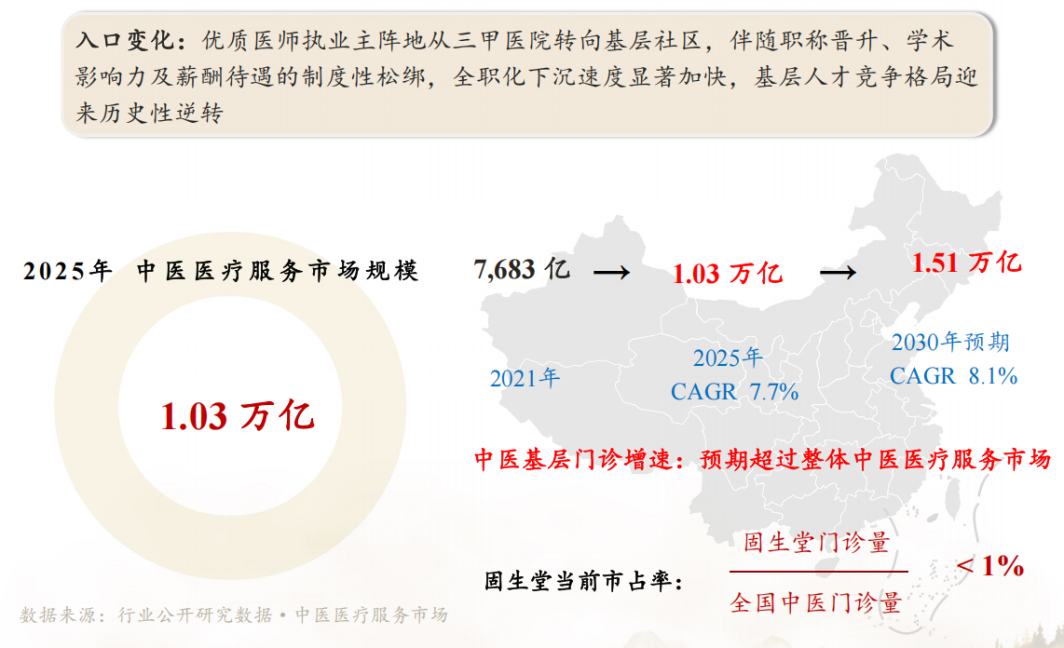
Looking forward to the future, Koseido's growth space is clear and quantifiable. The size of the TCM medical services market in China has grown from 768.3 billion yuan in 2021 to 1.03 trillion yuan in 2025, and is expected to expand to 1.51 trillion yuan in 2030. The growth rate of primary care outpatient clinics is expected to continue to outperform the overall market. However, the current number of outpatient clinics in Gushengtang still accounts for less than 1% of the country's traditional Chinese medicine outpatients — in mature industries, the market share of leading chain brands can usually reach 5%-10%. In a trillion-level track, every 1 percentage point increase in market share corresponds to a 10-billion-level revenue growth space. As the brand's potential continues to grow and its own doctor system is deeply rooted, Gushengtang will take the lead in completing a complete commercial closed loop from “traffic acquisition” to “capacity management” to “value monetization” in the process of accelerating the concentration of the traditional Chinese medicine market at the primary level.
Talent barriers are transformed into valuation premiums, and three-dimensional logic reshapes pricing hubs
When strong endogenous growth and clear strategic cards form a closed loop, the valuation logic of the capital market also changed qualitatively. The value of Gushengtang's full-time talent system is leaping from the level of operating efficiency to restructuring the valuation logic of the capital market. In the medical chain circuit, the core of a company's pricing is the certainty of profit and the replicability of same-store growth. By establishing a full-time doctor system, Gushengtang has achieved systematic breakthroughs in both dimensions, driving the valuation system from a single “scale growth” pricing to a three-dimensional pricing model of “growth+determinity+profit quality”.
Full-time employment means greater control over services. The in-house doctor system enables closed-loop management of diagnosis and treatment processes, medical quality, and clinical data, and fundamentally solves the long-standing problem of service standardization in the traditional Chinese medicine chain industry. The return rate of members continues to rise, the share of member revenue has increased to 46.8%, and the number of member consumers has increased by 28.7% year over year. Increased patient stickiness directly translates into higher follow-up rates and lower customer acquisition costs. Higher follow-up rates lead to more stable gross margins — against the backdrop of a 3.9% year-on-year decline in overall customer unit prices due to an increase in the share of consumer services, the unit price for serious medical customers bucked the trend and increased by 0.5 percentage points at the same time, reflecting the continued consolidation of the value of core medical services and a steady increase in operational efficiency.
The full-time physician system forms the core support for the company's profitability — stronger service control brought higher follow-up rates and customer unit prices, and boosted the annualized return on net assets (ROE) from 12.8% to 21.5%, an increase of 8.7 percentage points over the previous year. This value chain, which translates from talent density to organizational effectiveness and from organizational effectiveness to financial results, is a solid foundation that supports valuation premiums.