
Tesla Stock Slips as Cybercab Event in Austin Disappoints. How to Play TSLA From Here.
Tesla (TSLA) shares dropped almost 6% on Friday after the company's Cybercab rollout event in Austin disappointed Wall Street. The selloff came just a day after the stock had jumped 5.4% on hopes for the much-awaited event reveal. Tesla's stock has regained a little momentum today and is back up about 3% in early morning trading.
The disappointment centers on Tesla's push into the robotaxi business, a market currently led by Alphabet's (GOOG) (GOOGL) Waymo. Wall Street had been waiting nearly two years to see how Tesla's driverless, two-seat Cybercab would perform in the real world.
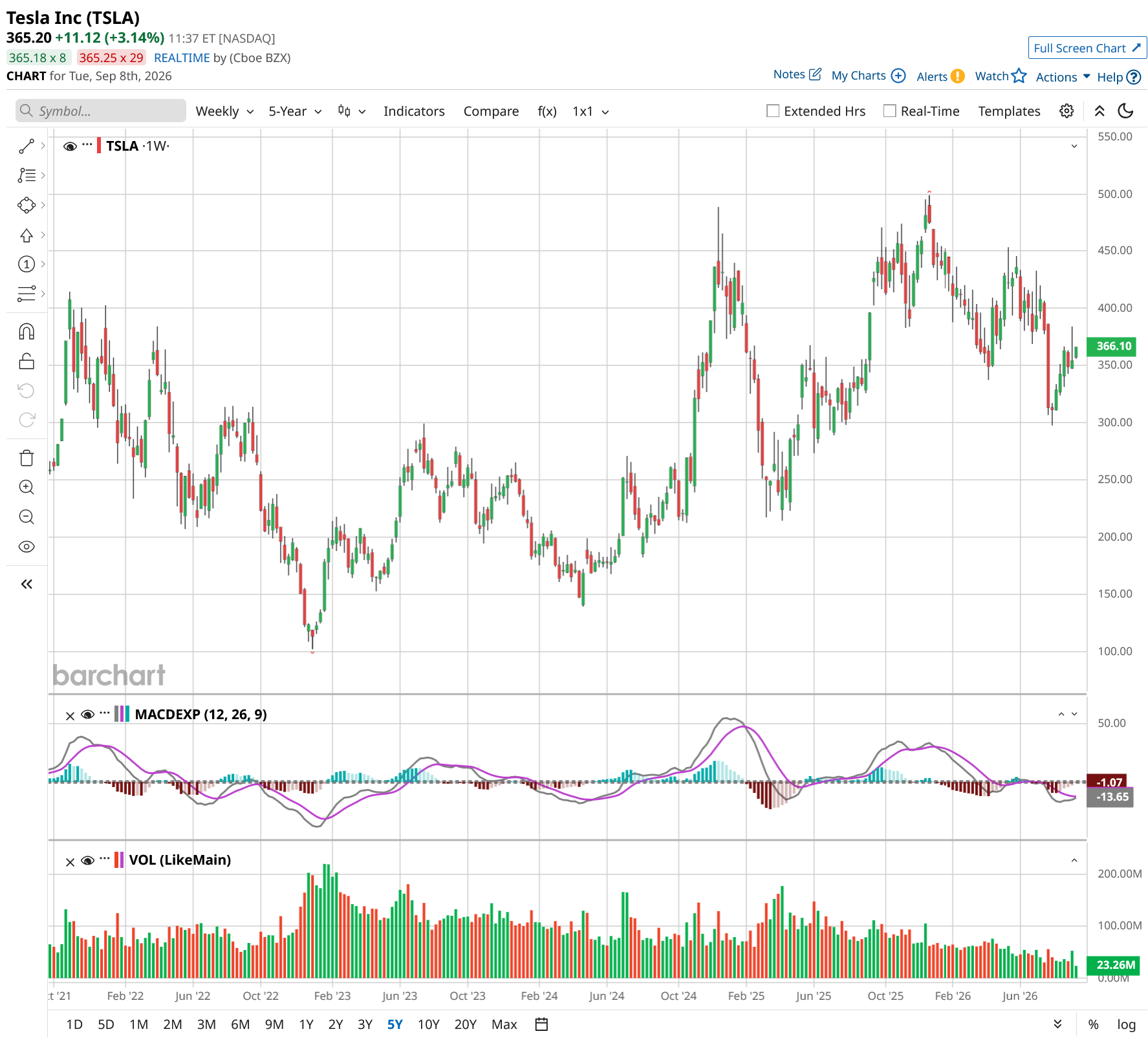
Tesla's Stock Drops After Quiet Event
According to CNBC, the Austin event was invite-only and was not livestreamed, a shift from Tesla's usual big product launches. CEO Elon Musk did not attend, something TechCrunch called “puzzling” given how often he has tied Tesla's future value to robotics and self-driving technology.
Tesla said riders using its Robotaxi app could now book driverless trips in a Cybercab within a limited zone around Austin. But RBC Capital analysts, who still recommend buying the stock, said the event offered little new information on pricing, production timelines, or regulatory approval, per CNBC.
Wells Fargo analysts were more blunt, titling their note “TSLA Cybercab Launch Event Underwhelms.” The investment firm pointed to early problems with the Austin robotaxi service, including rider complaints about wrong routes, missed stops, and long wait times, CNBC noted.
Regulators Open a Cybercab Safety Probe
According to a Reuters report:
- Hours after the event, the National Highway Traffic Safety Administration opened a formal audit into how Tesla certified the Cybercab as safe.
- The probe covers close to 1,000 vehicles and will examine whether Tesla properly proved the car meets federal safety rules.
- The Cybercab has no steering wheel, brake pedal, gas pedal, or mirrors, features that federal standards have long required for road use.
- Automakers in the U.S. can self-certify that a new vehicle meets those standards instead of waiting for government approval before launch.
- NHTSA Administrator Jonathan Morrison said the agency supports self-driving technology but must confirm that companies are following the law.
- As of Friday morning, Tesla had 420 autonomous vehicles registered in Texas, including 45 Cybercabs.
Legal experts explained that Tesla could try a workaround. Carnegie Mellon engineering professor Philip Koopman said Musk could offer a “creative interpretation” of the rules and expand the Cybercab fleet quickly, forcing regulators to sort out the legality later. Michael Brooks of the Center for Auto Safety was more skeptical, saying he sees no reasonable way the Cybercab meets current federal safety standards.
A recent example shows how this can go wrong. Amazon's Zoox tried to self-certify its steering-wheel-free robotaxi, only to face an NHTSA investigation and later withdraw that certification. Zoox eventually won a limited federal exemption this past July, Reuters noted.
Tesla Faces a Scale Problem
TechCrunch pointed out that hype from a single event matters less than whether Tesla can run a robotaxi service safely and at scale. Presently, with only 45 Cybercabs on the road, Tesla remains far behind Waymo in terms of size.
Despite the stock's slide, Tesla's broader business has shown strength. The company's second-quarter report highlighted record vehicle deliveries, energy storage deployments returning to growth, and services revenue hitting a record $648 million in gross profit.
Tesla also passed $100 billion in trailing 12-month revenue for the first time. Cybercab production began in the second quarter at Gigafactory Texas, and the company has said output will grow sharply later this year.
Robotaxi service using Tesla's Model Y, which does have manual controls, is already live in seven U.S. metro areas, including Miami, Orlando, and Tampa.
Is TSLA Stock a Good Buy?
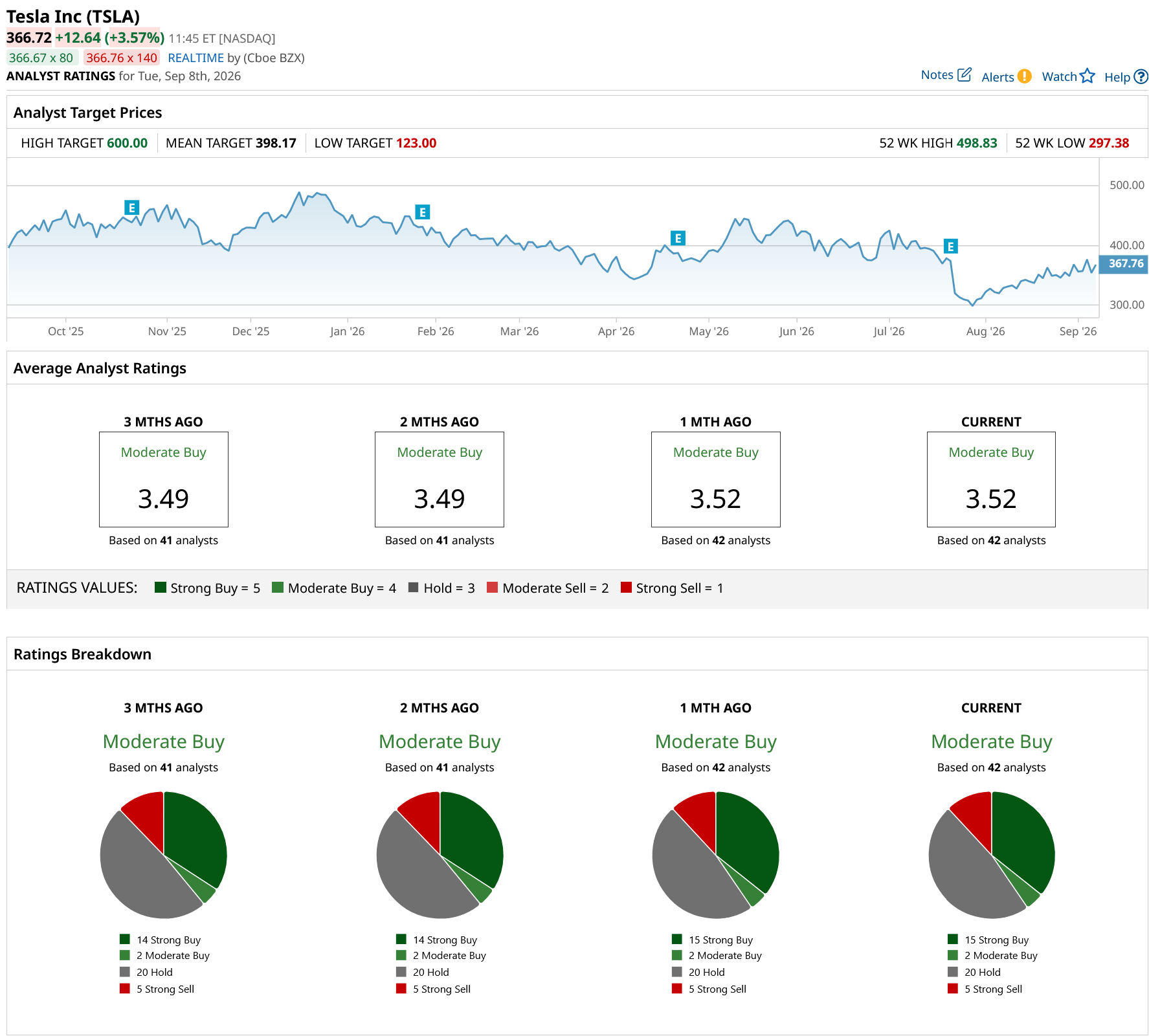
Valued at a market cap of $1.4 trillion, TSLA stock has surged more than 40% over the last five years. Out of the 42 analysts covering TSLA, 15 recommend “Strong Buy,” two recommend “Moderate Buy,” 20 recommend “Hold,” and five recommend “Strong Sell.” The average price target is $398.17, above the current price of about $367.
Tesla is an EV maker that continues to grow its core vehicle, energy, and software businesses. It is also betting heavily on megatrends such as robotics, artificial intelligence, and self-driving.
Investors who believe in Musk's self-driving vision may see Friday's drop as a buying opportunity. Those looking for concrete proof that Cybercab can scale safely and legally may want to wait for more clarity from NHTSA before gaining exposure.
On the date of publication, Aditya Raghunath did not have (either directly or indirectly) positions in any of the securities mentioned in this article. All information and data in this article is solely for informational purposes. For more information please view the Barchart Disclosure Policy here.