
Michael Burry Calls Palantir an ‘AI FOMO Consultant.’ Here’s Why He’s So Bearish on PLTR — And Why I’m Not Fully Convinced.
Few investors have been more vocal about Palantir Technologies (PLTR) than Michael Burry. The famed “Big Short” investor has repeatedly questioned whether the artificial intelligence (AI) darling deserves anything close to its lofty valuation, and his latest criticism goes straight at the heart of the bull case. Burry described Palantir as an “AI FOMO consultant,” arguing that fear of missing out on the AI boom is pushing companies to sign up for Palantir’s services even as its business model, in his view, looks more like consulting than traditional subscription software.
At the heart of Burry’s thesis are several accounting trends that he believes challenge Palantir’s software narrative. He has pointed to the company’s accounts receivable, customer concentration, and deferred-revenue patterns, arguing that they resemble those of consulting businesses such as Accenture (ACN) more than traditional software-as-a-service (SaaS) companies. That distinction matters because PLTR commands a massive valuation premium, meaning any reassessment of how investors view its business model could have significant implications for the stock.
So, is Burry right that Palantir is an overpriced “AI FOMO consultant,” or does its exceptional growth justify the valuation? Let’s take a closer look.
About Palantir Technologies Stock
Palantir Technologies develops and deploys software platforms for the intelligence community, commercial enterprises, and government entities around the globe. It offers a range of platforms, such as Palantir Gotham, Foundry, Apollo, and the Artificial Intelligence Platform. It currently has a market cap of $419 billion.
Palantir’s key platforms include Gotham, designed for detecting patterns in large datasets for defense and intelligence agencies, and Foundry, which functions as a central operating system for data across multiple industries. Apollo is the company’s cloud-agnostic platform that enables seamless software updates, while the Artificial Intelligence Platform (AIP) leverages generative AI models to improve decision-making across commercial and government sectors.
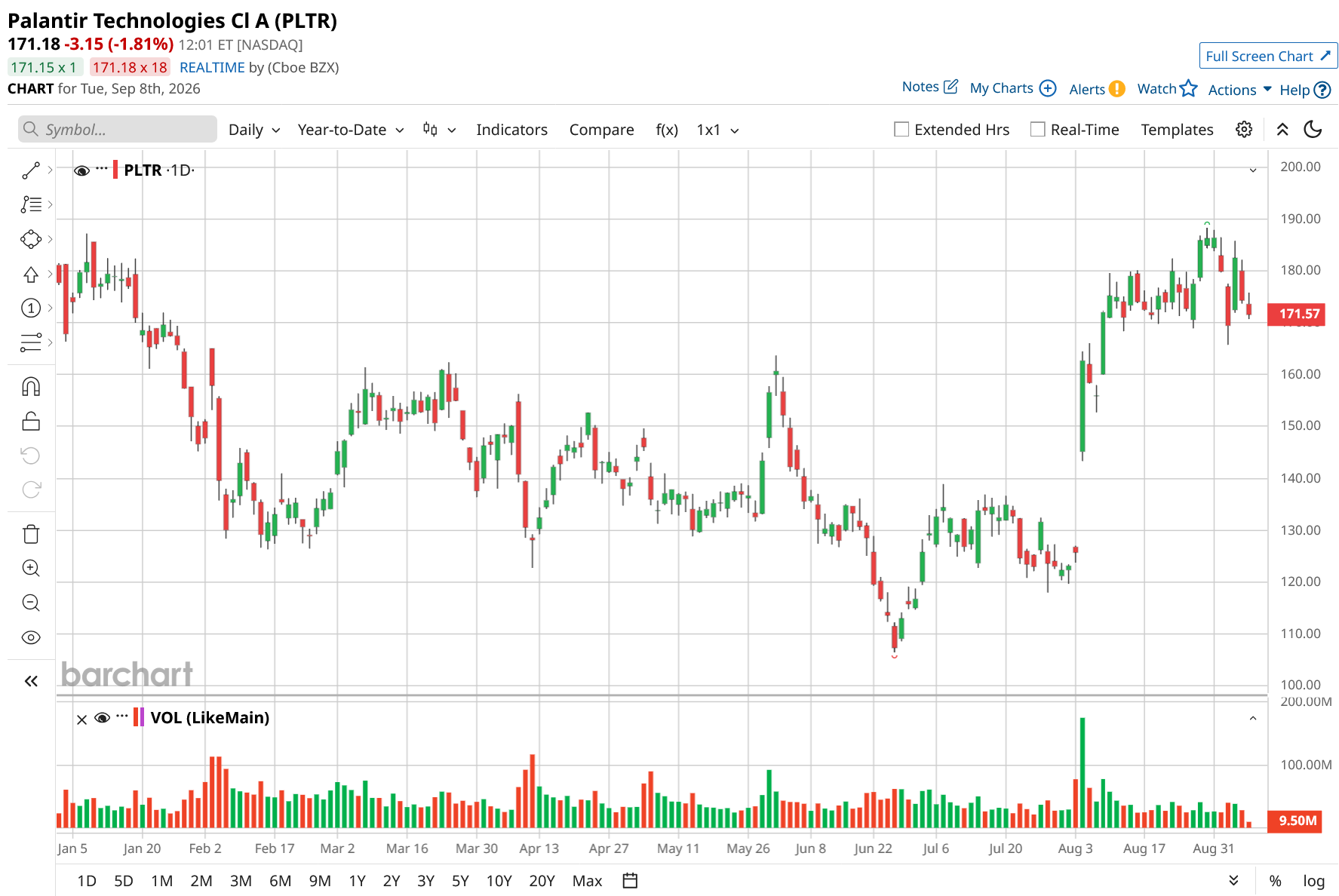
Shares of the analytics software provider have mostly recovered their earlier losses and are now only down about 3% year-to-date (YTD). PLTR stock jumped 51% in August, boosted by blowout Q2 earnings and broader strength across the software sector.
Michael Burry Doubles Down on His Palantir Bear Case
Michael Burry, best known for his early bet against the U.S. housing market and his portrayal by Christian Bale in “The Big Short,” doubled down on his bearish view of Palantir last week following the stock’s August rally. The famous investor reshared his February article titled “Palantir: An Accounting,” which focused on Palantir’s rising accounts receivable and deferred-revenue trends, saying that “the facts have not changed.” He added that FOMO is driving companies to hire Palantir for now and that its competitive position is becoming “more dire almost by the day.”
Well, let’s dig into the key points of Burry’s bearish thesis to see where things actually stand. First, Burry noted in his February article that Palantir’s accounts receivable (AR) had grown much faster than revenue in recent quarters. AR is the money that customers owe a business for goods or services they received. More specifically, Palantir’s receivables grew faster than revenue in nine of the 12 quarters through the fourth quarter of 2025. Burry argued that such a pattern could point to channel stuffing, aggressive revenue recognition, or extended payment terms used to win deals.
Burry said Palantir resembles a consulting business more than a software company and that, if a revaluation occurs, its market capitalization could fall below $100 billion. As part of his argument, Burry wrote in his February article that, for real subscription businesses, AR growth should closely track revenue growth. He warned that when receivables are volatile or outpace revenue, it can indicate that sales are being booked faster than cash is being collected. And this is where things get particularly interesting when we look at the latest reports.
In the first quarter, Palantir’s receivables stood at $1.405 billion, up 94% year-over-year (YoY), compared with an 84.4% YoY increase in revenue. Receivables rose to $1.485 billion in the second quarter, up 99% YoY, versus a 94% YoY increase in revenue. With that, there was basically no volatility in receivables, and more importantly, their growth closely tracked revenue growth in the second quarter—something Burry said should be the case “for real subscription businesses.” However, Palantir itself appeared to lend some support to Burry’s thesis. Palantir noted in its latest 10-Q filing that it has been shifting away from collecting several years of payments upfront toward annual billing or even billing in arrears, meaning after the work is completed. Such a billing structure is more commonly associated with consulting-style arrangements.
Burry’s Palantir Receivables Concentration Concern Just Got More Serious
At this point, let’s turn to another issue Burry highlighted in Palantir’s receivables—their concentration with a single customer. And here things only got worse.
According to Palantir’s second-quarter 10-Q filing, Customer I, which Burry believes is a large government client, accounted for 27% of receivables, up from 25% at the end of 2025, even though no single customer generated more than 10% of revenue. Burry wrote in February, “Customer A acquires a tremendous amount of bargaining power because they know very well that you cannot afford a write-down.” He also argued that because no new customer accounted for more than 10% of revenue—a pattern that persisted in the second quarter—the concentration could indicate either invoicing ahead of delivery, potentially suggesting channel stuffing, or delayed payments under extended terms. “Neither option is good. One is accounting fraud, and one is a weakening business condition,” Burry said.
To sum up, the concentration could reflect the terms of a large government-related account, though the combination of broadly distributed revenue and collection risk concentrated in a single customer is unusual for a software company. By comparison, Salesforce (CRM) said in its latest earnings report that no single customer accounted for 10% or more of its AR.
Deferred-Revenue Profile Adds Fuel to Burry’s Bearish Thesis
Now, let’s turn to what Burry described as a “kidney punch” to Palantir’s software narrative: the company’s deferred-revenue pattern.
Burry said a true subscription software company, such as Salesforce or ServiceNow (NOW), generally sells annual subscriptions. When a contract is signed, a SaaS company records the amount as deferred revenue—cash received but not yet recognized as revenue—and then recognizes it over the life of the contract. By contrast, consultancies tend to sell individual engagements, such as a three-month strategy project or a six-month systems-integration assignment, with deferred revenue rising as the business grows. Burry posted a series of charts showing that Palantir’s deferred-revenue pattern looked far more like that of consulting giant Accenture than that of a typical SaaS company.
Palantir’s latest filings offer a fresh look at the pattern. The company’s deferred revenue rose 10% quarter-over-quarter (QoQ) in Q2 and 22% QoQ in Q1 (Burry measured deferred-revenue volatility on a QoQ basis). Now, let’s see how that compares with SaaS companies. It is also important to note that most SaaS companies have a concentration of annual renewals in a single quarter, typically Q4, which causes deferred revenue to spike in that quarter and then decline over the following three quarters. Workday, one of the software companies Burry compared with Palantir, saw deferred revenue remain nearly unchanged QoQ in Q2 after falling 14% QoQ in Q1. Meanwhile, Accenture’s deferred revenue fell 10% QoQ in FQ1, rose 42% QoQ in FQ2, and declined 16% QoQ in FQ3. Against that backdrop, Accenture’s current pattern resembles Palantir’s from Q3 FY23 through Q1 FY24, while Palantir’s latest deferred-revenue trend looks more similar to Accenture’s than to Workday’s.
Burry then took his analysis a step further, presenting what he described as the “uppercut” in his bearish case against Palantir. He noted that the deferred revenue-to-revenue ratio for the SaaS companies he compared with Palantir ranged from 80% to 207%, versus just 31% for Accenture. So, let’s see what the latest numbers have to say. Palantir’s deferred revenue of around $613 million amounted to 32% of its second-quarter revenue of $1.94 billion. By comparison, Workday’s deferred revenue-to-revenue ratio stood at 168% in Q2, while Accenture’s was 35% in FQ3. On that measure, Palantir’s revenue collection pattern more closely resembles Accenture’s than Workday’s.
Conclusion
Putting it all together, Burry presented a compelling case that, in some respects, Palantir resembles a consulting business more than a traditional software company.
However, I cannot agree with his thesis that Palantir should be valued like a consultancy for one key reason: its AI-fueled growth. In the latest quarter, Palantir’s revenue growth was 7.3 times that of Workday and 16.8 times that of Accenture. Again, that growth was fueled by strong demand from government and commercial customers for its AI-powered data analytics software. And that growth helps explain why Palantir commands such a steep valuation premium, with its forward P/E currently at 108.77x. With that, as long as the company continues to deliver outsized growth, investors are likely to keep rewarding the stock regardless of how its revenue is recognized. Conversely, any signs that this growth is moderating are what I believe would be most likely to trigger a revaluation.
On the date of publication, Oleksandr Pylypenko did not have (either directly or indirectly) positions in any of the securities mentioned in this article. All information and data in this article is solely for informational purposes. For more information please view the Barchart Disclosure Policy here.