
Did Raised Revenue Guidance Just Shift Best Buy's (BBY) Investment Narrative?
- Best Buy reported past second quarter sales of US$9,779 million and net income of US$315 million, with full-year 2027 revenue guidance raised to a range of US$42.3 billion to US$42.8 billion.
- Stronger earnings, higher earnings per share from continuing operations, and continued capital returns through dividends and buybacks highlight Best Buy's focus on shareholder returns and operational execution.
- With Best Buy lifting revenue guidance, the next step is to see how this earnings update reshapes the broader investment narrative.
Scan how Best Buy's earnings, dividend and buyback story compares to other retailers returning cash to shareholders by reviewing our curated 6 dividend fortresses in the same space.
Best Buy Investment Narrative Recap
For Best Buy, the core belief is that a mature electronics retailer can still grow earnings by converting tech upgrade cycles into higher margin services and memberships. The latest quarter points to that story holding together in the near term, with higher net income, firmer earnings per share and raised revenue guidance for fiscal 2027. The key short term swing factor stays the same: Can management keep gross profit and SG&A in balance as more sales skew toward competitive categories like computing and gaming? The biggest operational risk remains pressure on margins as online rivals and promotions keep prices tight.
The raised full year 2027 revenue outlook to US$42.3b to US$42.8b is the announcement that matters most here. That guidance now sits above the prior range of US$41.2b to US$42.1b and gives you a clearer sense of how management sees demand for upgrades, services and marketplace volume feeding through the top line. It also frames upcoming earnings reports as checkpoints on execution. If gross margin mix, online competition or higher operating costs start to bite, this new range becomes the reference point investors watch against those catalysts.
That said, there is one operating wrinkle in the Best Buy story that rarely shows up in the headline numbers.
Read the full Best Buy narrative to see the case behind these numbers.
Best Buy's current outlook forecasts revenue of US$44.0b and earnings of US$1.6b by 2029. This corresponds to 1.4% annual revenue growth and an earnings increase of about US$300m compared to current earnings of US$1.3b.
Best Buy's forecasts flag a fair value of $86.70 against a $90.27 share price, implying a 4% downside to its current price that leaves little room for error.
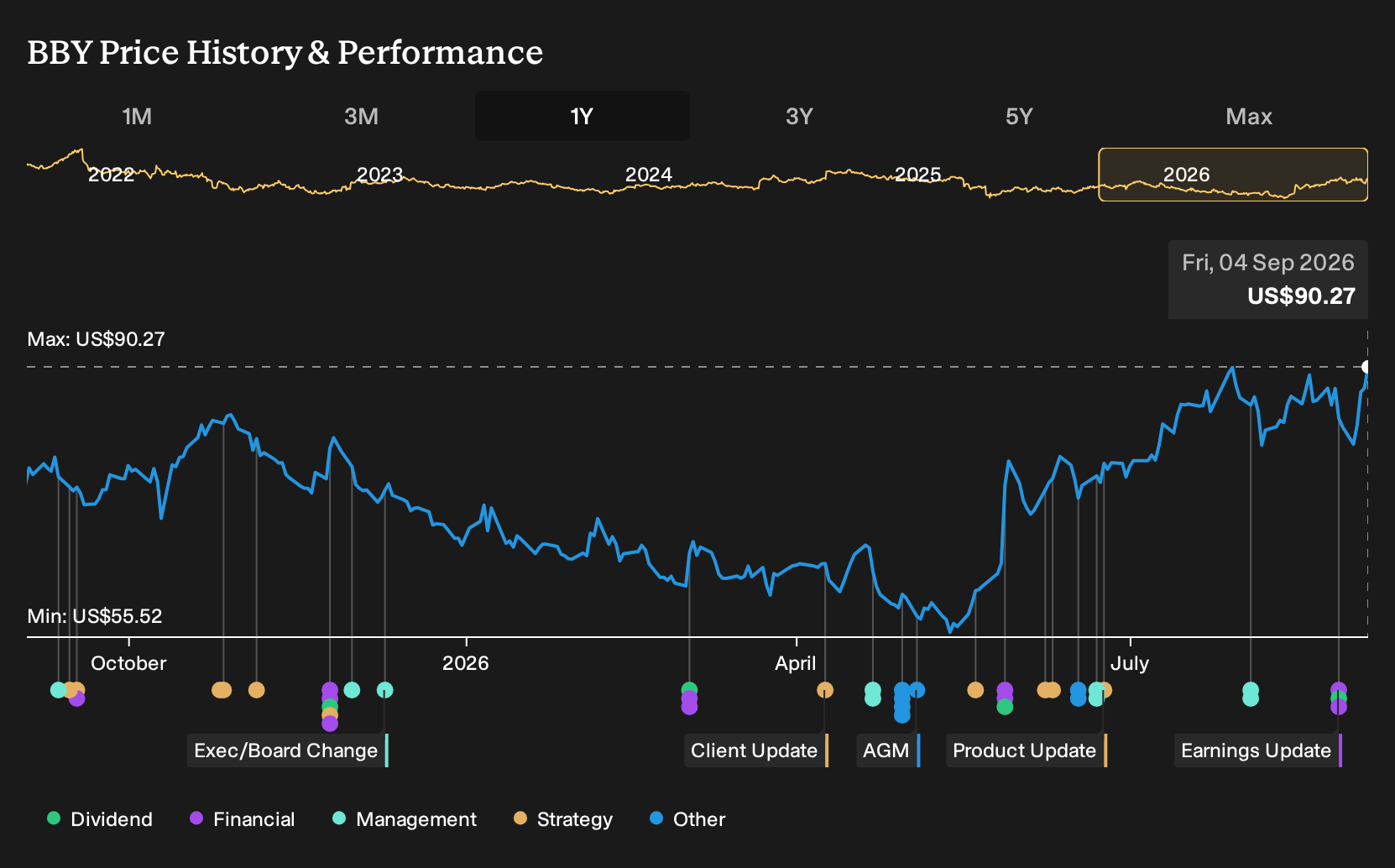
Exploring Other Perspectives
For a very different angle on Best Buy, focus on tariffs. The most cautious analysts expected new import duties and inflation to hold revenue around US$42.7b by 2029 and earnings near US$1.5b, with a much lower P/E of 11.7x. Their pre earnings view is far more skeptical, and this latest update may push them to revisit that story.
If you want to see how other investors are pricing the story, compare this view with 5 other fair value estimates for Best Buy
The Verdict Is Yours
Don't just follow the ticker; dig into the data and build a conviction that's truly your own.
- A great starting point for your Best Buy research is our analysis highlighting 5 key rewards and 1 important warning sign that could impact your investment decision.
- See our latest analysis for Best Buy. The report includes a comprehensive fundamental analysis summarized in a single visual, the Snowflake, making it easy to evaluate Best Buy's overall financial health at a glance.
Looking For More Best Buy Sized Investment Ideas?
If this Best Buy update has sharpened your thinking, you can use that same lens across the wider market with the Simply Wall St Screener. It helps you quickly filter for businesses that match the mix of quality, value and resilience you want to research next.
- If capital preservation is high on your list, you can start with companies that score well on balance sheet strength and cash flow resilience through the list of solid balance sheet and fundamentals (24 results).
- If you prefer opportunities where quality and valuation line up, scan a curated set of financially sound companies trading below fair value with the 49 high quality undervalued stocks.
- If you want to uncover lesser known ideas before they become crowded, search through a focused pool of smaller businesses with strong fundamentals using the 17 high quality undiscovered gems.
This article by Simply Wall St is general in nature. We provide commentary based on historical data and analyst forecasts only using an unbiased methodology and our articles are not intended to be financial advice. It does not constitute a recommendation to buy or sell any stock, and does not take account of your objectives, or your financial situation. We aim to bring you long-term focused analysis driven by fundamental data. Note that our analysis may not factor in the latest price-sensitive company announcements or qualitative material. Simply Wall St has no position in any stocks mentioned.
Have feedback on this article? Concerned about the content? Get in touch with us directly. Alternatively, email editorial-team@simplywallst.com