
Did Client Poaching Lawsuit Just Shift Willis Towers Watson's (WTW) Investment Narrative?
- Willis Towers Watson filed a lawsuit accusing Lockton Companies and 18 former employees of breaching non-solicitation and confidentiality agreements by taking clients that represented over US$5 million in annual revenue.
- The dispute highlights operational pressure on Willis Towers Watson’s client retention and talent stability, which are key pillars for its risk advisory and broking income streams.
- With legal claims tied to client departures and confidential data, we will look at how this lawsuit could reshape Willis Towers Watson’s investment narrative.
Compare how Willis Towers Watson’s retention challenge stacks up against peers by scanning our curated list of 82 resilient stocks with low risk scores that have historically held onto clients and key staff more consistently.
Willis Towers Watson Investment Narrative Recap
For Willis Towers Watson, the underlying belief is that specialist risk advice, benefits consulting and broking can still justify premium fees even as automation and AI pressure pricing. The lawsuit and reported client losses put the near term focus squarely on retention of both customers and senior producers. That is the most immediate swing factor for revenue stability in Risk & Broking. The same episode highlights the biggest current threat. Talent leakage to global rivals that already compete aggressively on price and technology, which could weigh on market share and make operating leverage harder to realise.
The appointment of Trevor Madden as Head of Captive and Insurance Management Solutions, Asia Pacific, looks most relevant right now. The legal action against Lockton centers on lost clients in risk advisory. Captives sit firmly in that arena. A veteran leader with 35 years in insurance and reinsurance gives Willis Towers Watson more operational depth in a region where regulatory complexity and cross border structures are central to client decisions. Execution will matter. The benefit only shows up if Asia Pacific captive wins offset any pressure from fee compression, automation, and intense competition elsewhere.
That said, before viewing the leadership hire and legal push as a clean fix, it is worth pausing on ...
Read the full Willis Towers Watson narrative to see the case behind these numbers.
Willis Towers Watson's current earnings sit at US$1.6b, with analyst consensus pointing to US$1.9b of earnings and US$12.0b of revenue by 2029. That profile relies on forecast revenue growth of 5.8% per year and an earnings increase of US$300m from today's base.
Willis Towers Watson's forecasts place fair value at $374.74 versus the $325.34 share price, indicating a 15% upside to its current price that could narrow fast.
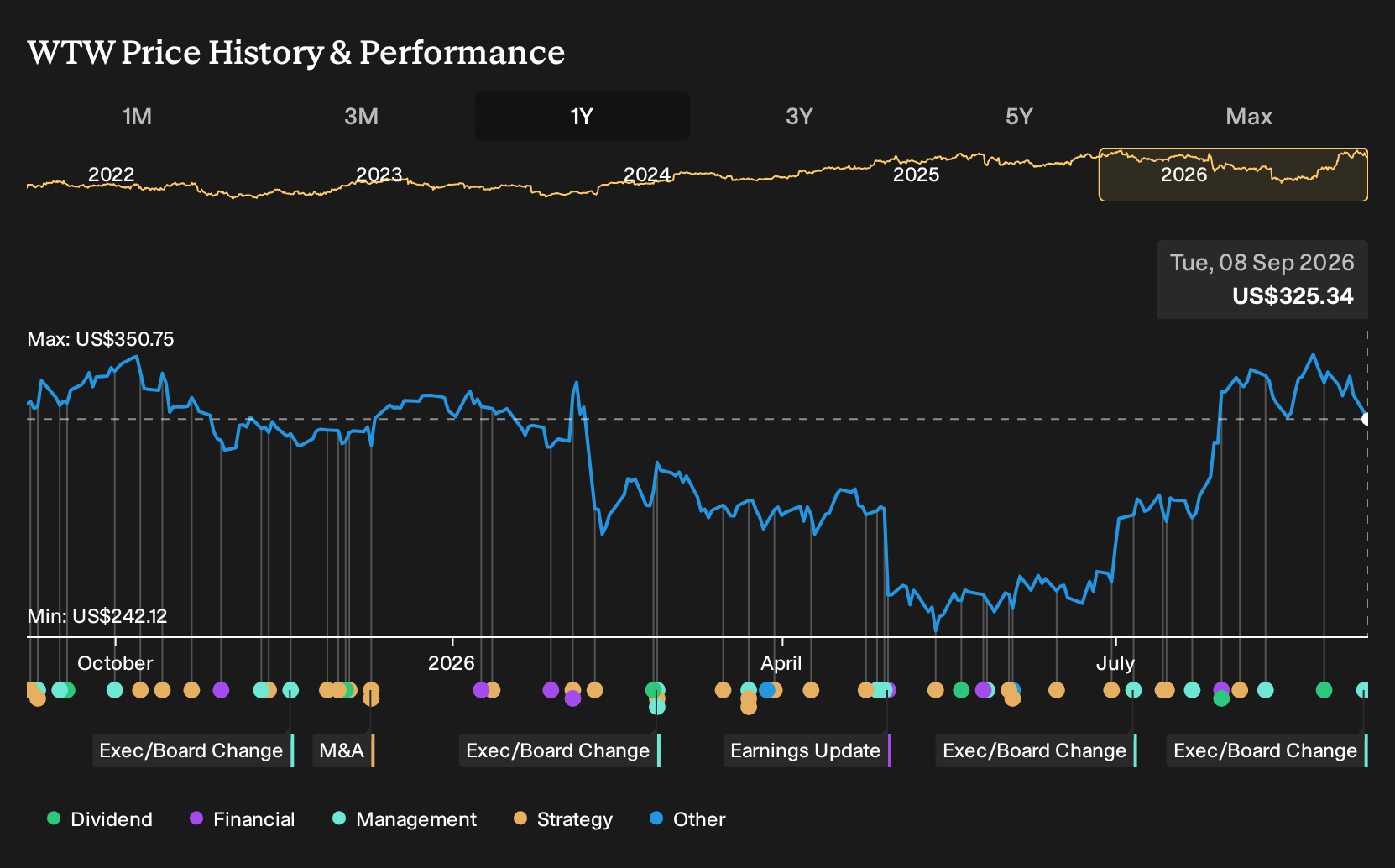
Exploring Other Perspectives
Three fair value views from the Simply Wall St Community cluster between about US$375 and US$477, so some retail investors see Willis Towers Watson as materially mispriced. Those opinions were formed before the lawsuit and the Trevor Madden appointment, so you should weigh fresh retention risks and Asia Pacific growth hopes, and then compare several contrasting viewpoints yourself.
To cross check your own thesis on Willis Towers Watson's pricing, compare it with the 2 other fair value estimates for Willis Towers Watson from the wider community.
Form Your Own Verdict
Don't just follow the ticker; dig into the data and build a conviction that's truly your own.
- A great starting point for your Willis Towers Watson research is our analysis highlighting 3 key rewards and 1 important warning sign that could impact your investment decision.
- See our latest analysis for Willis Towers Watson. The report includes a comprehensive fundamental analysis summarized in a single visual, the Snowflake, making it easy to evaluate Willis Towers Watson's overall financial health at a glance.
Looking For More Investment Ideas Beyond Willis Towers Watson?
If this Willis Towers Watson story has sharpened your thinking about risk, valuation and retention, you can use that same lens across other opportunities. The Simply Wall St Screener can help you filter for businesses that better fit your risk tolerance, income needs or balance sheet preferences in a structured, time efficient way.
- If capital preservation is high on your list, you could start with a basket of companies that score well on resilience by reviewing the 82 resilient stocks with low risk scores.
- If value is your focus, you might compare Willis Towers Watson with a wider set of quality businesses trading below their assessed worth by scanning the 49 high quality undervalued stocks.
- If income is a priority, consider rounding out your watchlist with reliable cash payers by checking out the 6 dividend fortresses.
This article by Simply Wall St is general in nature. We provide commentary based on historical data and analyst forecasts only using an unbiased methodology and our articles are not intended to be financial advice. It does not constitute a recommendation to buy or sell any stock, and does not take account of your objectives, or your financial situation. We aim to bring you long-term focused analysis driven by fundamental data. Note that our analysis may not factor in the latest price-sensitive company announcements or qualitative material. Simply Wall St has no position in any stocks mentioned.
Have feedback on this article? Concerned about the content? Get in touch with us directly. Alternatively, email editorial-team@simplywallst.com