
Learn Why The Bull Case For Biogen Stock Could Change Following Canada Reimbursement Backing
- Eisai and Biogen announced that in early September 2026 Canada’s Drug Agency issued a final recommendation supporting public reimbursement of LEQEMBI for eligible early Alzheimer’s patients, moving the therapy closer to funded access across provinces and territories.
- This decision adds another major reimbursing market to LEQEMBI’s footprint and reinforces Biogen’s focus on broadening real world access to its Alzheimer’s treatment alongside existing regulatory approvals worldwide.
- The focus now turns to how Canada’s supportive reimbursement stance for LEQEMBI could influence Biogen’s investment narrative and future execution.
Scan how Biogen's push into disease modifying Alzheimer treatments compares with other healthcare players by reviewing the hand picked 36 healthcare AI stocks.
Biogen Investment Narrative Recap
To own Biogen, you need to believe that a concentrated portfolio of neurology drugs can offset pressure on older multiple sclerosis therapies and justify continued investment in research. LEQEMBI, SKYCLARYS and ZURZUVAE sit at the center of that thesis because a handful of launches carry a lot of the load. The Canadian reimbursement backing for LEQEMBI is supportive for the Alzheimer franchise but does not change the near term swing factor, which is broad commercial execution on these newer products. The biggest operational risk remains that payer pressure and competition limit how much these launches can contribute.
The Canada reimbursement decision links directly to LEQEMBI’s broader rollout, which already includes approvals in 53 countries and regions and subcutaneous maintenance approval in the US. That global footprint makes real world access, pricing negotiations and treatment logistics key execution levers rather than just scientific ones. You are effectively watching whether Biogen can turn a technically complex monoclonal antibody regimen, with both IV and subcutaneous options, into a scalable Alzheimer treatment business. Any friction here, from negotiations with group buyers like the pan Canadian Pharmaceutical Alliance to clinic capacity, feeds straight back into the core catalyst for the stock.
Even so, there is a structural weak spot in the Biogen story that only becomes obvious when you look closely at ...
Read the full Biogen narrative to see the case behind these numbers.
Biogen's current analyst narrative points to revenue of US$11.1b and earnings of US$2.3b by 2029, off current earnings of US$834.6m. That profile assumes 3.3% yearly revenue growth and requires an earnings increase of about US$1.5b from today’s level.
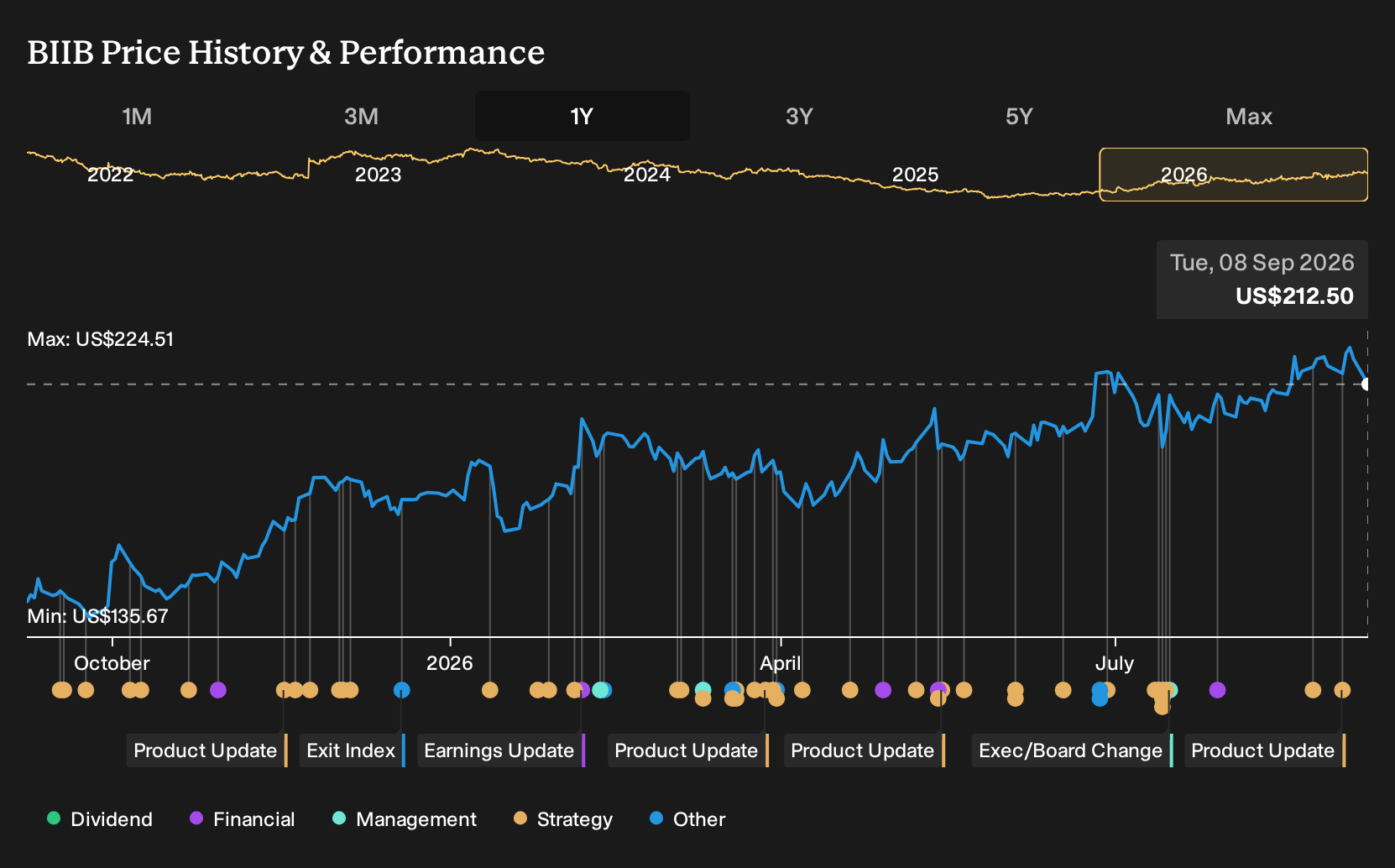
Biogen's forecasts sit at a $236.22 fair value versus the $212.50 share price, representing an 11% upside to its current price that could narrow quickly.
Exploring Other Perspectives
For Biogen, the key debate is access. The most cautious analysts worry that tougher reimbursement could hold revenue closer to about US$10.2b by 2029, with earnings near US$1.8b. That is well below consensus. This Canada decision could shift those assumptions, so treat it as a prompt to compare several viewpoints yourself.
Compare Biogen's current pricing assumptions with crowd-sourced views by checking 4 other fair value estimates for Biogen.
The Verdict Is Yours
Don't just follow the ticker. Dig into the data and build a conviction that's truly your own.
- A great starting point for your Biogen research is our analysis highlighting 2 key rewards and 2 important warning signs that could impact your investment decision.
- See our latest analysis for Biogen. The report includes a comprehensive fundamental analysis summarized in a single visual, the Snowflake, making it easy to evaluate Biogen's overall financial health at a glance.
Looking For More Biogen-Like Investment Ideas?
Once you have a view on Biogen, it can be useful to widen the lens and compare it with other businesses that fit different income, value or risk profiles. The Simply Wall St screener lets you scan for stocks that match specific traits, then track them as part of a broader watchlist.
- If capital preservation and steadier returns matter most to you, consider using the screener focused on resilient companies with lower risk scores by checking 82 resilient stocks with low risk scores.
- For readers looking for strong quality at a fair price, you can balance your research on Biogen with a curated group of potentially mispriced opportunities through the 49 high quality undervalued stocks.
- If you prefer businesses with robust finances and cleaner balance sheets, you can round out your watchlist with the list of solid balance sheet and fundamentals (24 results).
This article by Simply Wall St is general in nature. We provide commentary based on historical data and analyst forecasts only using an unbiased methodology and our articles are not intended to be financial advice. It does not constitute a recommendation to buy or sell any stock, and does not take account of your objectives, or your financial situation. We aim to bring you long-term focused analysis driven by fundamental data. Note that our analysis may not factor in the latest price-sensitive company announcements or qualitative material. Simply Wall St has no position in any stocks mentioned.
Have feedback on this article? Concerned about the content? Get in touch with us directly. Alternatively, email editorial-team@simplywallst.com