
US stock outlook | The three major stock index futures had mixed ups and downs, and Japan plans to raise interest rates to 1.25% in September, and Saudi Arabia was attacked in many parts of the country, raising geopolitical concerns
Pre-market market trends
1. Before the US stock market on September 8 (Tuesday), futures for the three major US stock indexes had mixed ups and downs. As of press release, Dow futures were down 0.81%, S&P 500 futures were down 0.25%, and NASDAQ futures were up 0.07%.

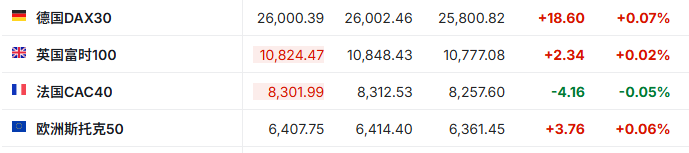
2. As of press release, the German DAX index rose 0.07%, the UK FTSE 100 index rose 0.02%, the French CAC40 index fell 0.05%, and the European Stoxx 50 index rose 0.06%.
3. As of press release, WTI crude oil rose 2.40 percent to $93.68 per barrel. Brent crude oil rose 1.59 percent to $98.54 per barrel.

Market news
It is rumored that the Bank of Japan plans to raise interest rates to 1.25% in September. According to Japan's Kyodo News, the Bank of Japan plans to raise interest rates to 1.25% at the September 17-18 meeting. Earlier, data released by Japan's Ministry of Health, Labor, and Welfare showed that Japan's nominal wage rose 4.7% year on year in July. This increase was the biggest since 1997, far exceeding the 3.8% forecast by economists. According to a report released by Japan's Cabinet Office, Japan's gross domestic product (GDP) for the second quarter increased by 1.4% on an annualized basis over the previous quarter, higher than the previously announced initial value of 1.1%, but lower than economists' median expectations of 1.8%. These two sets of better-than-expected data further support broad expectations that the Bank of Japan will raise interest rates. Investors also expect that after this rate hike, the Bank of Japan may further tighten its policy in a relatively short interval.
The US Treasury Department will announce the scale of US debt repurchases, and the market is concerned about Bezent's efforts. According to reports, US Treasury Secretary Bezent's determination to support the bond market is about to be tested. On Wednesday at 11:00 a.m. ET (23:00 Beijing time), the US Treasury Department will announce the maximum amount of 10-20 year US Treasury bonds it plans to repurchase. On September 10, the US Treasury will also announce the exact amount actually purchased in the buyback program that began in May 2024. Earlier, the US Treasury Department said that before November 4, every time long-term US bonds are bought back from the market, it will buy back at least 4 billion US dollars, which is higher than the 2 billion US dollars previously operated. However, the Ministry of Finance still has the power to expand the scale of repurchases at its discretion. However, the market generally expects that in the end, Bezent's efforts will exceed the repurchase target previously announced.
A number of Saudi energy facilities were attacked and caught on fire. According to information released by the Saudi Ministry of Energy today, many energy facilities and public facilities in the country were attacked by the Houthis in Yemen. Fires broke out in many locations, and the operation of some facilities was temporarily suspended. The Saudi Ministry of Energy said efforts are being made to ensure the safety of facilities, the safety of personnel and the continuity of operations. The Saudi-led coalition forces in Yemen said earlier today that the Houthis attacked civilian and economic facilities in Saudi Abha, Khamis Mushait, Najran, and Jizan, injuring 73 people. Coalition forces say they will respond resolutely to the Houthis attack.
Super-strong El Niño is approaching, and the World Food Programme: It will exacerbate the sudden global food insecurity problem. The United Nations World Food Programme (WFP) said in an interview that the El Niño phenomenon itself may push up food prices in affected countries. According to the latest analysis, under the influence of the current El Niño phenomenon, it is expected that by the end of 2027, 45 countries and regions around the world that are already facing serious food security challenges will add about 49 million new people with sudden food insecurity. At that time, the number of people facing sudden food insecurity in these countries and regions may increase from about 225 million to 274 million, an increase of about 22%. Among them, parts of Central America and southern Africa will be the most affected regions, while East Africa and South and Southeast Asia will also be significantly affected.
Zimbabwe immediately banned the export of antimony and tungsten, speeding up the promotion of local mineral processing strategies. The Zimbabwean government announced an immediate ban on the export of antimony and tungsten, while suspending the transportation of ores and concentrates. The aim is to promote local processing of raw materials by mining companies and increase the added value of resources. The ban was confirmed by Minister of Mines Thomas Uche in a letter dated July 21 to the state-owned Zimbabwe Minerals Sales Company. Zimbabwe is following the example of African countries such as Guinea, Ghana, and the Democratic Republic of the Congo (DRC) to derive greater economic value from natural resources. Previously, Zimbabwe suspended exports of lithium concentrate in February to promote local processing and curb illegal traffic. The relevant restrictions were relaxed in April. Currently, the ban is scheduled to be officially implemented in early 2027.
The intense rise in copper prices continued, and both the British and American markets set price records. Driven by supply and demand conflicts and tariff concerns, copper prices in the London and New York markets hit new all-time highs today. Analysts believe that the rise in copper prices in this round is due to the market's optimism about long-term strong demand brought about by data center construction, power grid upgrades, electric vehicles and new energy projects. At the same time, production in the world's major copper-producing countries has declined, putting pressure on the supply side. The potential increase in import tariffs on refined copper will further help the situation; the copper tariffs announced last summer did not cover refined copper, but the US Department of Commerce proposed imposing a 15% tariff on refined copper imports starting in 2027, and raising the tax rate to 30% in 2028.
Goldman Sachs raised its oil price forecast, saying that the risk of disruptions in Middle East shipping continues. Goldman Sachs raised Brent crude oil and WTI crude oil price forecasts for December 2026 and December 2027 by $5 per barrel on the grounds that shipping disruptions in the Middle East are expected to continue until next year. The bank currently predicts the price of Brent crude oil at 85 US dollars per barrel in December 2026 and WTI at 80 US dollars per barrel; in 2027, the price of Brent crude oil is expected to be 80 US dollars per barrel, and WTI is 75 US dollars per barrel. Goldman Sachs pointed out that if the average crude oil production in the Gulf region in 2027 is 4 million b/d lower than the pre-war level (compared to the 500,000 b/d gap assumed in its basic scenario), the price of Brent crude oil may rise above $120 per barrel. Conversely, if production in the Gulf is 1 million b/d higher than pre-war levels, the Brent price may fall to more than $60.
Individual stock news
Amazon (AMZN.US) tested the British pound bond market for the first time, and the tech giants' financing front was fully rolled out. Amazon appointed a bank on Tuesday to arrange for the issuance of its first pound-denominated bonds. It plans to launch four types of 3-year, 6-year, 12-year, and 19-year bonds. The deal is likely to land as early as Wednesday. The exact amount of financing has not been disclosed. This offering is a continuation of the cross-currency financing wave of hyperscale technology companies during the year. This year, giants such as Amazon have successively entered the euro, Swiss franc, and yen bond markets, aiming to diversify financing channels to support the huge capital expenses required for artificial intelligence transformation.
Intel (INTC.US) and ASML.US (ASML.US) are promoting high-NA EUV mass production applications. The 18A process has met performance standards, and millions of wafers have been processed. Intel Foundry and Asmat jointly announced that the two sides are continuing to promote mass production and application of high numerical aperture extreme ultraviolet lithography technology. Intel has processed more than 1 million wafers through early equipment certification, R&D, and some mass production processes. High NA EUV has been used in mass production of some layers of the Intel Core Ultra 3 series processor “Panther Lake”; the performance of Intel 18A process products using this technology reaches or exceeds similar layers using traditional 0.33 numerical aperture EUV lithography platforms. The two sides will continue to promote the transition from 6 inch to 6 x 12 inch large size, and through mask splicing technology, customers can also obtain some of the advantages of high NA EUV under existing 6-inch mask conditions.
Apple (AAPL.US) and Kioxia signed a long-term NAND supply agreement with no price cap. According to reports, Apple and Japan's Kioxia signed a long-term supply agreement (LTA) for NAND flash memory. The report's speculations on the memory market suggest that this contract will last for three to five years, and there may be no price cap. This means that Apple, which has huge bargaining power in memory price negotiations, is putting ensuring a stable supply of NAND flash memory above cost reduction.
Intel's CPU sales price will be raised by another 10%, and it is planned to eliminate low-margin products. According to supply chain sources, the price of Intel PC CPUs is expected to increase again by about 10% on October 5, 2026. This is Intel's third round of price increases since the end of 2025 — an increase of about 10% in the first quarter of 2026, and raised the prices of some consumer and server grade CPUs again in July, ranging from tens of dollars to over 1,000 US dollars. Meanwhile, Intel CEO Chen Liwu is reviewing the low-margin Small Core product line, and some products may enter the EOL (End of Life, discontinuation and delisting) stage. Supply chain sources pointed out that this series of actions all point to the same goal: increasing overall gross profit margin and leaving the market strategy of exchanging price for volume in the past.
Three setbacks in a week! Novartis Pharmaceuticals (NVS.US) DM1 Phase III clinical trial did not reach a major endpoint. Novartis experienced a third clinical trial setback in just one week. The Swiss pharmaceutical company said on Tuesday that its experimental injectable drug Del-Desiran for treating type 1 muscular dystrophy (DM1, a rare muscle atrophy disease) failed to reach a major end in the Phase III Harbor study. Del-Desiran is the core drug obtained in Novartis Pharmaceuticals's $12 billion deal to acquire Avidity Biosciences. Previously, it was regarded as a drug with bombshell potential. The drug's failed trial further dampened Novartis's efforts to find new sources of growth at a time when it was facing the largest patent cliff in the company's history.
Anthropic abandoned the $6 billion acquisition of Decart AI and is preparing for a major IPO. People familiar with the matter revealed that Anthropic has decided to abandon the acquisition of AI startup Decart AI. Anthropic previously explored the deal and completed due diligence, but ultimately abandoned it; however, the two sides may still seek other cooperation opportunities. Decart AI focuses on reducing AI training and operating costs by improving chip efficiency, and its software products can optimize the use of computing power without sacrificing performance. Anthropic has rarely made large-scale acquisitions, and is currently investing its main resources into developing new products and computing power required for customer service to prepare for a highly anticipated initial public offering (IPO); people familiar with the matter say the company plans to raise as much or more capital as SpaceX in the IPO.
Can.US (CAN.US)'s second-quarter revenue came under pressure, and cryptocurrency holdings reached a record high. Jianan Technology's total revenue for Q2 2026 was US$31.9 million, of which product revenue was US$13.6 million, reflecting weakening demand for mining machines and a decrease in the average selling price of computing power; mining revenue was US$17.7 million, which was affected by Bitcoin price pressure and seasonal power restrictions. However, the company's mining output during the quarter was 243 bitcoins, and its cryptocurrency asset holdings reached 1,915 BTC and 3,952 ETH, a record high.
Key economic data and event forecasts
23:00 Beijing time: The US New York Federal Reserve's 1-year inflation forecast for August.
Performance Forecast
Wednesday morning: Braze (BRZE.US)