
Dear SailPoint Stock Fans, Mark Your Calendars for September 9
SailPoint (SAIL) investors have a key date to watch as the identity security company prepares to report its second-quarter fiscal 2027 financial results before the market opens on Wednesday, Sept. 9.
Wall Street will be closely monitoring the report for signs that SailPoint can sustain its strong recurring-revenue growth while expanding profitability, particularly as enterprises increase spending on identity security. The company is seeking to secure the growing number of non-human and artificial intelligence (AI)-agent identities.
The upcoming report will also give investors a fresh look at SailPoint’s strategy around agentic AI and non-human identity security, two emerging opportunities that could materially expand the company’s addressable market. AI is increasingly becoming a driver of cybersecurity spending rather than simply a threat to traditional software vendors.
About SailPoint Stock
SailPoint is an Austin, Texas-based cybersecurity company focused on identity security and identity governance. Its platform helps enterprises manage and secure human, non-human, and increasingly AI-agent identities across applications, cloud environments, and other digital resources. The company has been expanding beyond traditional identity governance as enterprises face a rapidly growing number of machine identities and autonomous AI agents. SailPoint has a market cap of roughly $10.3 billion.
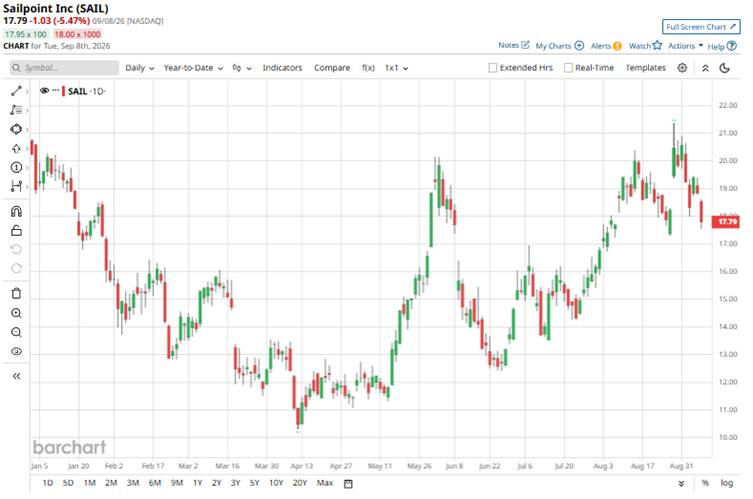
SAIL has faced a more challenging trading environment in 2026, with the stock declining despite SailPoint’s continued growth in recurring revenue and its expanding opportunity in identity security. Shares were down 12.3% year-to-date (YTD) and 20.8% over the past 52 weeks, reflecting investor concerns around the company’s profitability outlook and broader pressure on software stocks amid heightened fears about AI-driven disruption.
Moreover, while it reached a YTD high of $21.36 on Aug. 27, SAIL has pulled back significantly, leaving the shares roughly 17% below that peak, underscoring the stock’s elevated volatility ahead of the upcoming earnings report.
Despite the stock’s disappointing performance, SailPoint’s underlying business continues to show strong recurring-revenue growth, while its expansion into non-human and AI-agent identity security could provide a potentially important long-term catalyst.
Consequently, the upcoming earnings report will be closely watched to determine whether improving fundamentals and the company’s AI-related opportunity can help reverse the stock’s recent downtrend. However, notably, the stock slumped 5.5% intraday on Sept. 8, indicating investor pessimism ahead of the release.
Despite the price decline, SAIL stock currently trades at a premium to industry peers at 58.13 times forward earnings.
Strong Recurring-Revenue Growth
SailPoint reported its first-quarter fiscal 2027 financial results on Jun. 9 for the quarter ended Apr. 30. Total revenue increased 22% year-over-year (YoY) to $280 million, while subscription revenue climbed 23% to $266 million. Total ARR rose 26% to $1.2 billion, while SaaS ARR jumped 36% to $781 million.
The bottom line, however, remained in the red. SailPoint reported a net loss of $74.7 million, compared with a net loss of $187.3 million in the prior-year quarter.
At the same time, SailPoint’s adjusted results showed meaningful improvement in the underlying business. Adjusted income from operations increased to $38 million, compared with $24 million in the prior-year quarter. Adjusted EPS came in at $0.05, compared to $0.01 in the prior-year quarter and above the consensus estimate.
Cash generation was another positive. SailPoint generated $38 million in operating cash flow and $33 million in free cash flow. The company also reported 225 customers generating more than $1 million in ARR, up 32% YoY, while dollar-based net revenue retention stood at 113%.
For the second quarter of fiscal 2027, SailPoint expects total revenue of $308 million to $312 million, representing 17% to 18% YoY growth. The company expects total ARR of $1.218 billion to $1.222 billion, implying approximately 24% growth, while adjusted operating income is projected at $56.5 million to $57.5 million, representing an 18.1% to 18.7% margin. Adjusted EPS guidance stands at $0.07 to $0.08.
For the full fiscal year, SailPoint expects revenue of $1.265 billion to $1.275 billion, representing 18% to 19% growth. Total ARR is expected to reach $1.364 billion to $1.374 billion, while adjusted operating income is projected at $239 million to $244 million. The company maintained its adjusted EPS outlook of $0.30 to $0.34.
On the other hand, analysts anticipate EPS to rise 33.3% YoY to $0.32 in fiscal 2027 and again 28.1% to $0.41 in fiscal 2028. The consensus EPS for the about-to-be-reported quarter is $0.08, which is a 14.3% growth.
What Do Analysts Expect for SAIL Stock?
On Sept. 1, Cantor Fitzgerald reiterated an “Overweight” rating on SailPoint and raised its price target to $25 from $23, signaling increased confidence in the company’s growth outlook ahead of its fiscal second-quarter results.
Furthermore, Barclays maintained its “Overweight” rating on SailPoint and raised its price target to $21 from $19.
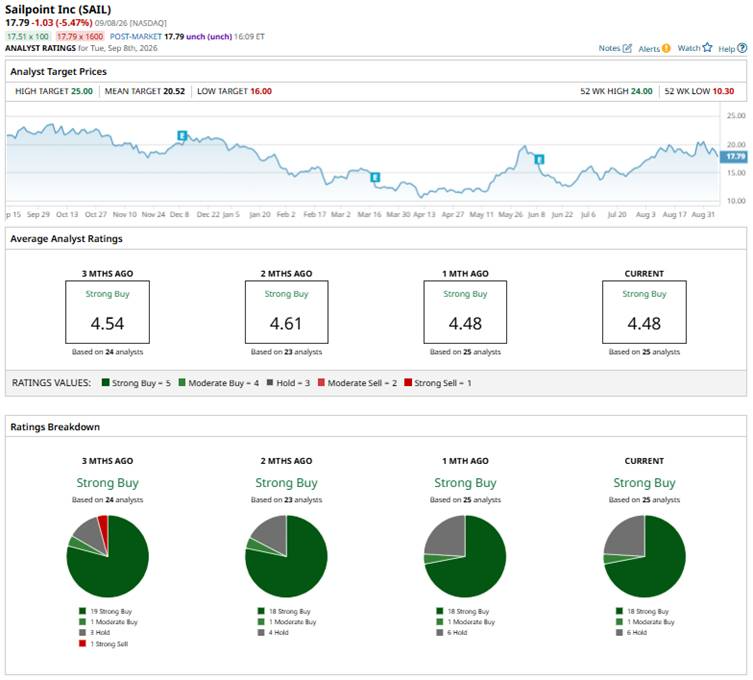
Analyst sentiment toward SailPoint has remained broadly positive despite the stock’s volatility. SAIL stock has a consensus “Strong Buy” rating overall. Out of 25 analysts covering the stock, 18 recommend a “Strong Buy,” one suggests a “Moderate Buy,” and six analysts stay cautious with a “Hold” rating.
SAIL’s average analyst price target of $20.52 reflects an upside of 15.3%, while Cantor Fitzgerald’s Street-high target price of $25 suggests 40.5% upside ahead.
On the date of publication, Subhasree Kar did not have (either directly or indirectly) positions in any of the securities mentioned in this article. All information and data in this article is solely for informational purposes. For more information please view the Barchart Disclosure Policy here.