
Volatility Insurance for Applied Optoelectronics (AAOI) Stock Potentially Inspires a Contrarian Outlook
While it might not be a household name, Applied Optoelectronics (AAOI) easily ranks among the top performers this year. Since the January opener, AAOI stock has gained 220%, an unsurprising figure thanks to its core business of fiber-optic networking products. Because AI data centers require massive amounts of data to be moved at ultra-high speeds between thousands of graphics processing units, Applied has witnessed a surge in demand.
Unfortunately, this rally is also a double-edged sword. One could make the argument that a good deal of the positive catalysts have already been baked into the AAOI stock price. Further, there are supply chain constraints and key component shortages that have tempered upside. In addition, financial concerns, such as dilutive equity offerings, widening GAAP losses and valuation premiums raise serious questions.
Subsequently, the near-term performance for Applied Optoelectronics stock has not been encouraging. In the trailing month, the ticker lost 16%. Since its closing high in May, AAOI is down exactly 50% at time of writing. Naturally, options traders are spooked, as the recent volatility suggests that the ticker could go either way.
If you look at the volatility skew for the Oct. 16 options chain, you’ll notice that AAOI stock options are pricing substantial two-tailed event/momentum risk, with somewhat greater fear/premium embedded in the downside tail than the upside tail.
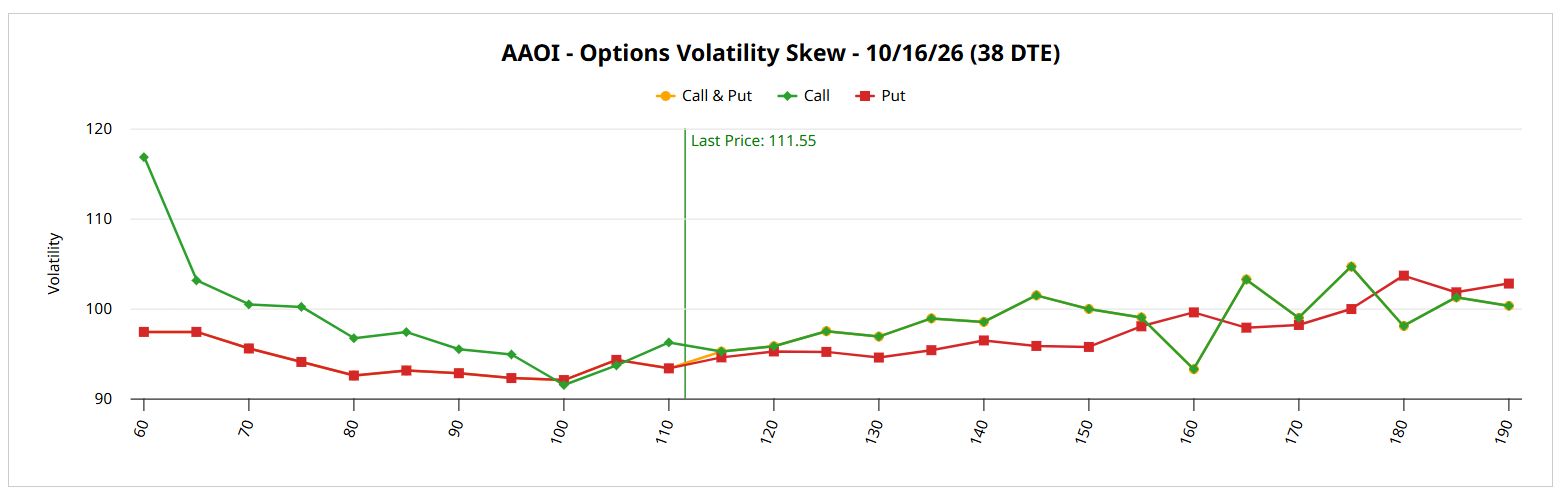
In other words, I’m not suggesting that traders think that Applied Optoelectronics stock is going to crash — that would be an exaggerated interpretation. Rather, the hedging activity implies that there is an acknowledgment that AAOI could move violently in either direction — but that downside insurance is especially expensive.
For the bullish speculator, that might not sound very encouraging. But because so much pessimism has already washed over Applied stock, the contrarian view may have less technical resistance.
Order Flow Imbalance May Signal a Clue for AAOI Stock
It’s not just that the recent print has looked negative for Applied Optoelectronics stock; it’s that AAOI over the past two months, the market has struggled to provide positive momentum. Specifically, in the last 10 weeks, AAOI has only managed to ink three positive weekly candlesticks. That’s a heavily bearish order flow imbalance, which suggests that at least a good portion of the weak hands have been flushed out.
Now, we know that Applied Optoelectronics is an incredibly relevant company thanks to the AI boom. It’s not the lead actor but it plays a pivotal role behind the scenes. Thus, we can’t talk about the machine intelligence paradigm shift without mentioning names like AAOI stock. As such, there’s good reason to believe in the contrarian argument.
Even better, we can use historical data to inductively infer where the security may head over the next couple of weeks. We know that whenever the above 3-7-D quantitative sequence (3 up weeks, 7 down weeks, downward slope) flashes in the chart, Applied Optoelectronics stock tends to rise about 8.5% as a median endpoint value over the next six weeks.
If so, one of the more intriguing ideas to consider is the 115/120 bull call spread expiring Oct. 16. This wager requires a net debit (cash outlay) of $220, with the hope that AAOI stock rises through the $120 second-leg strike price at expiration. Should that event prove successful, the maximum profit would be $280, a payout of over 127%.
While this trade may seem tempting at first glance, there’s a major problem: Wall Street doesn’t give it much of a chance to ring true.
Dueling Presuppositions Weigh on Applied Optoelectronics Stock
Right now, the Street’s options pricing mechanism implies a probability of profit (breakeven) of only 43.6%. Stated differently, you have less than coin-toss odds that AAOI stock will trigger the $117.20 breakeven price at expiration. Making matters worse, if you reverse engineer Barchart’s Expected Move calculator, the probability that AAOI triggers the $120 at expiration is only 34.76%.
You can see the basic conflict here without running a formal expected value (EV) calculation. If you were trading the Oct. 16 115/120 bull spread across multiple parallel universes, you would only be expected to win the full payout less than 35% of the time — and only break even less than 44% of the time. Eventually, your losses would stack up, threatening to crater your portfolio.
When it comes to risky debit spreads, these success ratios aren’t terrible but they’re nowhere near alluring. Given the stats, I would say most financial experts will probably steer you away from the above trade. Still, it’s important to realize where these probabilities are generated from.
Basically, the standard options pricing model presupposes that Applied Optoelectronics stock will undergo a random walk between now and the expiration date, with the current implied volatility (IV) serving as the constant “fuel” across the journey. In other words, it’s an artificial, risk-neutral construct guided by randomness.
I’m not saying that this presupposition is necessarily wrong but it may not be completely accurate, in part because of the order flow imbalance. With only three positive candlesticks out of the last 10, it’s plausible that outside observers would view AAOI stock as a temporary discount.
If that’s the case, we would expect the forward journey to be nonrandom, not random.
Running Conditional Probabilities on AAOI
In the absence of being able to absolutely determine a future price, I prefer making an inductive case for AAOI stock. Going back to the company’s initial public offering, we know that the 3-7-D quant sequence has flashed 50 times. Of this figure, AAOI has exceeded the equivalent of the $120 strike price a total of 27 times on week 6 (roughly corresponding with the Oct. 16 expiration date).
Based on this empirical analysis, the probability of full profitability may actually be 54%. I wouldn’t characterize this figure as great. However, it’s much better than 34.76%. By changing the presupposition from a random walk to a nonrandom walk, we have uncovered that AAOI stock may be underpriced relative to the quantitative risk that it usually incurs under this setup.
Of course, inductive models are hardly foolproof because past observations do not necessarily dictate future outcomes. But that’s a standard disclosure that applies across the entire equities market. Ultimately, if you find the presupposition of a nonrandom walk to be more convincing, Applied Optoelectronics may be worth a closer look.
On the date of publication, Josh Enomoto did not have (either directly or indirectly) positions in any of the securities mentioned in this article. All information and data in this article is solely for informational purposes. For more information please view the Barchart Disclosure Policy here.