
Greg Abel Says Berkshire Is Bullish on Hyperscaler Stocks as It Doubles Down on Google
Berkshire Hathaway (BRK.A) (BRK.B) is signaling that its AI strategy extends well beyond simply owning technology stocks. CEO Greg Abel says the conglomerate remains bullish on hyperscalers, with Alphabet (GOOG) (GOOGL) now its third-largest common-stock holding after Berkshire authorized an additional $10 billion investment in Google’s parent. Abel described Alphabet as a significant AI player while highlighting Berkshire’s firsthand visibility into how its portfolio companies are adopting AI.
The bigger opportunity, however, may lie in the infrastructure powering the AI boom. Abel believes electricity could become a key constraint as hyperscalers race to build data centers, creating a potentially meaningful growth avenue for Berkshire Hathaway Energy. In Iowa, data centers already accounted for about 8% of the utility’s electricity load last year.
This combination of a growing Alphabet position and rising exposure to the power demand behind AI gives investors a fresh look at how Berkshire could benefit from the hyperscaler buildout. Berkshire’s AI bets could become a meaningful new growth engine for the conglomerate.
About Berkshire Hathaway Stock
Berkshire Hathaway is a diversified holding company headquartered in Omaha, Nebraska, with operations spanning insurance and reinsurance, freight rail transportation, utilities and energy, manufacturing, services, and retail. The company operates through a decentralized portfolio of businesses and also maintains a substantial publicly traded equity portfolio, making capital allocation a central part of its investment strategy.
Under CEO Greg Abel, who succeeded Warren Buffett at the start of this year, Berkshire continues to pursue long-term investments across a broad range of industries. Berkshire Hathaway has a market cap of $1.1 trillion.
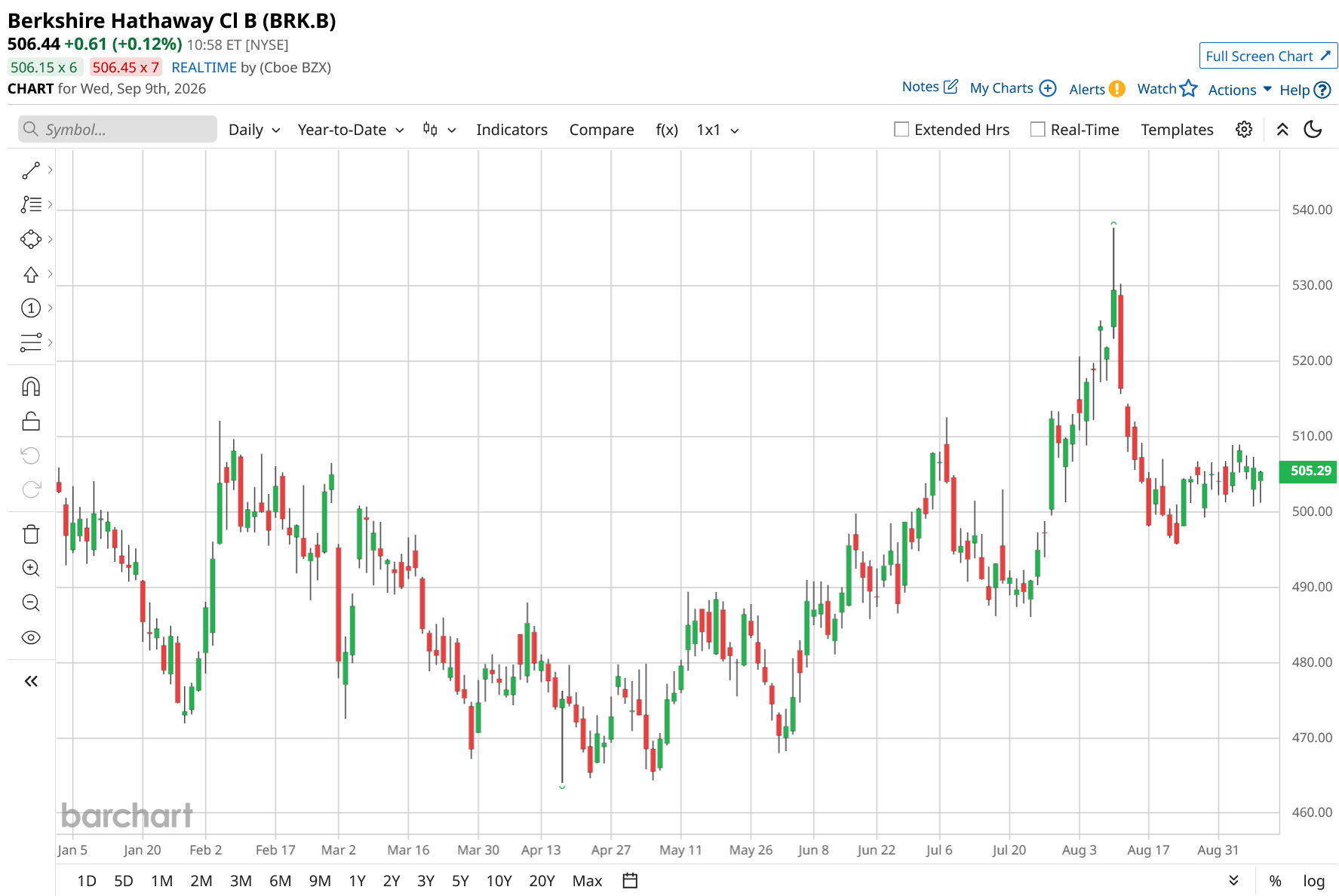
Berkshire Hathaway shares have delivered a muted performance so far this year, compared with the broader market. BRK.B stock has gained just marginally year-to-date (YTD), while the stock was down slightly over the past year. BRK.B closed at $506.03 on Sept. 4, after declining marginally during the session. So far this week it has been essentially flat on the price chart.
The muted returns come despite several potentially important catalysts for Berkshire, including the conglomerate expanding its exposure to the AI ecosystem. The stock has, however, shown stronger momentum over the shorter term, gaining roughly 3.5% over the past three months.
Still, Berkshire’s near-flat performance this year highlights the challenge facing investors as the company enters the post-Warren Buffett era. The market appears to be waiting for clearer evidence that Abel can translate Berkshire’s enormous capital base and growing AI and energy exposure into a new phase of earnings and returns.
Valuation-wise, BRK.B is priced at 23.32 times forward earnings, which is higher than the sector average. However, in terms of price-to-sales (P/S) ratio, it is at 2.91, below the sector average but above Berkshire’s historical average.
A Snapshot of Berkshire’s Q2 Performance
Berkshire Hathaway reported its second quarter of 2026 on Aug. 8, with revenue increasing 10% year-over-year (YoY) to $101.8 billion, while operating earnings rose 16.3% to $13 billion. Net earnings attributable to Berkshire shareholders more than doubled, climbing 107.5% to $25.7 billion, helped by a $12.7 billion investment gain compared with around a $5 billion gain in Q2 2025. Berkshire’s equivalent Class B earnings per share similarly jumped to $11.91 from $5.73.
The underlying segment performance was mixed but generally positive. BNSF operating earnings increased 6.3% to $1.6 billion, while Berkshire Hathaway Energy (BHE) jumped 26.9% to $891 million. Manufacturing, service, and retailing were particularly strong, with earnings rising 24.1% to $4.5 billion from $3.6 billion. The key weakness was insurance, where underwriting earnings declined 13.1% to $1.7 billion, while insurance investment income fell 9.1% to $3.1 billion, primarily reflecting lower interest income as short-term rates declined.
Berkshire also strengthened its financial position while beginning to deploy its enormous liquidity more aggressively. Shareholders’ equity reached $747.9 billion at June 30, up $30.5 billion since Dec. 31, 2025, while insurance float stood at approximately $177.5 billion, up $1.1 billion from December 2025. Operating cash flow for the first six months was $21.7 billion, compared with $21 billion in the prior-year period. Meanwhile, Berkshire repurchased approximately $4.5 billion of its own shares during Q2, bringing first-half buybacks to roughly $4.8 billion.
Greg Abel has begun putting Berkshire’s substantial cash reserves to work, including increased equity investments and the company’s larger position in Alphabet. That strategy, combined with improving BHE earnings and the potential for rising electricity demand from hyperscalers and AI data centers, could become an increasingly important part of Berkshire’s growth story.
The consensus EPS estimate for the full year is $21.67, up 5.1% YoY, while it is expected to rise 1.9% to $22.07 in the next year.
What Do Analysts Expect for BRK Stock?
UBS maintained its “Buy” rating on Berkshire Hathaway and raised its price target for Class B shares to $604 from $585 on Aug. 10.
Furthermore, DA Davidson maintained its “Buy” rating on BRK stock and raised its price target to $592 from $531 on Aug. 11.
The revised targets reinforced the bullish analyst sentiment emerging around Berkshire following its quarterly performance and increased capital deployment under CEO Greg Abel.
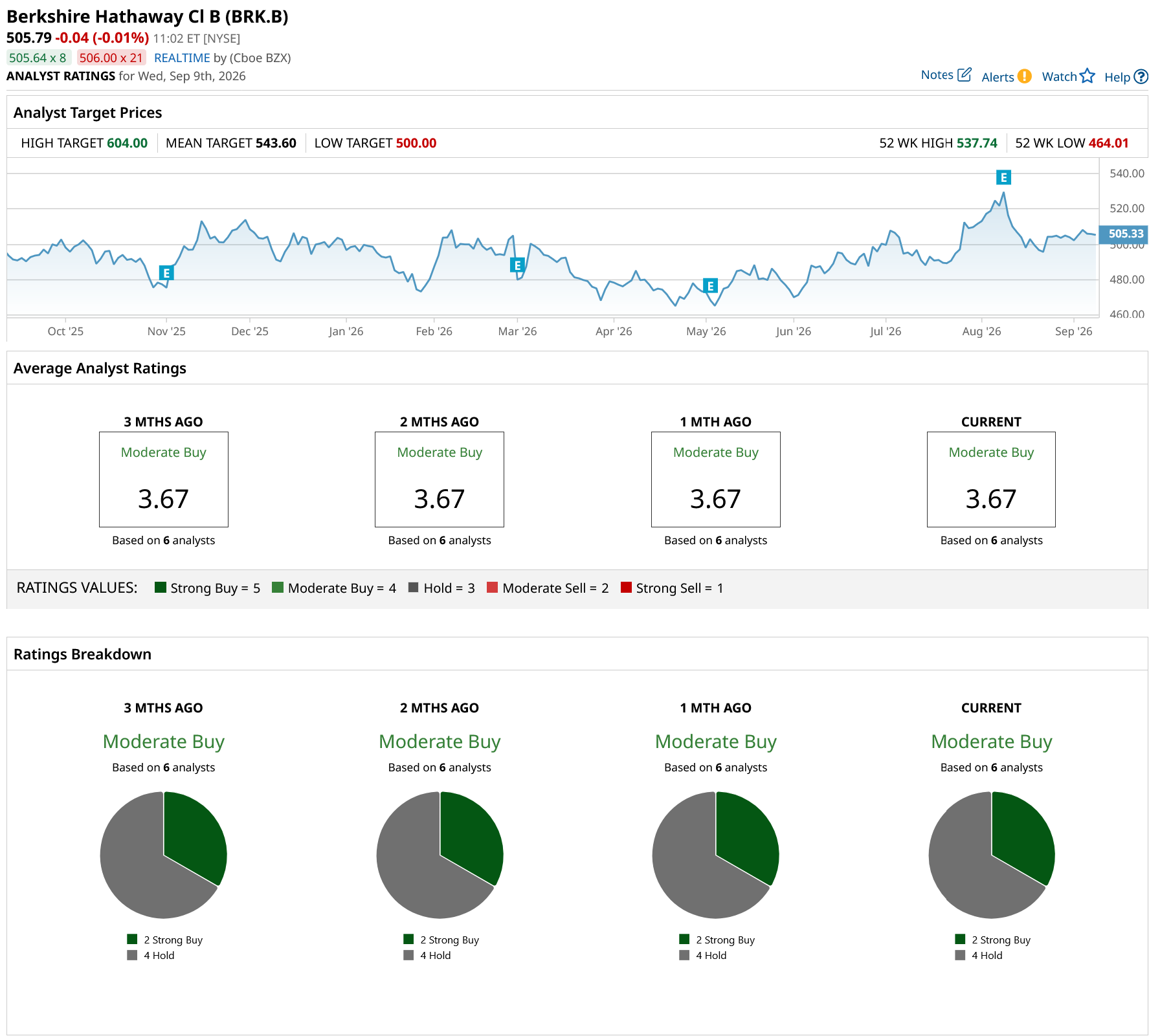
The stock has a consensus “Moderate Buy” rating overall. Out of six analysts covering BRK.B stock, two recommend a “Strong Buy,” and four analysts stay cautious with a “Hold” rating.
BRK.B’s average analyst price target of $543.60 indicates an upside of 7.5%, while UBS’ Street-high target price of $604 suggests a 19% upside ahead.
On the date of publication, Subhasree Kar did not have (either directly or indirectly) positions in any of the securities mentioned in this article. All information and data in this article is solely for informational purposes. For more information please view the Barchart Disclosure Policy here.