
Apple’s New CEO Heads Into Its Launch Event With a China Problem Tim Cook Never Faced
Apple’s (AAPL) rivals in China are not waiting for it to make the first move. Just days before Apple's anticipated debut of its first foldable iPhone at its Sept. 9 event, Huawei and Xiaomi (XIACF) rolled out premium foldable devices of their own.
The timing gives both companies a chance to grab attention before Apple’s launch. Huawei is launching the Mate XT 2, a trifold device that packs a phone and a tablet-sized screen into one body, while Xiaomi is close behind with the Xiaomi 18 Fold, a passport-style handset that looks a lot like what Apple is expected to show. So, both companies are trying to enter the high-end foldable market before Apple arrives.
This adds extra pressure on Apple because the company is already on the back foot in China. In its latest quarter, Apple reportedly held about 19% of the mainland China smartphone market, behind Huawei’s 23%. Greater China revenue grew but still landed below what analysts expected. This means the company's new foldable will arrive in a market where Apple is still playing catch-up.
The New CEO's First Big Launch
There is another reason this launch matters more for Apple than it normally would. On Sept. 1, just over a week before the event, John Ternus took over as Apple’s new CEO. The foldable is the first flagship device to debut under him. Ternus is also a hardware engineer who has spent 25 years at Apple, so the complex new form factor puts his hardware expertise directly in the spotlight.
Meanwhile, a quieter threat worth noting comes from Xiaomi. The company's Xiaomi 18 Fold runs on Xiaomi’s own Xring processor and Chinese-made ChangXin Memory Technologies (CXMT) memory. This shows that Chinese phone makers are increasingly developing their own high-end semiconductor technology. Apple, on the other hand, still depends on outside suppliers, while the global memory shortage is already pushing its costs and prices higher.
All of this doesn’t necessarily mean the new foldable iPhone is set to flop. Counterpoint Research analyst Ivan Lam expects the device to sell well and gain market share quickly. Lam also thinks Apple’s entry will make foldables mainstream, and that some of that fresh interest will eventually benefit rivals like Huawei and Xiaomi, too.
About Apple Stock
Apple designs and sells consumer devices and the software and services that run on them, including the iPhone, Mac, iPad, and Apple Watch. Its first foldable iPhone is set to expand a lineup that already spans hardware, the App Store, and services like iCloud and Apple Music. Founded in 1976, Apple is based in Cupertino, California, and led by CEO John Ternus.
Over the past year, AAPL stock has climbed roughly 34%, outperforming the S&P 500’s ($SPX) 18% gain during the same period. The rally has been driven by strong demand for the iPhone 17 lineup along with record Services revenue and widening margins.
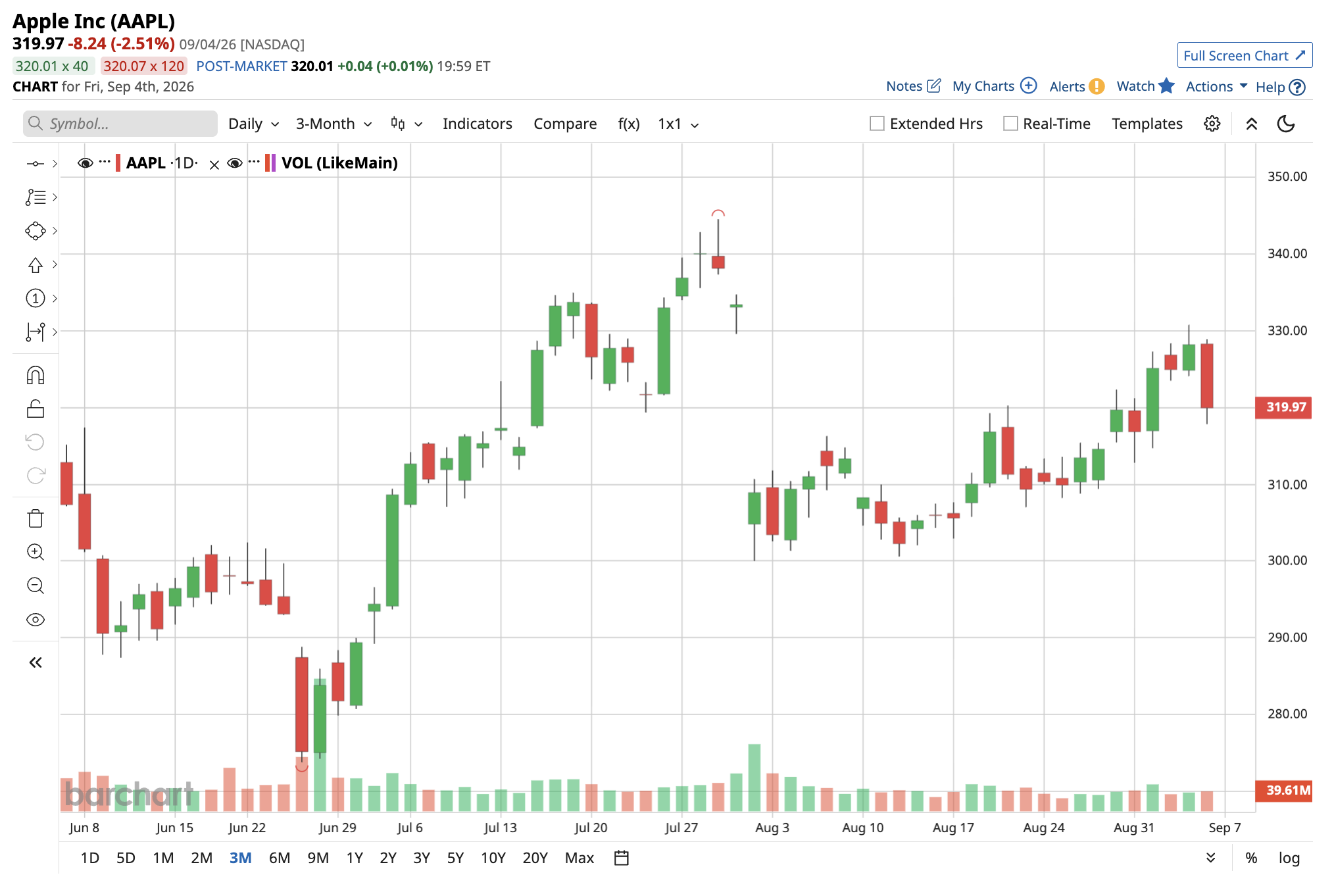
Apple’s valuation reflects the strength of its brand reputation. The forward price-to-earnings (P/E) ratio of 36.5 times sits above its five-year average of about 29 times. Similarly, the price-to-sales (P/S) ratio of 11.2 times is above its five-year average of around 7.5 times. So, the stock trades at a premium to its historical norms based on both measures.
The EPS outlook is steady rather than explosive. Analysts expect growth of 17% in fiscal 2026 and 9% growth in fiscal 2027. For a company already worth trillions of dollars, this is still decent, but it doesn’t justify the premium on its own.
The balance sheet is not much of a concern. Apple holds about $62 billion in cash against roughly $85 billion in debt. The resulting net debt of around $23 billion looks insignificant compared to the company’s market capitalization of roughly $4.6 trillion. Overall, the market is paying up for Apple’s consistency and proven track record. But at this premium, if something like the foldable launch underperforms, AAPL stock could fall a long way from where it currently sits.
iPhone Powers a Record June Quarter
Apple reported its third-quarter fiscal 2026 earnings on July 30. Revenue reached $109.4 billion, up 16% year-over-year (YOY) and above the $108.8 billion analysts expected. Adjusted EPS of $1.91 also marginally beat the $1.89 estimate. iPhone was the main driver, with revenue up 22% YOY. On his way out as CEO, Tim Cook called Q3 the best June quarter in Apple’s history.
However, even after such a strong quarter, AAPL stock dropped sharply. The reason was the outlook. Apple sees revenue rising just 9% to 11% next quarter due to tight supply and currency headwinds. Management also expects margins to slip from 50.1% to a range of 47% to 48%. That drop even after a clear top- and bottom-line beat shows just how high the bar has been set for Apple heading into its foldable launch.
What Do Analysts Expect for Apple Stock?
Bank of America Securities reiterated a “Buy” rating on AAPL stock with a $380 price target. Analyst Wamsi Mohan pointed to steady Services momentum and flagged the potential upside new products could bring under new CEO John Ternus. Meanwhile, Morgan Stanley reiterated an “Overweight” rating on Apple stock with a $360 price target.
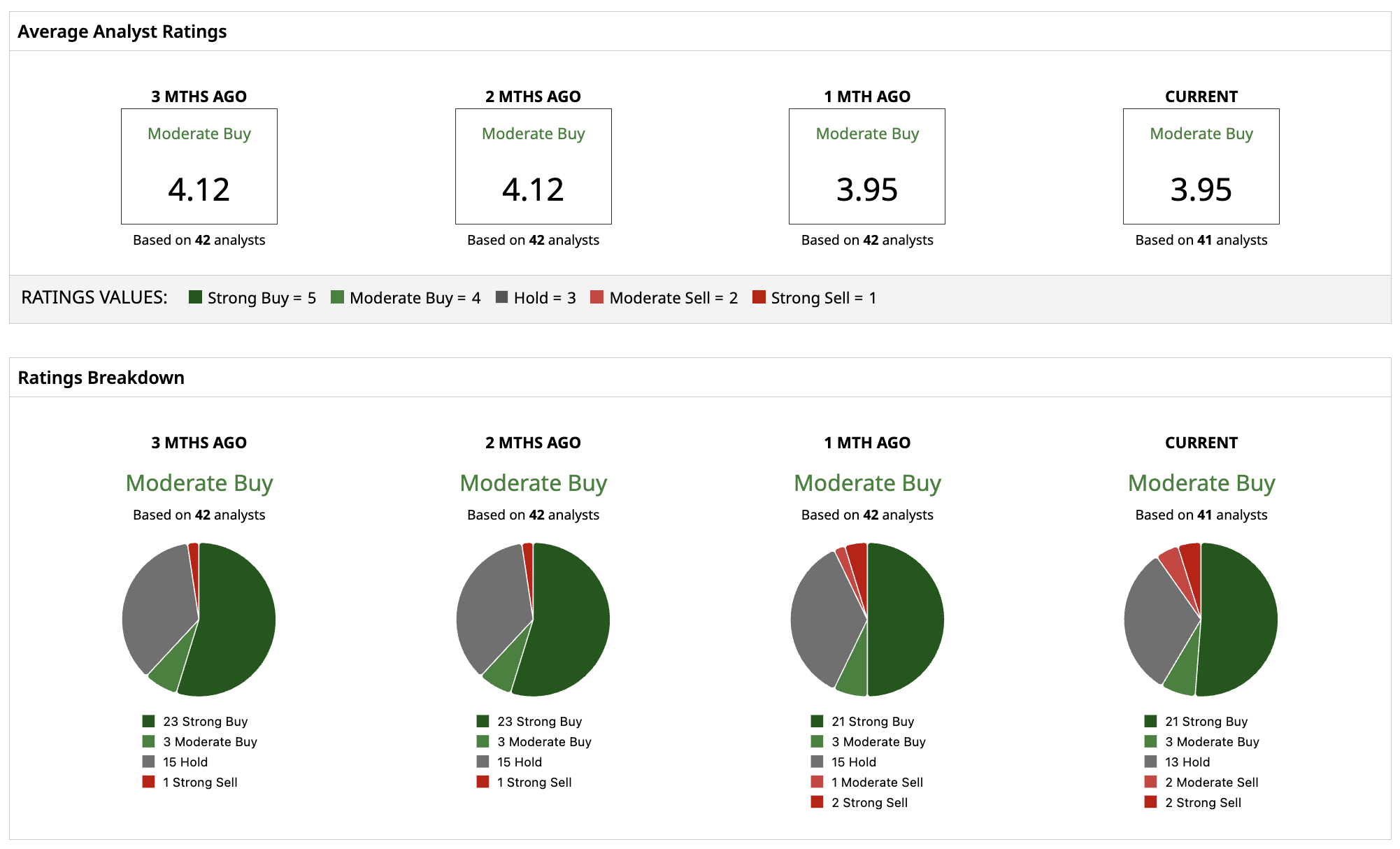
Based on 41 Wall Street analysts with coverage, Apple holds a consensus “Moderate Buy” rating overall. The mean price target of $330.07 indicates modest potential upside of 5% from current levels.
On the date of publication, Jabran Kundi did not have (either directly or indirectly) positions in any of the securities mentioned in this article. All information and data in this article is solely for informational purposes. For more information please view the Barchart Disclosure Policy here.