
Lockheed Martin (LMT) Stock May Be Undervalued On Fresh Missile Contract News
Lockheed Martin stock has pulled back in recent weeks even though a Discounted Cash Flow (DCF) intrinsic value estimate and market multiples both point to a meaningful valuation gap against the current share price. After a 5 year return of 73.7%, investors now face a stock that screens cheap on several fronts while headlines highlight fresh defense contracts and new partnerships.
- Over the past 5 years, Lockheed Martin has returned 73.7%. This puts the recent share price weakness into context for anyone trying to time an entry.
- Large Pentagon awards and new production agreements, such as the expanded missile programs and the Javelin co production plan in India, can support cash flow expectations. At the same time, reliance on government defense budgets and geopolitical risk may limit how far investors are willing to stretch the valuation.
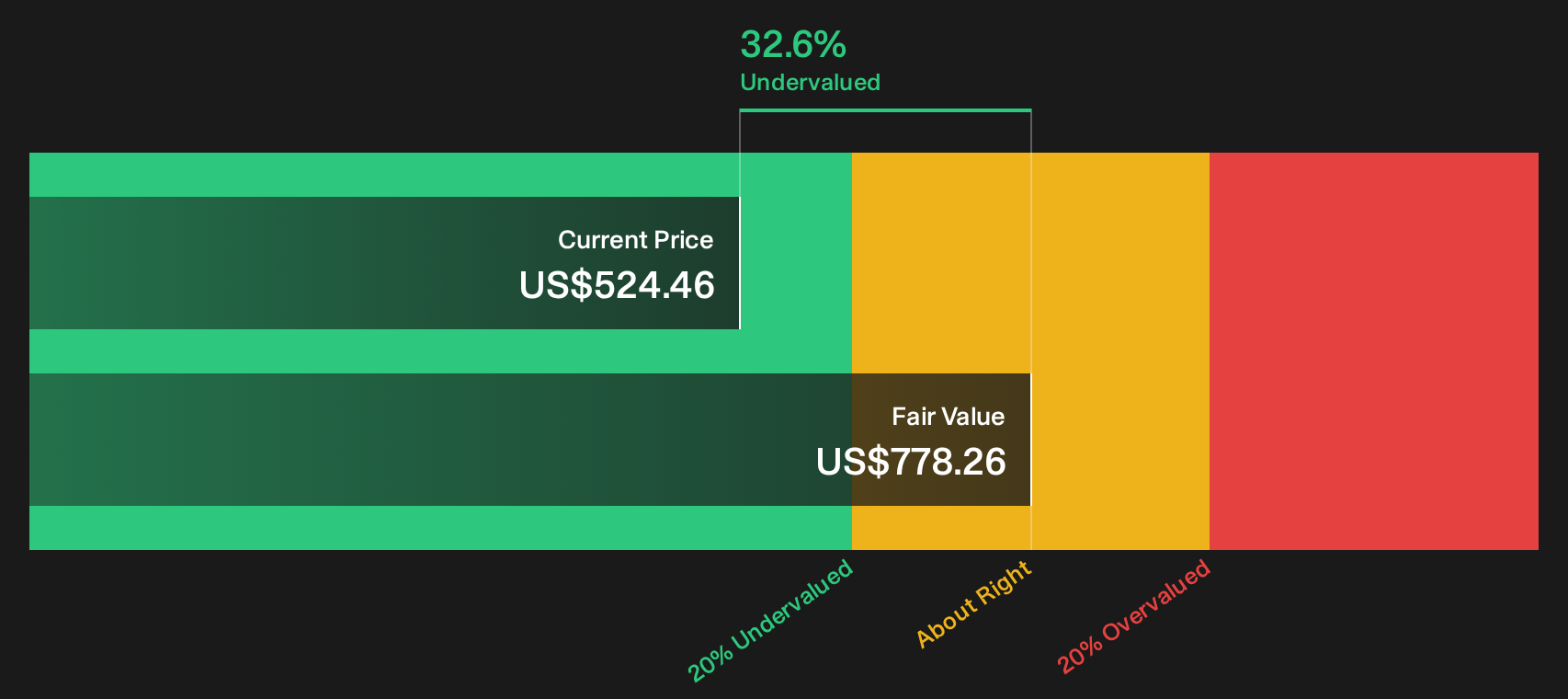
- On a broad set of checks, including a Discounted Cash Flow (DCF) intrinsic value estimate that sits about 32.6% above the market price and earnings based multiples that also screen cheap, Lockheed Martin looks undervalued. The value score of 6 reflects that the broader checks lean cheap rather than expensive.
The issue now is whether the current discount to intrinsic value will persist or close as the recent contract wins and partnerships feed through into Lockheed Martin’s long term cash flows.
Spot opportunities like Lockheed Martin's recent pullback by scanning 49 high quality undervalued stocks, which combines compressed valuations with solid fundamentals and potential catalysts.Does Lockheed Martin Look Undervalued on Cash Flow?
The Discounted Cash Flow (DCF) model here relies on projected cash flow rather than headline earnings to anchor value for Lockheed Martin. Latest twelve month free cash flow sits at about $8.6b, and the model assumes this cash generation grows rather than contracts over the next decade before fading to a steadier pace.
On these inputs, the DCF points to an estimated intrinsic value of about $778 per share, which is roughly 32.6% above the current market price. The recent $59b Patriot missile contract is one factor used to support the cash flow assumptions in the model, even if investors still apply a discount because of reliance on government budgets and geopolitical risk.
On this discounted cash flow view, Lockheed Martin stock currently screens as undervalued relative to the cash the business is expected to produce.
Our Discounted Cash Flow (DCF) analysis suggests Lockheed Martin is undervalued by 32.6%. Track this in your watchlist or portfolio, or discover 49 more high quality undervalued stocks.
Is Lockheed Martin a Bargain on Earnings?
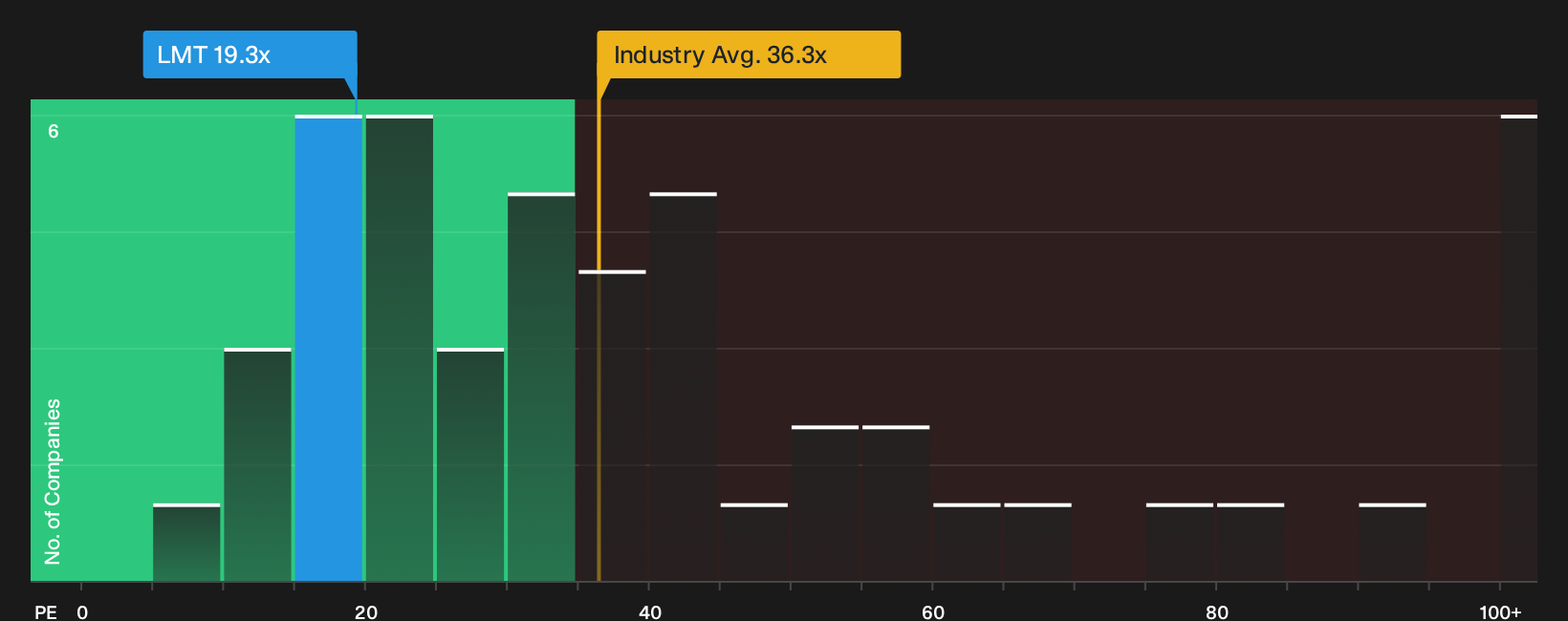
The P/E ratio is a useful yardstick for Lockheed Martin because earnings still sit at the center of how many investors value defense contractors. On this measure, the stock trades on about 19.3x earnings, which is well below the aerospace and defense industry average of roughly 36.3x and also below a peer group closer to 41.3x. That is a sizeable gap for a large, established contractor with long term programs and multi year contracts.
A tailored fair P/E multiple for Lockheed Martin sits near 28.6x. This reflects what investors might pay given its size, margins, sector and risk profile rather than simply matching the sector average. The current 19.3x level is therefore lower than this fair ratio, indicating that the shares may be pricing in a discount even after the recent news flow on contracts and partnerships.
On the P/E lens alone, Lockheed Martin stock appears undervalued relative to what its earnings profile might typically command.
See what the numbers say about this price — find out in our valuation breakdown.
The Lockheed Martin Narrative: What Would Justify Today's Price?
Simply Wall St Narratives for Lockheed Martin pick up where the valuation gap above leaves you. They spell out what future growth, profitability and earnings path would need to hold for the stock to be worth materially more or less than today’s price, and they sit on Simply Wall St’s Community page. Rather than leaning on a single multiple or model result, each narrative lays out its own fair value assumptions so you can compare them with the company’s reported numbers over time.
The community is split on Lockheed Martin, with one camp focusing on missile demand and backlog strength while the other leans into budget and margin risk.
Bull case: 17% undervalued
"Demand for advanced platforms such as the F-35, PAC-3, THAAD, and hypersonic weapons is being reinforced by actual combat use and rising geopolitical tensions..."
Read the full Bull Case to see why Lockheed Martin could be undervalued
Bear case: roughly fairly valued
"Persistent cost overruns and newly identified reach-forward losses on legacy and classified programs highlight ongoing supply chain pressures and potential future margin compression..."
Read the full Bear Case to see why Lockheed Martin could be overvalued
Do you think there's more to the story for Lockheed Martin? Head over to our Community to see what others are saying!
The Bottom Line
Lockheed Martin screens undervalued on both the Discounted Cash Flow (DCF) intrinsic value estimate and the earnings multiple view, which points to a consistent message rather than a quirky model outcome. The broader valuation checks lean supportive, so the key question is whether future cash generation and contract execution track close enough to those expectations for the discount to narrow. Everything now turns on whether defense budget decisions and program level margins justify a higher earnings multiple or whether the current gap simply reflects persistent concern about cost risk and dependence on government spending.
This article by Simply Wall St is general in nature. We provide commentary based on historical data and analyst forecasts only using an unbiased methodology and our articles are not intended to be financial advice. It does not constitute a recommendation to buy or sell any stock, and does not take account of your objectives, or your financial situation. We aim to bring you long-term focused analysis driven by fundamental data. Note that our analysis may not factor in the latest price-sensitive company announcements or qualitative material. Simply Wall St has no position in any stocks mentioned.
Have feedback on this article? Concerned about the content? Get in touch with us directly. Alternatively, email editorial-team@simplywallst.com