
IPO outlook | More than half of the market value evaporated during the year, and Xinlitai (002294.SZ) went public in Hong Kong to seek a new way out?
According to a recent disclosure from the Hong Kong Stock Exchange, Shenzhen Xinlitai Pharmaceutical Co., Ltd. (abbreviation: Xinlitai, 002294.SZ) has submitted a listing application to the main board of the Hong Kong Stock Exchange. The co-sponsors are Goldman Sachs, Citigroup and CITIC Securities. This is the second time the company has submitted a statement. If the listing in Hong Kong is successful this time, Xinlitai will form an A+H dual capital platform layout.
By the close of trading on September 9, the market value of the company's A shares was about RMB 35.1 billion, and the closing price was RMB 31.49, down more than half from the stock price high of 70.44 yuan in April this year.
From a fundamental perspective, the company's generic drug business is under pressure from collection and price reduction, but the innovative drug business has taken over and become the main revenue force, and it has a variety of innovative drug products that have been marketed and approved. At the same time, the company's sales expenses continue to rise, and the goodwill scale to 220 million yuan, which may become a potential risk point.
Promising results in both profit growth and transformation into innovative drugs
According to the prospectus, Xinlitai focuses on the treatment of cardiovascular and renal metabolic syndrome diseases. According to the 2025 Chinese cardiovascular pharmacy sales revenue, its market share is 11.3%, ranking second in the industry, and is in the first tier of the domestic cardiovascular drug circuit.
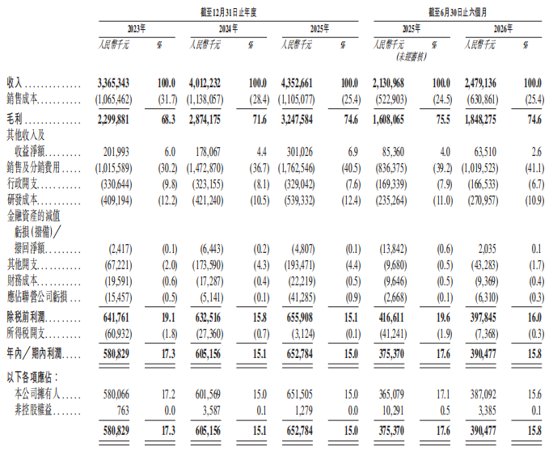
Judging from financial performance, Xinlitai's performance has been growing strongly in recent years. In 2023, 2024, 2025 and the first half of 2026, the company's revenue was 3.365 billion yuan, 4,012 billion yuan, 4.353 billion yuan and 2,479 billion yuan respectively. Profit for the corresponding period was 581 million yuan, 605 million yuan, 653 million yuan and 390 million yuan respectively. Revenue and profit increased steadily.
In the first half of 2026, the company achieved revenue of 2,479 billion yuan, a year-on-year increase of about 16.4%. The growth rate rebounded markedly from the full year of 2025; profit for the period reached 390 million yuan, compared to 345 million yuan in the same period last year, and the growth rate was also quite impressive.
At the level of profitability, the company's gross margin continued to rise. From 2023 to the first half of 2026, comprehensive gross margins were 68.3%, 71.6%, 74.6% and 74.6%, respectively, reflecting increased product added value and cost structure optimization.
It is worth noting that the company's revenue structure has been significantly optimized. From 2023 to 2025 and the first half of 2026, revenue from the innovative drug business reached 922 million yuan, 1,357 million yuan, 1,999 million yuan and 1,214 billion yuan respectively, accounting for 27.4%, 33.9%, 45.9% and 49.0% of the total revenue for the current period. By the first half of 2026, it was close to half of total revenue.
In the same period, revenue from the generic drug sector showed a clear contraction trend, falling from 1,641 million yuan in 2023 to 1,304 million yuan in 2025, and further falling to 633 million yuan in the first half of 2026, accounting for a decline of 48.8% to 25.5%. Take the company's starting variety “Taiga” (clopidogrel bisulfate tablets) as an example. This drug was once the first approved generic of clopidogrel in China. However, as volume procurement progressed, its terminal retail price dropped sharply from 14.5-22.26 yuan per box in 2023 to 6.99 yuan in the first half of 2026, and the sales revenue of this product dropped from 558 million yuan in 2023 to 464 million yuan in 2025. The prospectus admits that due to the increasingly transparent drug pricing mechanism and involving multi-party negotiation games, there is continuous downward pressure on product prices. As of the last practical date, the vast majority of the company's generic drug types have been included in the scope of collection.
On the cost side, sales expenses continue to rise, or reflect the market expansion pressure and channel construction costs faced by the company in the early stages of promoting innovative drugs. In 2024, sales and distribution expenses surged 45% year on year to 1,473 billion yuan, and further increased to 1,763 billion yuan in 2025. The corresponding sales expenses ratio reached 40.5%, and the cost growth rate significantly outperformed the revenue growth rate during the same period.
The Zhitong Finance App learned that the company's R&D costs in 2025 reached 539 million yuan, an increase of 28% over the previous year, accounting for 12.4% of total current revenue. The company has set up six R&D centers in China and the US. The technology platform covers cutting-edge fields such as small molecules, small nucleic acids (including siRNA and AOC), cyclic peptides, conventional biopharmaceuticals, complex biopharmaceuticals (such as antibodies, fusion proteins and ADCs), and novel medical devices.
It is important to be wary that by the end of June 2026, the company's goodwill reached 220 million yuan, mainly due to a series of mergers and acquisitions in recent years. If the future operating performance of the acquired assets falls short of expectations, the risk of impairment of goodwill may have a direct impact on current net profit.
The balance sheet shows a strong margin of safety. The company's cash flow from operating activities continues to be abundant. From 2023 to 2025, it recorded 839 million yuan, 1,186 million yuan, and 1,052 billion yuan respectively. The balance ratio has remained around 20% in the past four years, 20% at the end of 2025, and there is no large rigid debt repayment pressure.
Laying out the full cardiovascular and renal metabolism disease cycle, 6 new drugs have been launched
Cardio-renal metabolic syndrome has become a major global public health challenge. Cardiovascular disease, chronic kidney disease (CKD), and metabolic diseases share common pathogenesis pathways such as insulin resistance. Multiple diseases such as high blood pressure, diabetes, and heart failure have remarkable co-occurrence characteristics, making it difficult for traditional single disease treatment models to meet clinical needs.
According to the Zhitong Finance App, Xinlitai's innovative drug pipeline now has 6 marketed innovative drugs, 79 innovative drugs under development, and is equipped with 17 medical devices and 18 device candidate projects, aiming to cover the entire cardiovascular and renal metabolic disease cycle.
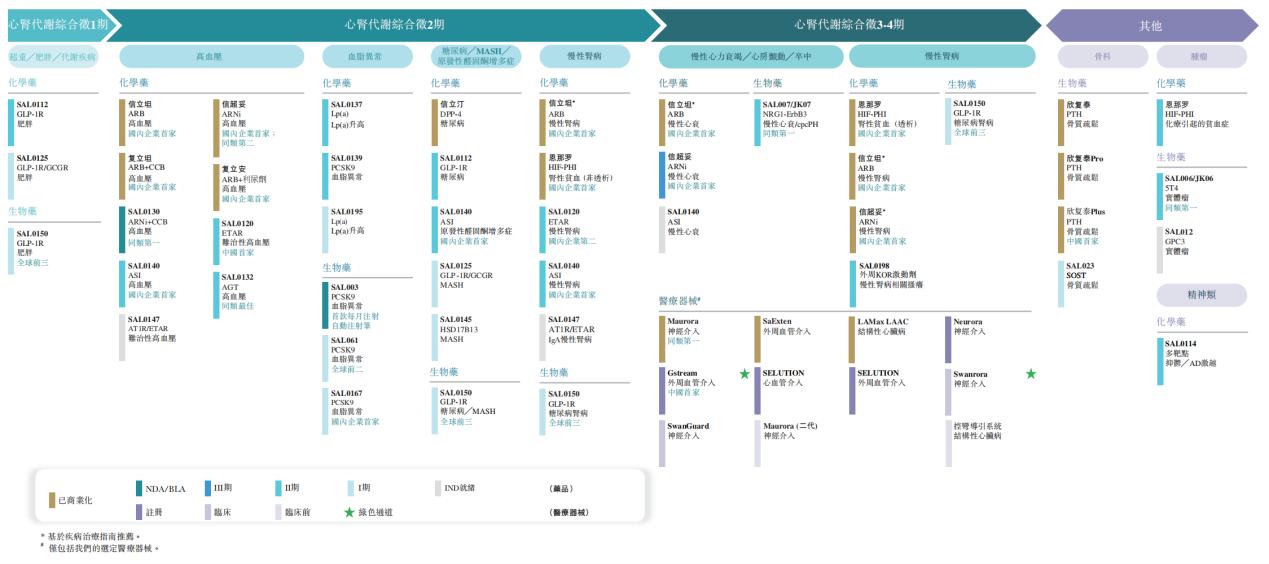
In the field of hypertension treatment, the company's two main products are Xinlitan and Xinchao. Xinlitan is an angiotensin II receptor blocker (ARB). It was approved by the State Drug Administration for mild to moderate primary hypertension in October 2013, and is the first domestically produced ARB in China. In 2025, its ARB in-hospital market share reached 29.1%, ranking first among all ARB drugs and third among all hypertension drugs in China, with annual sales revenue of 1,484 billion yuan, accounting for 38.7% of total drug revenue.
However, the invention patent for the Xinlitan compound expired in July 2026, and will face competition and pricing pressure for generic drugs in the future. To this end, the company has focused on innovative drugs in recent years, and 5 innovative drugs have been approved for marketing between 2023 and 2025.
Xinchaotur was approved in May 2025. It is the first angiotensin receptor enkephalin inhibitor (ARNi) in China and the second in the world. It has a dual complementary mechanism of action, taking into account both antihypertensive and cardiorenal protection.
In addition, Forlitan was approved in May 2024 as the first ARB and calcium channel blocker (CCB) fixed-dose compound formulation developed independently in China, suitable for high-risk patients requiring strict nighttime blood pressure control; Forilizan was approved in May 2025 as the world's first ARB and thiazine-like diuretic fixed-dose combination formulation to provide options for patients with refractory hypertension, salt-sensitive hypertension, elderly hypertension and high risk of stroke; sal0130 may be the world's first ARNi (Xinchao) and CCB (amidaclopine) Fixed-dose compound formulation with composition, suitable for light For patients with severe hypertension and poor control of monotherapy, the NDA for essential hypertension was accepted by the State Drug Administration in July 2026.
Focusing on the products already on the market, the company is also developing novel drugs such as SAL0132, SAL0120, and SAL0140 to expand treatment options for uncontrolled and intractable hypertension.
In the field of heart failure, in addition to XinChaotuzheng carrying out phase III clinical studies on heart failure (hFrEF) with reduced chronic ejection fraction, JK07 (SAL007) is an NRG1-ErbB3 antibody fusion protein. It is currently the only disease-repairing biopharmaceutical used for heart failure during active global clinical development, and is currently undergoing international multi-center phase II clinical trials.
In the field of dyslipidemia management, the company has the largest pipeline of NME dyslipidemia drug candidates in the world in the IND stage or later development stage. SAL003 is potentially the first PCSK9 monoclonal antibody to be injected subcutaneously in China. BLA has been reviewed by the National Drug Administration; SAL061 is the first PCSK9 targeted gene editing therapy to enter clinical trials in China, and is also one of only two similar clinical-stage treatments in the world. Phase I clinical trials have been initiated for heterozygous familial hypercholesterolemia; SAL0139 is one of the few clinical-stage oral small molecule PCSK9 inhibitors in the world.
In the field of chronic kidney disease (CKD) and renal anemia, Xinlitan, which has been marketed, has been recommended by many CKD prevention guidelines. The company is also exploring SAL0120 (selective ETAR antagonist) and SAL0140 (highly selective ASI) for CKD treatment. Among them, SAL0120 has entered phase II clinical trials, and is one of the first three ETAR antagonists in the world to advance to this stage.
Enalol was approved in June 2023 and is a next-generation HIF-PHI for the treatment of renal anemia. According to the Zhitong Finance App, the market penetrated rapidly after its launch, covering more than 1,800 hospitals across the country as of the last practical date. In 2025, it had an 8.4% share of the HIF-PHI market in China, ranking second in terms of in-hospital sales revenue.
The metabolic disease field focuses on type 2 diabetes, overweight, obesity, and steatohepatitis (MASH) associated with metabolic dysfunction, including cinriptine (DPP-4 inhibitor, approved in June 2024), SAL0150 (GLP-1RA taken orally once a week), and SAL0145 (targeted siRNA). The latter two are in phase I clinical trials.
Revenue from medical devices mainly comes from the Maurora rapamycin-eluting vertebral artery stent system. It was the first drug-eluting stent to use rapamycin to treat cerebrovascular stenosis. It was approved as a Class III medical device by the State Drug Administration in July 2020, with sales revenue of 196 million yuan in the first half of 2026.
Overall, in the context of the traditional generic drug business facing collection pressure, Xinlitai's transformation to innovative drugs has achieved remarkable results in recent years. It has formed a fairly broad product matrix in the field of cardio-renal metabolic syndrome. Revenue from innovative drugs has become “half of the country” that cannot be ignored, and many innovative drugs have global pioneering potential.
However, innovative drug research and development investment is large, the cycle is long, and the risk is high, and many products in the company's innovative drug pipeline are still in phase II clinical trials, and specific efficacy data have yet to be disclosed. In May of this year, the company disclosed phase II clinical data for JK07, an innovative drug for heart failure. The test's core evaluation index, the LVEF left ventricular ejection fraction, only showed an improvement trend. It did not reach the statistically significant level required for marketing, and only a slight improvement in the final quality of life score. Although the company said it will continue to advance the trial until the complete clinical endpoint is revealed in 52 weeks, and it is still impossible to conclude that research and development has completely failed at this stage, the news has caused the company's stock price to continue to fall to a standstill.
Judging from this, the subsequent commercial value of Xinlitai's innovative drug pipeline is still uncertain, and future phase III clinical and commercialization will require significant capital investment. Investors still need to take a cautious attitude towards the company's subsequent performance and valuation trends.