
The ECB's interest rate hike tonight is almost a foregone conclusion. The market focuses on future policy paths and Lagarde's stay
The Zhitong Finance App learned that the ECB will announce its interest rate decision at 20:15 Beijing time on Thursday. The market generally expects the bank to raise interest rates by 25 basis points and raise the deposit mechanism interest rate from 2.25% to 2.50%. This will be the second time that the ECB has raised interest rates since the war in Iran boosted energy prices. The current inflation rate is far above the target level, and economic performance in the Eurozone is surprisingly steady.
According to the survey, all analysts, with the exception of one, believe that the ECB will raise deposit interest rates by 25 basis points to 2.5% on Thursday. The new quarterly forecast will reinforce the reason for interest rate hikes: while economic growth in the Eurozone accelerates, inflationary pressure will also increase.
Policymakers are struggling to cope with the 3% increase in consumer prices last month, which is close to the highest level in three years, and is unlikely to fall sharply in the next few months. Unlike the Federal Reserve and the Bank of England, etc., the ECB raised interest rates in June, and another rate hike this week is almost a foregone conclusion.
The focus turned to the future path of rate hikes. Markets expect two or more rate hikes, while economists are skeptical. ECB officials are also divided: some believe that further interest rate hikes may be needed after this month, while others urge caution because a second round of inflation has not yet occurred, and trade risks between the Middle East and the US still exist.
“The ECB will obviously raise interest rates this week,” said Jari Stern, chief European economist at Goldman Sachs. “However, there is great uncertainty about the outlook, and there are some signs of disagreement in the management committee, which means that the interest rate outlook is uncertain.”
The interest rate decision is scheduled to be released at 2:45 p.m. Berlin time. ECB President Christine Lagarde will hold a press conference in 30 minutes.
2.5% may hit the “neutral interest rate cap”, and differences within the G7's hawkest central bank have surfaced
ECB officials have widely predicted interest rate hikes in September, which will reinforce the ECB's position as the most hawkish central bank in the G7.
Follow-up actions, however, were divided. Bank of Lithuania Governor Gediminas Simkus said that raising interest rates to 2.5% is not enough to bring inflation back to 2%. Reasons include stronger economic growth. ECB Executive Committee member Piero Cipollone warned that the ECB should not tighten monetary policy excessively so as not to damage the economy.
This is partly because 2.5% is widely regarded as the upper limit of the neutral range. Above this level, economic activity will be suppressed. Not everyone shares this view, though. Ireland's Gabrielle Macloof believes that economic activity is limited only when interest rates exceed 2.75%. Bundesbank President Joachim Nagel said that officials must also consider the recent rise in global bond yields, which “complicates the situation”, although tightening financial conditions will help the ECB curb inflation.
Economists David Powell and Simone Delle Kiai said, “At a time when the oil market is once again volatile and gas prices are soaring, hawks will undoubtedly push for another rate hike in December. However, the tightening of financial conditions and limited signs of indirect effects of energy shocks have created major obstacles for them.”
Economic outlook: Next year's inflation forecast is expected to be revised, and 2028 will become a “verifier” of interest rate hikes
The new economic outlook is critical to discussions at the ECB meeting on Thursday and the future path of interest rates. The market expects the ECB to once again release a different forecast scenario, as in March and June.
Under the baseline scenario, analysts expect next year's inflation forecast to rise from 2.3% in June, the 2026 inflation forecast will remain unchanged at 3%, and economic expansion is expected to be stronger.
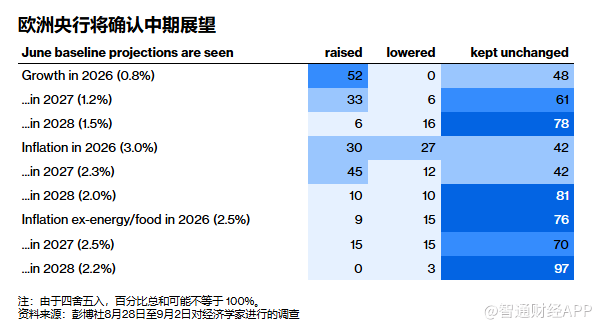
“Unless the 2028 forecast falls short of the target, particularly in terms of core inflation and inflation excluding energy, this will confirm expectations of slightly more than three rate hikes,” J.P. Morgan economist Greg Fuzey said in a report.
However, the ECB official's predictions may be a bit out of date. Since the deadline is August, this outlook probably won't reflect recent spikes in bond yields or higher energy prices.
Lagarde's future: speculation about leaving office early heats up
Speculations about Lagarde leaving the ECB early are heating up. Her remarks after the July interest rate meeting indicated that she would not wait until the end of her term in October 2027.
The media reported last month that the World Economic Forum, famous for its annual conference in Davos, is still inviting her to take over, and Lagarde seems ready to accept the position.
Lagarde also recently refused to rule out the possibility of participating in French politics, saying, “No matter what role I play, I only need to be able to play my best role.” Shortly after her trip to Berlin, she will attend the annual political gathering organized by Normandy Regional President and Centrist Party leader Hervé Moran as a guest.
If ECB Executive Board member Isabelle Schnabel leaves office early, the pressure Lagarde is likely to increase. At that time, she will need to clarify her future direction. Schnabel's term ends in December 2027, but according to some sources, she may be transferred to the International Monetary Fund.