
Roblox (RBLX) Stock May Look Reasonable On Cash Flow Yet Rich On Sales
Roblox stock has fallen 66.5% over the past year, yet the Discounted Cash Flow (DCF) intrinsic value estimate points to meaningful upside, while market multiples still flag the shares as expensive.
- The share price is down 66.5% over 12 months, which puts recent gains into context as a rebound inside a longer slide.
- Growth in Roblox's creator economy, highlighted by a reported US$752 million GDP impact in the U.S. for 2025, can support optimism on future cash flows. At the same time, tighter regulatory scrutiny in Europe under the Digital Services Act may weigh on investor perceptions of risk and required returns.
- On a broad set of valuation checks, Roblox screens as on the pricey side rather than a clear bargain, with only 2 of 6 tests pointing to value.
The issue now is whether the discounted intrinsic value view or the richer-looking trading multiples give the better guide to where Roblox should trade from here.
Compare Roblox’s mixed valuation signals with other potential rebound stories by scanning 31 high quality undervalued stocks, which our process has filtered for quality and pricing support.
Is Roblox a Bargain on Cash Flow?
The Discounted Cash Flow (DCF) model here evaluates Roblox based on the cash it can return to shareholders over time. On this view, the business is already generating meaningful cash, with latest twelve month free cash flow of about $1.75b, and the model assumes that cash generation continues to grow rather than shrink from here.
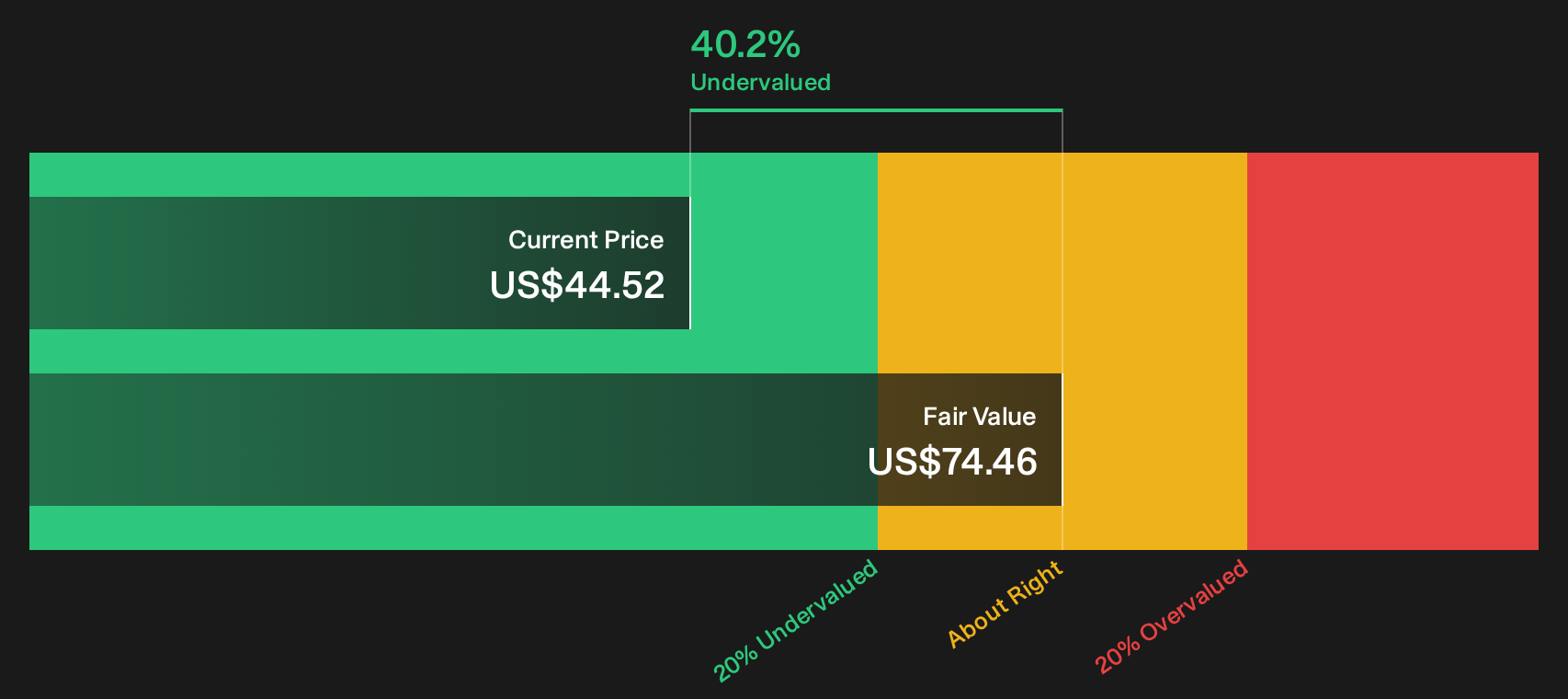
Feeding those projections into a 2 Stage Free Cash Flow to Equity framework produces an estimated intrinsic value of about $74 per share. That figure sits roughly 40.2% above where the market currently prices Roblox, which implies the stock screens as undervalued on this method. The recent designation as a Very Large Online Platform under the EU Digital Services Act helps explain why some investors may still demand a higher risk premium despite the cash flow support.
On the DCF numbers alone, Roblox stock currently looks undervalued relative to the cash the business is projected to generate.
Our Discounted Cash Flow (DCF) analysis suggests Roblox is undervalued by 40.2%. Track this in your watchlist or portfolio, or discover 31 more high quality undervalued stocks.
Is Roblox Getting Expensive on Sales?
P/S is a useful lens for Roblox because investors often frame the business around platform scale and spending rather than current accounting profits.
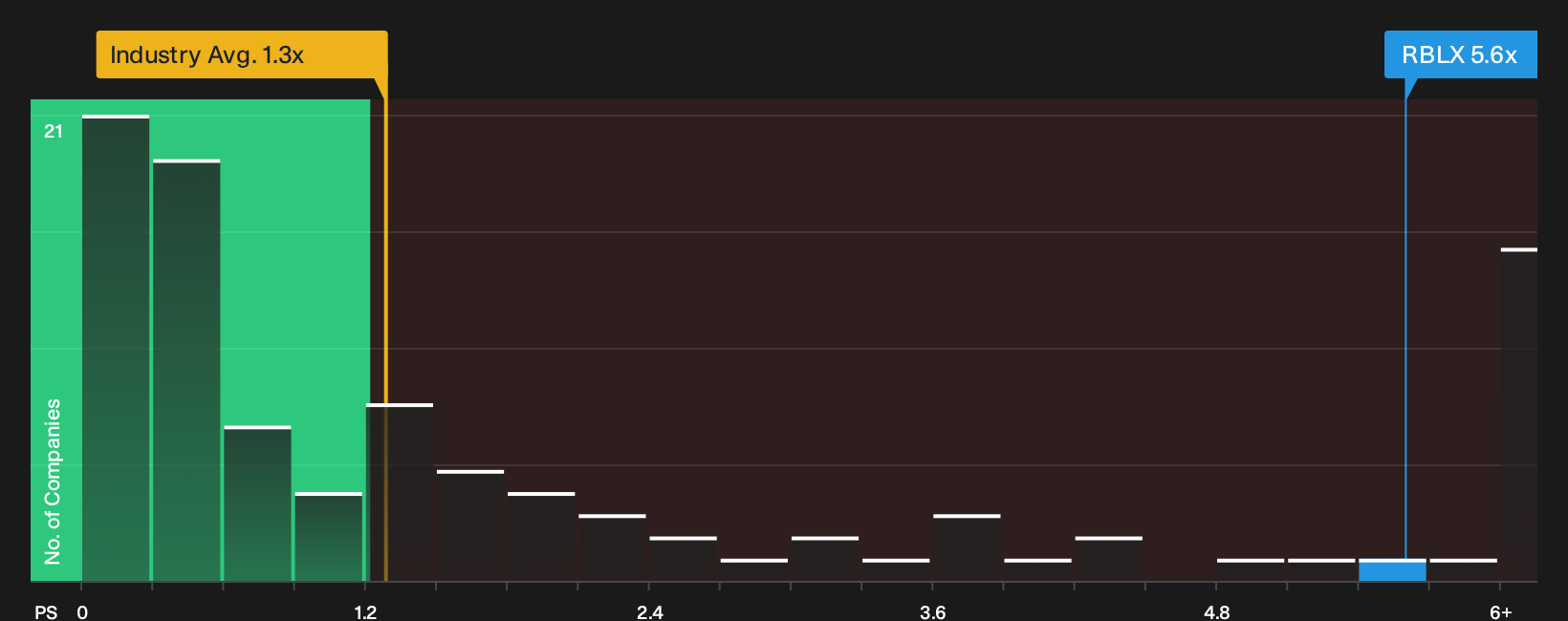
On this metric, Roblox trades on a P/S of about 5.6x. That compares with an Entertainment industry average near 1.3x and a peer group closer to 3.7x, so the stock changes hands at a clear premium to both the broader sector and closer comparables.
The Fair P/S Ratio from the model sits around 2.9x. This reflects what investors might typically pay given Roblox’s profile, risk and sector. The gap between that fair level and the current 5.6x suggests buyers are paying a steep mark up that is more focused on the platform’s potential than on its current sales base.
On the P/S multiple, Roblox appears expensive relative to both its sector and the model’s tailored fair ratio.
See what the numbers say about this price — find out in our valuation breakdown.
The Roblox Narrative: What Would Justify Today's Price?
Roblox’s valuation story splits into two threads, and Simply Wall St Narratives sit where those threads meet. Narratives lay out the specific paths for growth, margins and earnings that would need to play out for Roblox’s market value to land meaningfully above or below today’s share price. Instead of giving a single ratio or model output, they spell out the future that number rests on so you can watch how the real business matches up over time on the Community page.
Roblox inspires sharply different storylines, with one camp focused on long haul platform upside and the other zeroing in on regulatory and cost pressure.
Bull case: 8% undervalued
"International expansion and localization initiatives, especially enhancements in auto-translation and server infrastructure, are driving rapid user growth in APAC and other regions. This broadens the addressable market and increases global revenue potential…"
Read the full Bull Case to see why Roblox could be undervalued
Bear case: 48% overvalued
"As digital privacy regulations continue to tighten across key global markets, Roblox faces increasing limitations on data collection and targeted advertising. This threatens the future effectiveness of its advertising initiatives and its long-term monetization potential…"
Read the full Bear Case to see why Roblox could be overvalued
Do you think there's more to the story for Roblox? Head over to our Community to see what others are saying!
The Bottom Line
Roblox looks cheap on a Discounted Cash Flow (DCF) view, yet its richer P/S multiple and low overall value score point to a market that is already paying up for the platform story. The disconnect comes from DCF leaning on future cash generation, while trading multiples are anchored to today’s revenue base and sector mood. That split will only close if the business can turn its creator ecosystem and user scale into cash flows that convincingly support both the intrinsic value estimate and the premium sales multiple. The key issue from here is whether monetisation and regulation land closer to the bullish or the cautious narrative.
This article by Simply Wall St is general in nature. We provide commentary based on historical data and analyst forecasts only using an unbiased methodology and our articles are not intended to be financial advice. It does not constitute a recommendation to buy or sell any stock, and does not take account of your objectives, or your financial situation. We aim to bring you long-term focused analysis driven by fundamental data. Note that our analysis may not factor in the latest price-sensitive company announcements or qualitative material. Simply Wall St has no position in any stocks mentioned.
Have feedback on this article? Concerned about the content? Get in touch with us directly. Alternatively, email editorial-team@simplywallst.com