
The basis for the Federal Reserve's interest rate hike has been strengthened again! The US PPI recorded the biggest increase in three months in August, and energy became the main driver. Tomorrow's CPI may be determined
The Zhitong Finance App learned that due to the rebound in energy product prices, the US Producer Price Index (PPI) further accelerated in August, continuing a series of high readings since the US and Iran resumed hostilities. This may further strengthen the basis for the Federal Reserve to raise interest rates at next week's meeting.
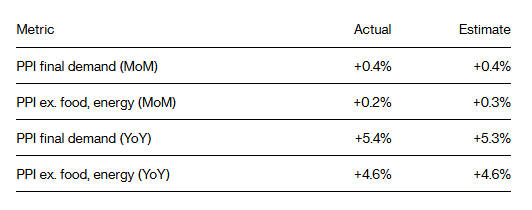
According to data released by the US Bureau of Labor Statistics on Thursday, PPI rose 0.4% month-on-month in August, the biggest increase since May. In line with economists' expectations, the July increase was revised to 0.1%; the year-on-year increase was 5.4%, up from 4.8% in July. Core PPI excluding food and energy rose 0.2% month-on-month, lower than market expectations of 0.3%, and 4.6% year-on-year.
In terms of items, energy prices became the main driver of the PPI increase in August. Energy prices rose 4.2% month-on-month, and previously fell for two consecutive months, but renewed hostilities between the US and Iran boosted oil prices, which led to a rebound in energy costs. Wholesale food prices rose slightly by 0.1% month-on-month, and fell 0.9% in July.
Overall commodity prices rose 1.1%, with commodity prices rising 0.4% month-on-month after excluding highly volatile food and energy components. Service prices rose only 0.1% month-on-month, but some components showed strong increases. Additionally, a less volatile PPI indicator that excludes food, energy, and trade services rose 0.3%.
Data center construction is one of the sources of price pressure this year. The cost of electronic components and accessories increased by 3.4%, and the price of computers and computer equipment increased by 0.2%. The broader construction cost index did not change much.
The report also showed that the air ticket price index rose 0.7% last month, while the health care category showed mixed performance. These segments receive particular attention from the Federal Reserve because they will be included in the Federal Reserve's preferred inflation indicator, the Personal Consumer Expense Price Index (PCE).
Details of profit margins on wholesale and retail trade services in PPI reports have also been closely watched to find clues about whether companies are absorbing tariff-related costs or passing them on to customers. Profit margins fell 0.2% in August.
Although many tariffs were ruled invalid by the Supreme Court earlier this year, the Trump administration is still using other laws to authorize tariffs on imported goods. Trade truce negotiations between the US and Canada broke down in August, causing the Trump administration to fulfill its threat of imposing 50% tariffs on billions of dollars of Canadian goods. Canada retaliated against hundreds of US products with tariffs of 15% to 50%.
PCE calculation method adjustment, core PCE may be downgraded
The Federal Reserve uses the PCE price index as a measure of the 2% inflation target. Part of the PPI will be included in the calculation of the PCE inflation index. However, starting in August, the US government will adjust the price calculation methods for categories such as portfolio management and investment advisory services, legal services, and computer software and accessories, which will change the impact of PPI on PCE inflation.
Specifically, portfolio management components that have caused significant fluctuations in the core PCE price index will be replaced with estimates to fill in. “At the same time, new PPI-based estimates for family law services and computer software will be added,” said Lou Crandall, chief economist at Wrightson iCAP. As a result, our confidence in the conversion of August PPI data to PCEPI contributions will be lower than usual.”
Economists at Morgan Stanley believe that this method adjustment may cause the PCE inflation data for the first four months of this year to be revised downgraded, but it will not substantially change the data from May to August.
In their report, they estimate that the 12-month and 6-month annualized core PCE inflation rates up to July may be revised down from the current 3.3% and 3.5% to about 3.1% and 3.2%, respectively. Since the monthly data for May to July is not expected to be significantly revised, the three-month annualized growth rate up to July should generally remain around 3.0% to 3.1%.
Some Federal Reserve officials are watching the three-month change in PCE inflation. The US Bureau of Economic Analysis (BEA) will release updated PCE inflation data and annual revised gross domestic product (GDP) data on September 30.
Interest rate hike bets are heating up, and the market focuses on the CPI and the Federal Reserve meeting
As inflation remains above target and the labor market regains its foothold in August, some economists believe the Federal Reserve should raise interest rates next week to emphasize its independence. They said that market uncertainty about the direction of the Federal Reserve's policy has boosted long-term treasury bond yields.
Scott Anderson, chief economist at BMO Capital Markets, said, “(Federal Reserve Chairman) Walsh's hawkish speech at the Jackson Hole meeting left him with little room for maneuver at the upcoming meeting. If he wants to maintain his anti-inflationary credit in the bond market, and all the data, especially the inflation data, points in the same direction — raising interest rates, he will be forced to act.”
Prior to the release of the PPI report, according to CME's FedWatch tool, the financial market expected the probability that the Federal Reserve would raise interest rates by 25 basis points at the September 15-16 meeting to be about 62%. The Federal Reserve's benchmark overnight interest rate is currently in the 3.50% to 3.75% range.
Affected by PPI data, US stock index futures declined, treasury bond yields rose, and investors increased their bets on the Federal Reserve's interest rate hike at the same time.
The day after the PPI report is released, the latest consumer price index (CPI) will be released. The market generally expects core inflation to remain relatively moderate, although rising gasoline prices may drive up overall indicators. Some Federal Reserve officials have hinted that interest rate decisions at the September 15-16 meeting may depend on what this week's report reveals.
Federal Reserve Chairman Walsh said in a speech last month that the Federal Reserve “still has work to do” if policymakers are unsure of a substantial improvement in potential inflation trends. As hostilities between the US and Iran continue, another rise in oil prices may further complicate the outlook.
Another government report released on Thursday showed that the number of initial jobless claims did not change much, at 206,000. This indicates that the scale of layoffs is still low and continues to support the labor market.
Since mid-July, the number of initial jobless claims has been hovering in a narrow range of 189,000 to 212,000, which is in line with the trend that the labor market is regaining its footing after experiencing brief twists and turns in late spring and most of summer. According to data released by the US government last week, the number of non-farm payrolls increased by 162,000 in August, the biggest increase in five months, and 21,000 in July. The unemployment rate remained flat at 4.1%.
Despite the acceleration in employment growth, long-term unemployment is still prominent, and the median length of unemployment in August was close to a four-and-a-half-year high. According to the data, in the week ending August 29, the number of renewed jobless claims (an alternative measure of recruitment) dropped by 1,000 to 1.774 million seasonally adjusted.