
Honda (TSE:7267) Stock Looks Undervalued As Its 75% Five Year Gain Holds
Honda Motor stock has delivered a strong 5 year gain, yet current valuation checks suggest the market price still sits below what its cash flows and earnings multiples imply. Both the intrinsic value estimate based on Discounted Cash Flow and the market based ratios point in the same direction, which is unusual for a large, widely followed automaker.
- Over the past 5 years, Honda Motor has returned about 75.4%, which means long term holders have already seen substantial value created even before considering any valuation gap today.
- The new software partnership with Nissan on standardized control units may support long run cash generation, while execution risk around large scale software projects can weigh on how much of that cash ultimately reaches shareholders.
- On Simply Wall St’s broader checks, Honda Motor scores a high value rating of 5 out of 6, which leans clearly cheap and lines up with a Discounted Cash Flow intrinsic value that sits about 28.2% above the recent share price.
The issue now is whether Honda Motor’s current market price already reflects the benefits of its software push and past share price gains, or if the discount to intrinsic value still offers enough appeal for patient investors.
Scan beyond Honda Motor and explore other potential deep value ideas with solid cash flows using our curated list of 17 high quality undervalued stocks.
Does Honda Motor Look Undervalued on Cash Flow?
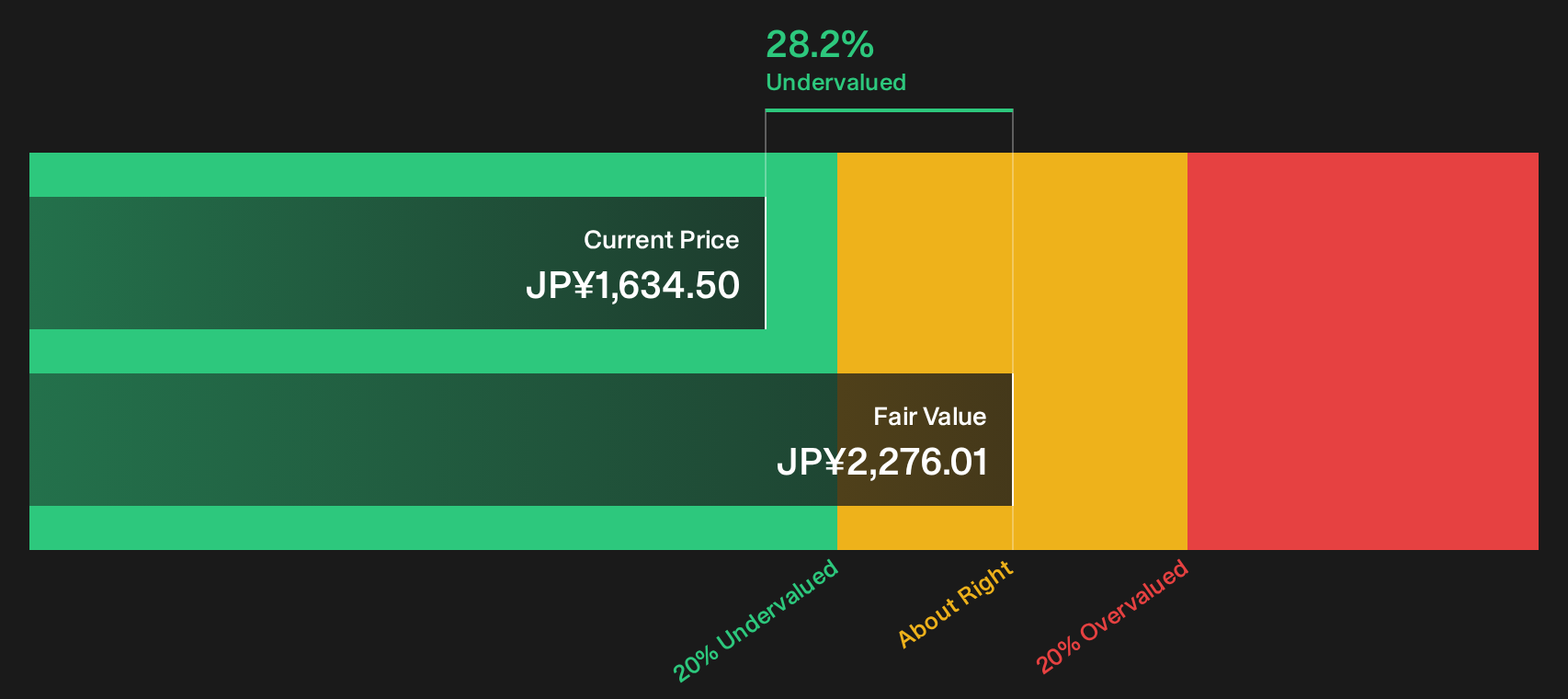
The Discounted Cash Flow (DCF) model here projects what Honda Motor’s future free cash generation could be worth in today’s money. On the latest figures, the business produced trailing twelve month free cash flow of about ¥349.7b, and the model assumes these cash flows broadly recover and grow over time rather than shrink. On that basis, the DCF points to an estimated intrinsic value of roughly ¥2,276 per share.
That DCF estimate sits about 28.2% above the current market price, which suggests the stock trades at a clear markdown to the cash flows implied by the model. The planned 2029 software partnership with Nissan helps explain why projected cash flows build over the long term, because shared development can keep investment heavy while still supporting equity value. On this cash flow view, Honda Motor appears undervalued relative to its estimated intrinsic worth.
Our Discounted Cash Flow (DCF) analysis suggests Honda Motor is undervalued by 28.2%. Track this in your watchlist or portfolio, or discover 17 more high quality undervalued stocks.
Does Honda Motor Look Undervalued on Sales?
P/S suits Honda Motor because investors often compare large automakers on how much they pay for each unit of revenue rather than earnings that can swing with model cycles and investments.
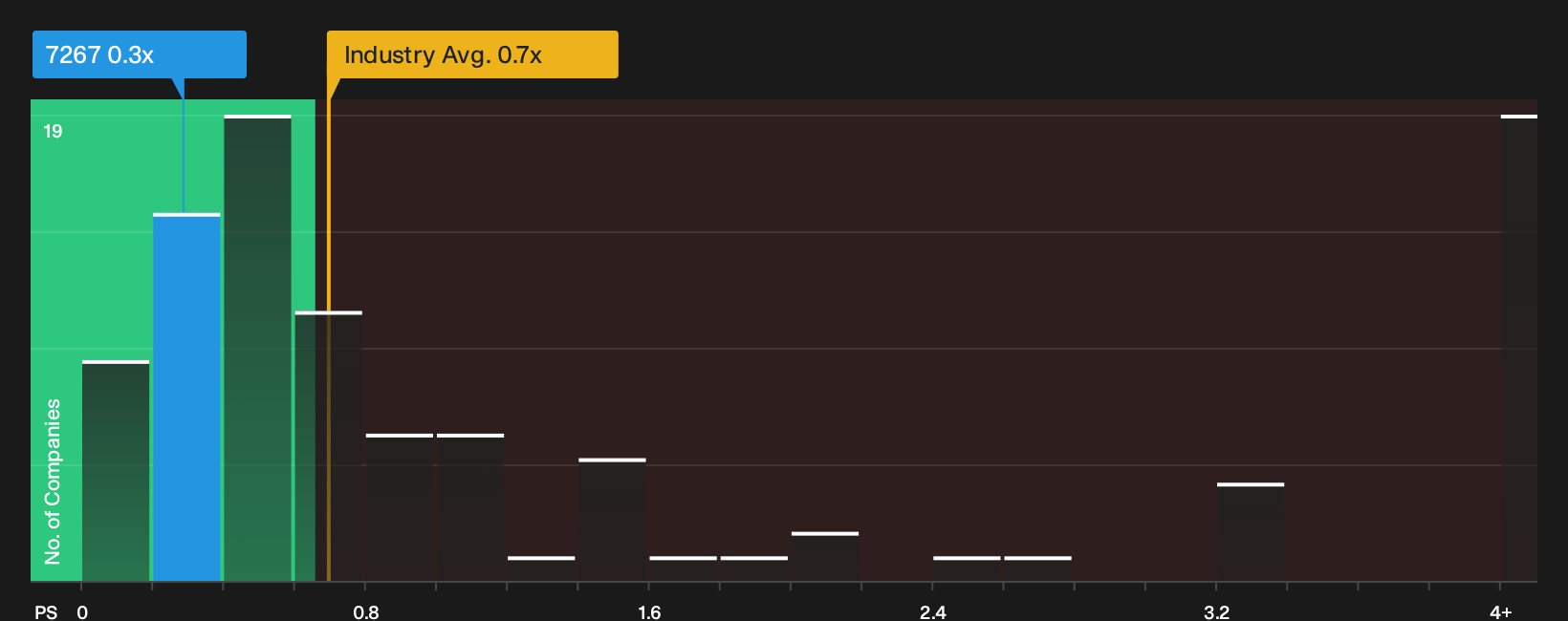
On this lens, Honda Motor trades at about 0.3x P/S. The wider auto industry averages roughly 0.6x, while a peer set comes in near 0.5x. The fair ratio estimate that blends those comparables with Honda Motor’s size, margins and risk profile is about 0.8x, which is above where the shares currently change hands.
That gap indicates the stock price reflects a sizeable discount relative to what this framework would suggest for a business of Honda Motor’s scale and revenue mix.
On the P/S multiple, Honda Motor appears undervalued relative to both sector norms and its own fair ratio benchmark.
See what the numbers say about this price — find out in our valuation breakdown.
The Honda Motor Narrative: What Would Justify Today's Price?
Honda Motor’s Simply Wall St Narratives pick up where this valuation puzzle leaves off. They spell out what path for revenue, profitability and earnings would need to play out for the stock to be worth materially more or less than today’s price, and they sit on the Community page. Rather than a single multiple or model line, each one lays out its own fair value assumptions so you can later compare those inputs with actual results.
Community views on Honda Motor pull in very different directions, from balanced opportunity to concerns about future pressure on the multiple.
Bull case: roughly fairly valued
"Persistent investment in mobility services and partnerships in advanced technologies is setting the stage for Honda to access new high-margin revenue streams beyond traditional car sales..."
Read the full Bull Case to see why Honda Motor could be undervalued
Bear case: 17% overvalued
"Honda's delayed and cautious investment in battery electric vehicles, highlighted by the indefinite postponement of its large-scale EV and battery plant in Canada, risks leaving the company structurally behind as global electrification accelerates..."
Read the full Bear Case to see why Honda Motor could be overvalued
Do you think there's more to the story for Honda Motor? Head over to our Community to see what others are saying!
The Bottom Line
Honda Motor screens as undervalued on both the Discounted Cash Flow (DCF) intrinsic value estimate and the sales based multiples, which is rare alignment for a large automaker. That combination points to a clear pricing gap that only closes if either cash generation underdelivers or the market keeps applying a low P/S to the business. The single question that separates bulls and bears is whether Honda Motor can execute on its software and technology ambitions without eroding returns on the heavy investment those projects demand.
This article by Simply Wall St is general in nature. We provide commentary based on historical data and analyst forecasts only using an unbiased methodology and our articles are not intended to be financial advice. It does not constitute a recommendation to buy or sell any stock, and does not take account of your objectives, or your financial situation. We aim to bring you long-term focused analysis driven by fundamental data. Note that our analysis may not factor in the latest price-sensitive company announcements or qualitative material. Simply Wall St has no position in any stocks mentioned.
Have feedback on this article? Concerned about the content? Get in touch with us directly. Alternatively, email editorial-team@simplywallst.com