
Learn Why The Bull Case For Akamai Stock Could Change Following MuleSoft API Security Tie Up
- Akamai Technologies expanded its collaboration with MuleSoft, creating a two-way synchronization between MuleSoft Exchange and Akamai API Security to govern APIs, MCP servers, agents, and AI interactions, while ITV plc used Akamai TrafficPeak on Akamai Cloud to gain subsecond observability during the World Cup.
- The MuleSoft integration and ITV’s World Cup deployment both underline how Akamai Technologies is embedding its security and observability tools directly into customers’ operational stacks, which can influence demand for its higher value cloud, security, and data services.
- We will now look at how Akamai Technologies' deeper MuleSoft security integration could reshape the broader investment narrative for the business.
Scan how Akamai Technologies fits into the broader push for secure AI and API infrastructure by lining it up against 89 AI infrastructure stocks.
Akamai Technologies Investment Narrative Recap
A shareholder in Akamai Technologies needs to believe the shift from traditional CDN into security, compute, and AI oriented services can outweigh pressure in the delivery segment and higher investment needs. The recent MuleSoft and ITV updates both sit within that thesis. They speak to Akamai’s ability to plug deeper into customer workflows rather than just deliver bits.
Over the next year or so, the key swing factor is likely execution on higher value security and cloud deals while managing capex and margin pressure. These announcements provide a modest incremental data point for that potential catalyst. The biggest risk still appears operational, with heavy spend and customer concentration creating exposure if ramp timelines or usage patterns disappoint.
The expanded MuleSoft collaboration is the clearest operational signal in this batch of news. Akamai is wiring its API security intelligence directly into MuleSoft’s control plane, with more than 20 customers already using the integration. That is notable because it ties Akamai into day to day governance workflows across APIs, MCP servers, agents, and AI interactions.
For you as an investor, this highlights two considerations. First, the security and AI infrastructure narrative depends on Akamai securing deeper, more embedded roles inside large enterprises. Second, it raises the question of whether the business can scale these partnerships without eroding margins or over relying on a small set of large clients. Execution on this MuleSoft integration will be an important proof point.
Akamai Technologies' current analyst narrative points to US$6.0b in revenue and US$659.8m in earnings by 2029. This implies 11.6% yearly revenue growth and an earnings increase of about US$248.8m from US$411.0m today.
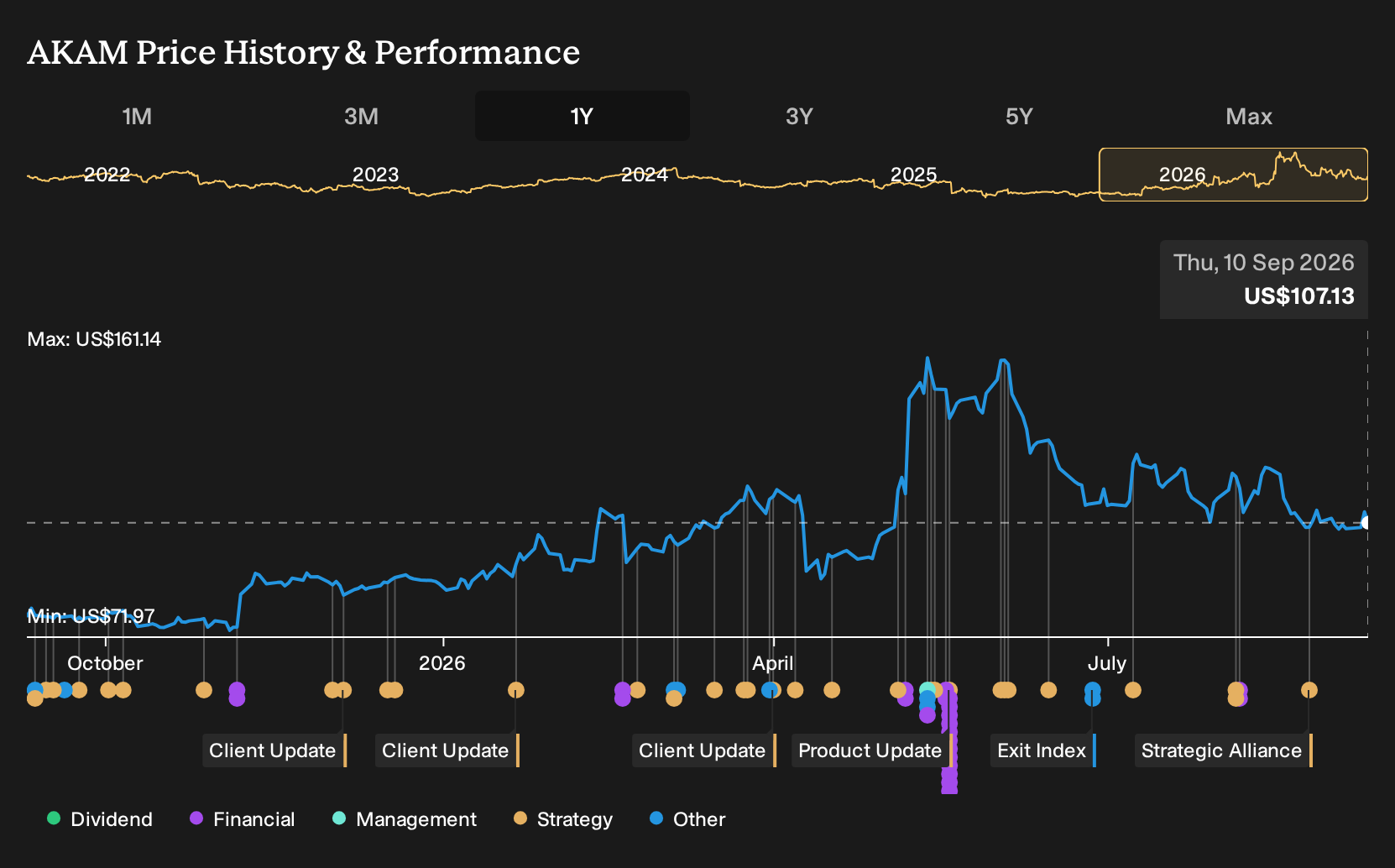
Uncover why Akamai Technologies' fair value indicates a 43% potential upside to its current price, before that gap starts to close.
Exploring Other Perspectives
One alternate view argues that the real risk for Akamai Technologies is hyperscale cloud competition capping demand for these kinds of MuleSoft style integrations. The most pessimistic analysts were modeling only 9.4% annual revenue growth and about US$408.7m in 2029 earnings, versus US$411.0m today, before this news. That gap in expectations shows how widely opinions differ and why it can be useful for you to explore several pre news scenarios and decide which feels closer to your own read of Akamai’s new security and observability push.
Explore 3 other Akamai Technologies fair value estimates, including one that suggests as much as 72% downside from the current price.
Decide For Yourself
Don't just follow the ticker. Instead, dig into the data and build a conviction that's truly your own.
- A great starting point for your Akamai Technologies research is our analysis highlighting 1 key reward and 1 important warning sign that could impact your investment decision.
- See our latest analysis for Akamai Technologies. The report includes a comprehensive fundamental analysis summarized in a single visual, the Snowflake, making it easy to evaluate Akamai Technologies' overall financial health at a glance.
Looking For More Ideas Beyond Akamai Technologies?
If the Akamai Technologies story has sharpened your thinking about security, APIs, and cloud infrastructure, it can be useful to line that thesis up against other listed businesses with very different profiles. The Simply Wall St Screener lets you do that side by side so you can see which opportunities better fit your risk tolerance and time horizon.
- If you want potential mispricing with quality behind it, scan through 33 high quality undervalued stocks that already clear a basic fundamental bar.
- For investors who care most about capital preservation and steadier journeys, filter for 11 resilient stocks with low risk scores that score well on resilience metrics.
- If your focus is on strength of balance sheet and financial footing, start with a list of solid balance sheet and fundamentals (23 results) that may better handle funding needs and shocks.
This article by Simply Wall St is general in nature. We provide commentary based on historical data and analyst forecasts only using an unbiased methodology and our articles are not intended to be financial advice. It does not constitute a recommendation to buy or sell any stock, and does not take account of your objectives, or your financial situation. We aim to bring you long-term focused analysis driven by fundamental data. Note that our analysis may not factor in the latest price-sensitive company announcements or qualitative material. Simply Wall St has no position in any stocks mentioned.
Have feedback on this article? Concerned about the content? Get in touch with us directly. Alternatively, email editorial-team@simplywallst.com