
GameStop (GME) Stock Trades Below Fair Value Despite Mixed Signals
GameStop stock has delivered a steep 5 year decline of about 60%, yet current valuation checks flag a mixed picture rather than a simple verdict of cheap or expensive.
- The roughly 60% fall over five years means long term holders have seen significant value erode. This makes any hint of undervaluation feel tempting but also raises questions about how durable the underlying business model looks to the market.
- Stronger profitability tied to its large investment portfolio and tighter cost base can support the current share price. At the same time, the remaining convertible debt and pressure on sales leave investors exposed if those profit drivers weaken.
- With a value score of 4 out of 6, GameStop screens as a mixed case on the broader checks rather than a clear bargain or a clear overvaluation.
The issue now is whether the current valuation of GameStop fairly reflects that blend of long term share price damage, recent profit strength and ongoing balance sheet and revenue risks.
Spot check how GameStop’s mixed valuation compares by scanning 33 high quality undervalued stocks, which pairs stronger balance sheets with cash flows the market may be underpricing.Is GameStop Still Cheap on Earnings?
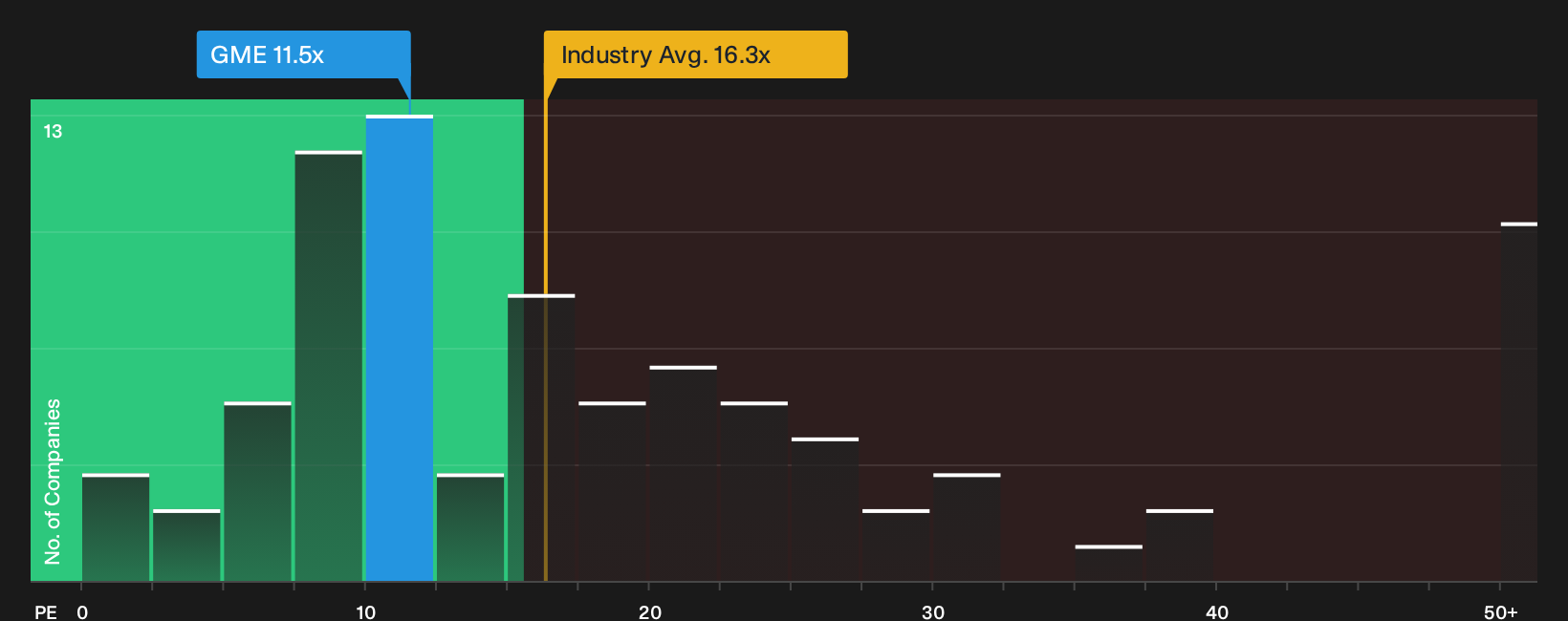
The P/E ratio fits GameStop because earnings are now a key driver for how investors frame the turnaround versus pure speculation. On headline numbers, the stock trades at about 11.5x earnings, which is well below the Specialty Retail average of roughly 16.3x and also under the peer group at about 18.7x. That gap indicates the market is assigning a lower price tag to each dollar of GameStop profit than to sector competitors.
Recent headlines around the eBay stake and stronger profit outlook have lifted sentiment, yet the current P/E still points to a discount versus both the industry and peers. The key issue is whether those earnings are viewed as repeatable or heavily tied to the investment portfolio. If you believe the underlying profitability holds up, this kind of multiple can appear conservative next to other retailers that carry higher P/E ratios for similar or lower current earnings power.
On the P/E yardstick alone, GameStop stock appears undervalued compared with its sector and peer averages.
See what the numbers say about this price — find out in our valuation breakdown.
The GameStop Narrative: What Would Justify Today's Price?
GameStop’s valuation puzzle really comes into focus once you pair today’s price with Simply Wall St Narratives on the Community page. These spell out what kind of future for growth, profitability and earnings would need to play out for the stock to be worth meaningfully more or meaningfully less than it is now. Each scenario links its number to a specific view on where GameStop’s expansion, margins and risk profile could head next, giving you something you can revisit as fresh results and filings come through.
One of the top community narratives on GameStop: 91% undervalued
"GameStop’s transformation from a legacy retailer to a crypto-invested, cash-rich entity underscores its long-term growth potential…"
Read one of the top narratives on GameStop
Do you think there's more to the story for GameStop? Head over to our Community to see what others are saying!
The Bottom Line
GameStop screens as undervalued on P/E, yet the broader checks still flag a mixed picture rather than a clear green light. The real hinge now is whether recent profitability tied to investments and cost discipline proves resilient enough to justify any future rerating of that multiple. If earnings quality holds and the core business steadies, the current discount can look like pricing in too much doubt. If those supports fade or sales weaken further, today’s lower valuation may simply reflect the ongoing risk in the story.
This article by Simply Wall St is general in nature. We provide commentary based on historical data and analyst forecasts only using an unbiased methodology and our articles are not intended to be financial advice. It does not constitute a recommendation to buy or sell any stock, and does not take account of your objectives, or your financial situation. We aim to bring you long-term focused analysis driven by fundamental data. Note that our analysis may not factor in the latest price-sensitive company announcements or qualitative material. Simply Wall St has no position in any stocks mentioned.
Have feedback on this article? Concerned about the content? Get in touch with us directly. Alternatively, email editorial-team@simplywallst.com