
Dear Rackspace Stock Fans, Here’s What the Nvidia Partnership Means for RXT
Rackspace Technology (RXT) is a San Antonio, Texas-based hybrid cloud and enterprise AI solutions provider operating through two core segments: Public Cloud and Private Cloud. The company designs, builds, and manages multi-cloud environments for enterprises transitioning legacy infrastructure toward modern, AI-ready platforms. Rackspace has increasingly pivoted toward high-margin enterprise AI infrastructure, forging strategic partnerships with Nvidia (NVDA), AMD (AMD), Palantir (PLTR), and Uniphore to deliver governed AI compute capacity, sovereign AI deployments, and agentic infrastructure solutions for regulated industries. Under this AI-first transformation strategy, Rackspace is working to offset declining legacy cloud resale revenue with faster-growing, higher-margin AI infrastructure and managed services offerings.
Rackspace Stock Performance
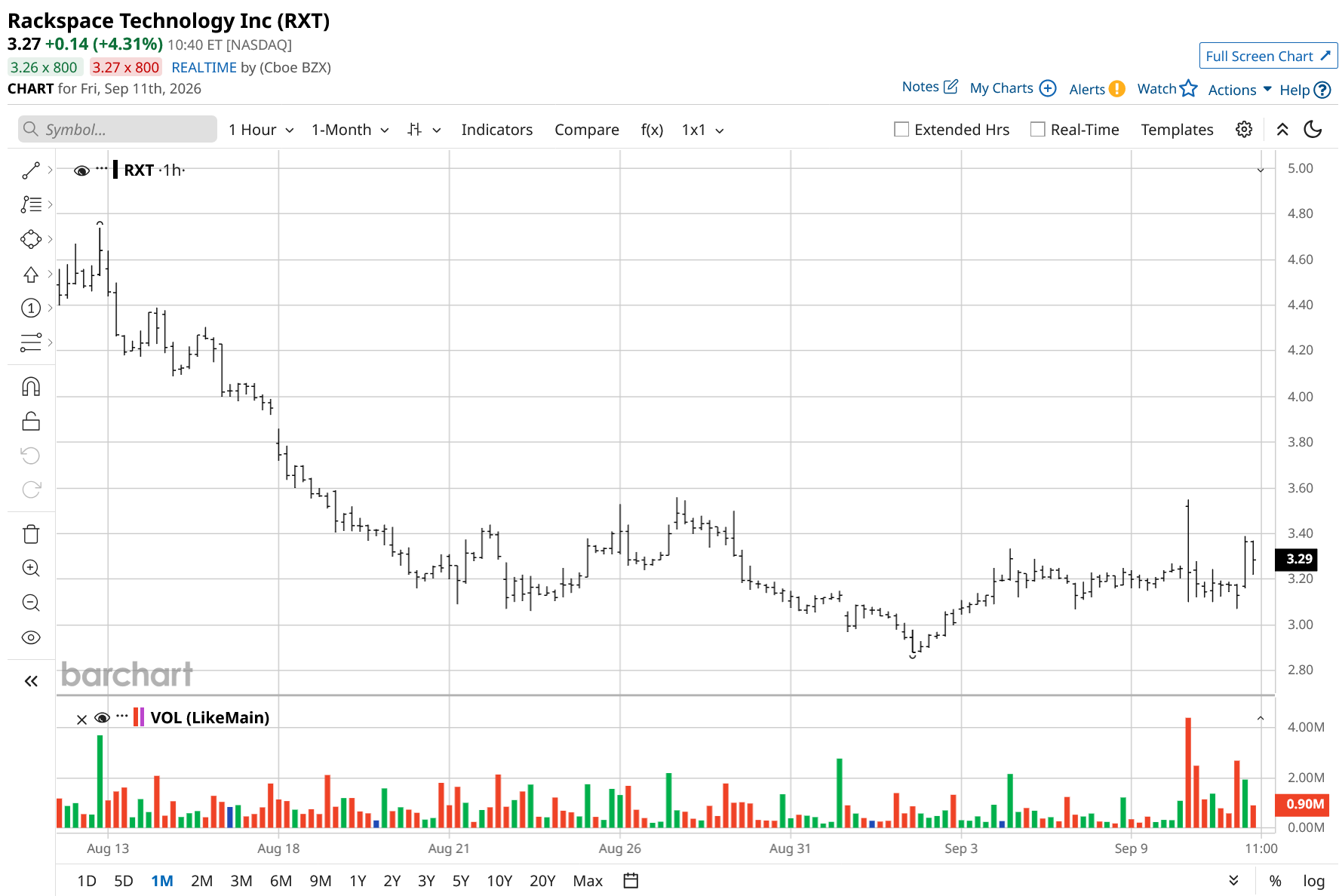
Rackspace's stock has been extraordinarily volatile in 2026, recently trading around $3.25, up more than 118% over the past year despite sitting about 62% below its 52-week high of $8.60. Shares have swung wildly on AI-related headlines, including a 13% jump after Rackspace joined the Nvidia Cloud Partner Program, followed by a sharp 33.6% single-day plunge after the company faced securities fraud allegations claiming it misled investors about the impact of its AI infrastructure pivot.
By comparison, the Russell 2000 small-cap index has staged one of its strongest rallies in three decades in 2026, recently touching a record high above 3,036 before pulling back modestly. RXT stock has dramatically underperformed this small-cap benchmark in recent weeks, reflecting company-specific turmoil surrounding its AI transition and mounting legal challenges.
Mixed Quarterly Results
Rackspace's second-quarter 2026 results showed revenue of $670.1 million, up a modest 0.6% year-over-year (YoY) but comfortably topping the $646 million analyst consensus. However, the company posted a wider net loss of $67.5 million, or $0.27 per diluted share, missing the Street's forecast of a $0.31 loss on an adjusted basis while still worsening from the $54.5 million loss reported in the year-ago quarter.
Private Cloud revenue grew 5% YoY to $263 million, while Public Cloud revenue declined 2.3% amid the company's deliberate exit from lower-margin infrastructure resale. Loss from operations widened to $33 million from $25 million a year earlier, and the company announced a $250 million at-the-market equity offering to help fund GPU-related growth capital as it scales AI compute capacity, which management said could generate 50%-plus EBITDA margins once deployed.
Management lowered full-year 2026 revenue guidance to a range of $2.45 billion to $2.55 billion, a 7% cut at the midpoint, alongside EBITDA guidance of $285 million to $295 million, citing timing mismatches between exiting legacy revenue streams and ramping AI investments. CFO Mark Marino emphasized that Private Cloud growth remains on track, while executives pointed to McKinsey estimates that AI inferencing workloads will surpass training by year-end, reinforcing Rackspace's long-term enterprise AI infrastructure strategy.
Rackspace Partners With Nvidia
Rackspace Technology shares jumped more than 6% in premarket trading Thursday after the company announced it had joined the Nvidia Cloud Partner Program, a move designed to strengthen Rackspace's ability to deliver and manage Nvidia-powered AI computing for regulated and sovereign enterprises.
CEO Gajen Kandiah framed the partnership around AI sovereignty, emphasizing that Nvidia provides the accelerated computing foundation while Rackspace supplies the infrastructure, engineering, and operational expertise needed to run it reliably in production environments where governance and uptime are non-negotiable.
As part of the collaboration, Rackspace unveiled its new Institutional Sovereign Pod, a governed AI infrastructure architecture combining Nvidia's Blackwell technology with Palantir's Foundry and AIP platforms, giving enterprises tighter control over their data, models, and AI environments. Rackspace will provide forward-deployed engineering and managed operations support, helping customers accelerate the transition from deployment to full production and realize value faster from their AI investments.
Is RXT a “Buy” Following the Nvidia Deal?
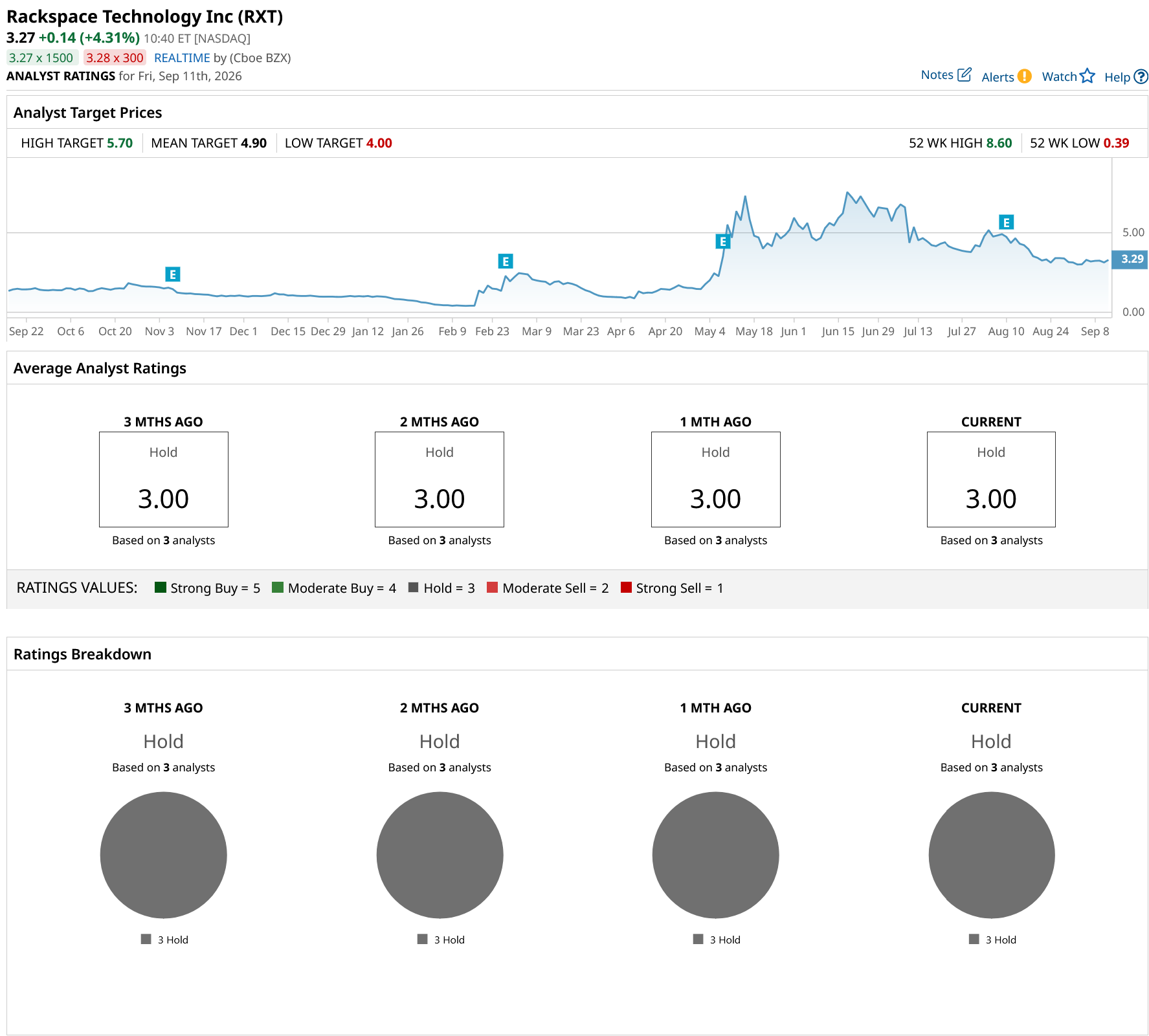
Rackspace's Nvidia Cloud Partner Program tie-up and new Institutional Sovereign Pod show real momentum in the company's AI sovereignty pivot, even as the stock remains highly volatile amid ongoing legal scrutiny. Analyst coverage stays thin but cautiously optimistic: All three analysts covering RXT stock rate it a “Hold,” with an average price target of $4.90, implying a notable 50% upside from current levels. That gap between sentiment and price target suggests limited analyst conviction despite the stock's speculative upside, leaving RXT best suited for risk-tolerant investors watching Rackspace's AI infrastructure buildout closely.
On the date of publication, Ruchi Gupta did not have (either directly or indirectly) positions in any of the securities mentioned in this article. All information and data in this article is solely for informational purposes. For more information please view the Barchart Disclosure Policy here.