
DoorDash (DASH) Stock May Trade At A Premium Following Retail Expansion News
DoorDash stock has delivered a powerful 3 year run, but the recent pullback and a richer market multiple now leave pricing questions front and center for anyone trying to judge what is already baked in. With recent partnerships expanding beyond food delivery and broader checks flagging the shares as overvalued on multiples, investors are weighing strong past returns against a less clear value case today.
- Over the past 3 years, DoorDash has returned about 142.3%, which shows how much optimism has already flowed into the story.
- New retail and advertising partnerships, such as with Locally and Circana, can support revenue opportunities, while reliance on continued demand for rapid local delivery remains a key risk if consumer behavior or competition shifts.
- The broader valuation workup, with a mixed value score of 3 out of 6, points to a company that screens expensive on market multiples but not as a clear outlier.
The issue now is whether DoorDash at around US$201 per share offers enough potential reward to justify paying what looks like a premium multiple after such a strong multi year run.
Capitalize on the pullback in DoorDash by comparing its rich multiple and mixed value score to other platform businesses in 33 high quality undervalued stocks that still screen as high quality on Simply Wall St.Is DoorDash Getting Expensive on Earnings?
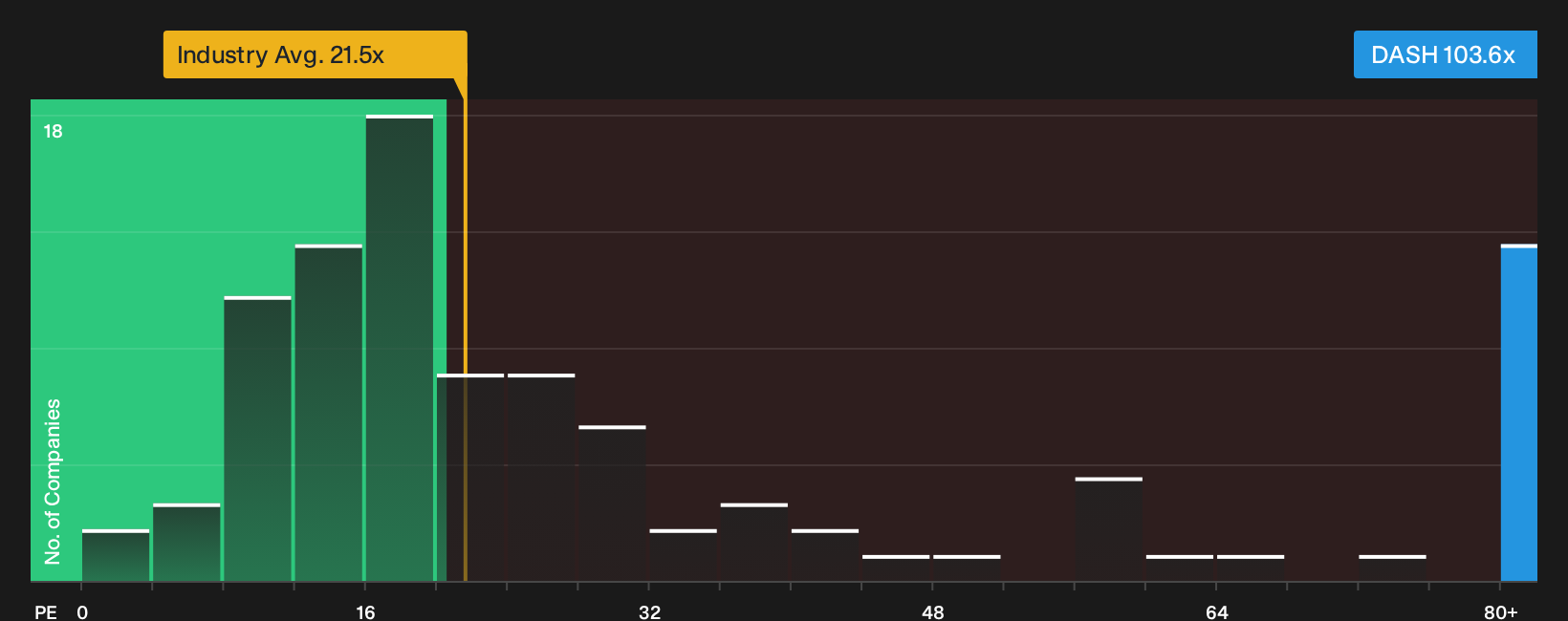
P/E fits DoorDash reasonably well because the discussion is now about what investors are paying for each dollar of current earnings rather than just future potential. On that score, the stock trades on a P/E of about 103.6x, versus a Hospitality industry average near 21.5x and a peer group around 32.2x. That is a steep premium for NasdaqGS:DASH compared with both its sector and similar platform style businesses.
The Fair P/E ratio implied by Simply Wall St’s model is roughly 46.1x, which is less than half of the present earnings multiple and points to an overvalued reading on this framework. Recent partnerships with Locally, Circana and major retailers may help explain why the market is comfortable paying up for DoorDash, even though the current price embeds far richer expectations than either the industry or the tailored fair multiple suggest.
On the P/E yardstick, DoorDash appears overvalued, with the market paying a far higher earnings multiple than either peers or the modelled fair ratio support.
See what the numbers say about this price — find out in our valuation breakdown.
The DoorDash Narrative: What Would Justify Today's Price?
Simply Wall St Narratives gives you a way to explain what would need to happen for DoorDash's current market price to look either conservative or stretched, based on concrete assumptions about revenue growth, profit margins and earnings power. Each scenario links a fair value estimate to a particular mix of potential drivers and threats for DoorDash, so you can track over time which version of the story appears to be gaining traction on the Community page.
The Simply Wall St community is split on DoorDash, with one camp leaning into the platform expansion story while another focuses on rising cost and regulatory risks.
Bull case: 21% undervalued
"Accelerating growth of high-margin revenue streams (notably, platform advertising and emerging SaaS offerings like the SevenRooms acquisition) is expanding DoorDash's profit pool beyond core delivery. This is seen as supporting further earnings upside…"
Read the full Bull Case to see why DoorDash could be undervalued
Bear case: 10% overvalued
"DoorDash faces significant risk from evolving labor regulations as several jurisdictions move towards classifying gig workers as employees rather than contractors. This could materially increase labor costs and directly impact net margins and overall profitability in the coming years…"
Read the full Bear Case to see why DoorDash could be overvalued
Do you think there's more to the story for DoorDash? Head over to our Community to see what others are saying!
The Bottom Line
DoorDash now screens as overvalued on market multiples, which suggests the easy valuation case has passed and the burden of proof sits with the bullish story. The crux is whether higher margin revenue streams, such as advertising and broader platform services, can grow fast enough and durably enough to make today’s rich P/E look sensible over time. If that shift in earnings mix plays out, the current premium could look understandable rather than excessive. If it stalls or regulatory costs bite harder, the present pricing may prove to have assumed too smooth a path.
This article by Simply Wall St is general in nature. We provide commentary based on historical data and analyst forecasts only using an unbiased methodology and our articles are not intended to be financial advice. It does not constitute a recommendation to buy or sell any stock, and does not take account of your objectives, or your financial situation. We aim to bring you long-term focused analysis driven by fundamental data. Note that our analysis may not factor in the latest price-sensitive company announcements or qualitative material. Simply Wall St has no position in any stocks mentioned.
Have feedback on this article? Concerned about the content? Get in touch with us directly. Alternatively, email editorial-team@simplywallst.com