
Why Everyone Is Watching Willis Towers Watson (WTW) Right Now
Willis Towers Watson (WTW) has put AI execution in sharper focus after announcing a partnership with Lyzr, aiming to help clients embed agentic AI workflows directly into everyday operations and workforce decisions.
Recent trading shows a mixed picture for Willis Towers Watson. The share price is US$315.61 after a 7 day decline of 5.71% and a 30 day fall of 7.25%. However, the 90 day share price return of 20.17% and 3 year total shareholder return of 59.87% point to momentum that has built over a longer stretch, even as the 1 year total shareholder return is down 5.68%.
Scan beyond Willis Towers Watson and compare how other insurers are wiring AI into their business models with a curated set of 31 AI small caps.
Willis Towers Watson now trades at a sizeable discount to both analyst targets and intrinsic value estimates after that recent pullback. Is this caution a fair read on the risks, or has the market stepped too far back?
Most Popular Narrative: 15.8% Undervalued
The most followed valuation story for Willis Towers Watson anchors on a fair value of $374.74 versus the last close at $315.61. This frames the current pullback as a sizable markdown that depends on execution of efficiency and AI programs.
Increasing adoption and deployment of AI-powered analytics, digital platforms, and automation tools is set to further enhance productivity and enable scalable solutions, improving operating leverage and underpinning ongoing operating margin expansion.
Want to see what has to happen inside Willis Towers Watson for that valuation to hold up? The story centers on steady revenue gains, firmer margins, and a future earnings profile that assumes the current efficiency work really sticks.
Result: Fair Value of $374.74 (UNDERVALUED)
Have a read of the narrative in full and understand what's behind the forecasts.
Still, the Willis Towers Watson thesis depends on avoiding two big potholes: AI tools pushing core advisory work toward fee pressure, and acquisition costs eroding the hoped for margin gains.
Find out about the key risks to this Willis Towers Watson narrative.
Another View: What Multiples Say About Willis Towers Watson
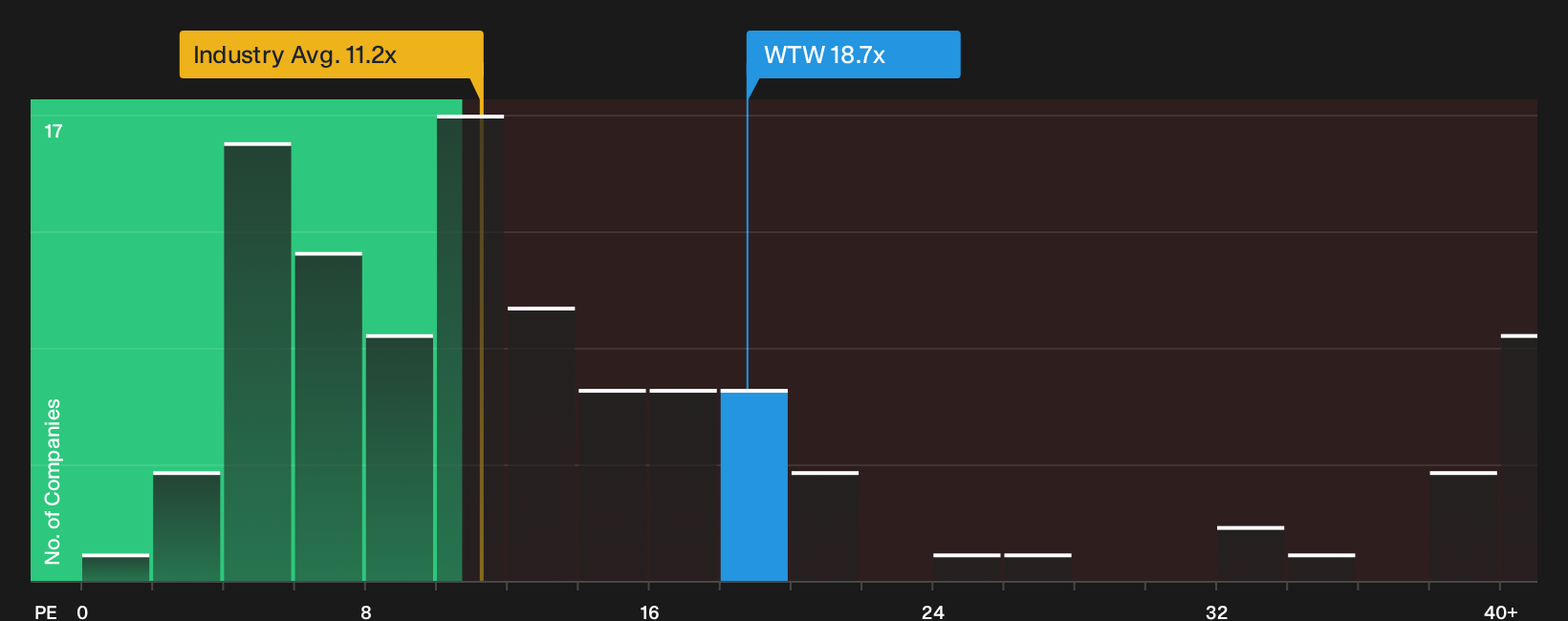
On the flip side of that 15.8% undervalued fair value story, the basic P/E check paints a very different picture for Willis Towers Watson. The shares trade on 18.7x earnings, compared with 11.2x for the wider US Insurance sector and a fair ratio of 13.4x from regression analysis. That gap points to investors already paying up for quality and growth, which raises the question of how much margin for error is really left if execution stumbles.
For a closer look at how that earnings multiple compares to both sector norms and the fair ratio the market could move toward, See what the numbers say about this price — find out in our valuation breakdown.
Next Steps
Mixed signals around Willis Towers Watson can either be noise or the early shape of a new story, depending on how you read the data. If you want to move quickly and make your own call using the same inputs behind this piece, start with the full picture of 4 key rewards and 1 important warning sign.
Looking for more ideas beyond Willis Towers Watson?
If Willis Towers Watson has you thinking harder about where to put fresh capital, do not stop here. The right watchlist can shape your next move.
- Target dependable income and stress test your dividend watchlist against a curated pool of 6 dividend fortresses that already clear a 5% yield hurdle.
- Hunt for value by lining up your own research against a focused group of 31 high quality undervalued stocks that pair solid balance sheets with attractive pricing.
- Limit downside shocks by scanning a pre-filtered set of 11 resilient stocks with low risk scores that score well on resilience and financial strength before you commit capital.
This article by Simply Wall St is general in nature. We provide commentary based on historical data and analyst forecasts only using an unbiased methodology and our articles are not intended to be financial advice. It does not constitute a recommendation to buy or sell any stock, and does not take account of your objectives, or your financial situation. We aim to bring you long-term focused analysis driven by fundamental data. Note that our analysis may not factor in the latest price-sensitive company announcements or qualitative material. Simply Wall St has no position in any stocks mentioned.
Have feedback on this article? Concerned about the content? Get in touch with us directly. Alternatively, email editorial-team@simplywallst.com