
Nasdaq (NDAQ) Stock Trades Near Fair Value While Earnings Sit Above Fair Value
Nasdaq has delivered a strong 87.0% gain over the past three years, yet today the stock screens as fairly valued on an intrinsic value estimate, while market multiples point to a richer price tag.
- The 87.0% return over three years puts recent share performance well ahead of the shorter term, which has been weak by comparison.
- Nasdaq’s push into AI driven tools and private markets data, highlighted by the Dasseti acquisition and new Verafin partnerships, can support expectations for long term cash flows. At the same time, execution risks around integrating these capabilities may weigh on how much investors are willing to pay.
- The company’s low value score, 2 out of 6 checks, suggests the stock currently leans expensive on the broader set of valuation gauges rather than offering a clear bargain.
The issue now is whether Nasdaq’s current price already reflects the value of its data and AI ambitions or still leaves room for further upside in the intrinsic value estimate.
Scan beyond Nasdaq to find additional AI focused financial stocks that could be repricing quickly with the hand picked 89 AI infrastructure stocks.
Where Does Nasdaq Sit on Excess Returns?
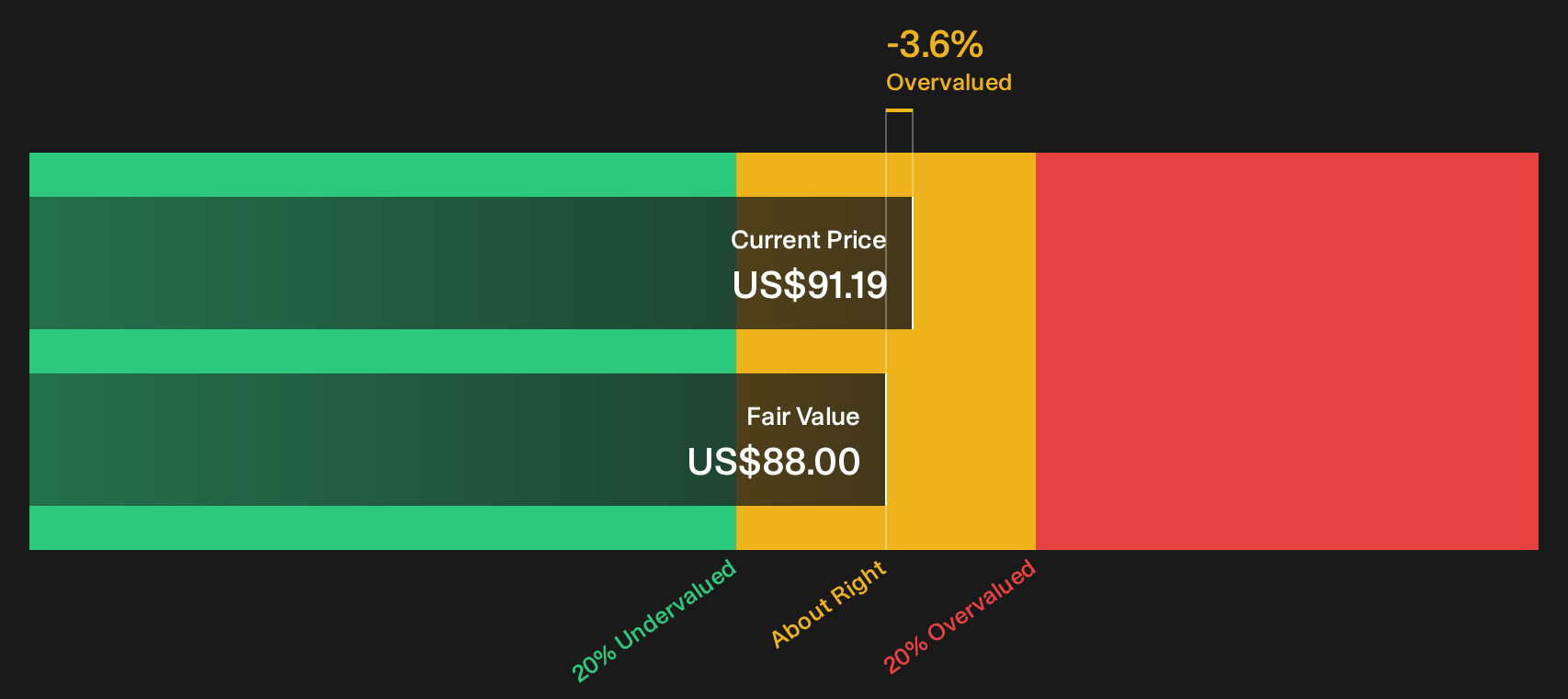
The Excess Returns model looks at how profit on equity compares with the cost of that equity. For Nasdaq, the inputs show a business earning more on its capital than it pays to shareholders for that capital, with an average return on equity of 20.39% against a cost of equity of $1.95 per share. Stable EPS is estimated at $4.85 per share on a stable book value base of $23.77 per share, implying that the franchise continues to generate an excess return of about $2.90 per share above its funding cost.
That stream of excess profit supports an intrinsic value estimate of $88 per share, which sits only slightly above the current share price. On this model, the stock looks roughly fairly valued. Nasdaq’s acquisition of Dasseti, which builds out eVestment’s AI and private markets tools, helps explain why investors appear willing to pay close to the Excess Returns estimate for a business that relies heavily on data and software driven earnings.
Overall, the Excess Returns work up suggests Nasdaq currently looks about fairly valued, with the share price already close to the intrinsic value estimate.
Nasdaq is fairly valued according to our Excess Returns, but this can change at a moment's notice. Track the value in your watchlist or portfolio and be alerted on when to act.
Is Nasdaq Getting Expensive on Earnings?
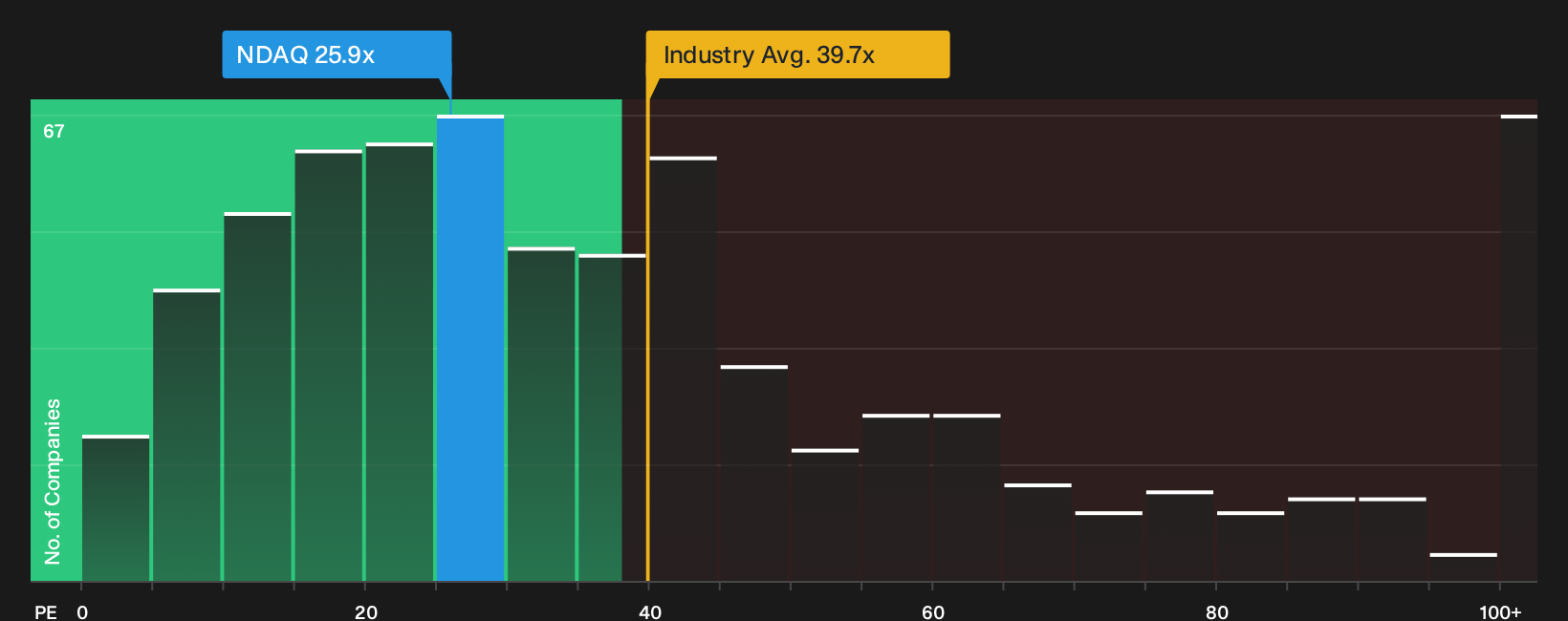
P/E suits Nasdaq because earnings capture the value of its data and software heavy model better than revenue alone. On that yardstick, the stock trades on a P/E of about 25.9x, which is very close to the 25.7x peer average in Capital Markets, even though the wider industry screens much higher at 39.7x.
The Fair Ratio model points to a P/E of 16.3x for Nasdaq, based on factors like size, margins and risk, which is well below where the shares change hands today. That gap indicates investors are already paying a premium multiple for the earnings stream relative to what the model indicates as a more typical level.
On the P/E multiple, Nasdaq appears overvalued compared with the Fair Ratio benchmark.
See what the numbers say about this price — find out in our valuation breakdown.
The Nasdaq Narrative: What Would Justify Today's Price?
Nasdaq’s valuation puzzle only really comes into focus once you spell out the future that would need to unfold for growth, margins and earnings to justify a much higher or much lower share price than today. Simply Wall St Narratives on the Community page turn each single P/E or intrinsic value figure into a set of clear assumptions so you can see the path those numbers rely on and watch over time whether that story still lines up with reality.
One of the top community narratives on Nasdaq: 17% undervalued
"The expansion of Verafin's AI driven solutions is anticipated to enhance the platform's value, facilitating upselling opportunities, attracting new clients, and increasing engagement…"
Read one of the top narratives on Nasdaq
Do you think there's more to the story for Nasdaq? Head over to our Community to see what others are saying!
The Bottom Line
Nasdaq’s Excess Returns workup points to an intrinsic value estimate that sits close to where the shares trade, so the model does not flag an obvious discount. The P/E and Fair Ratio checks instead lean toward the stock looking overvalued, which lines up with the low value score across broader metrics. That tension comes from cash flow strength and capital efficiency on one side, and already full growth expectations embedded in the multiple on the other. The real swing factor from here is whether Nasdaq can turn its AI and data push into earnings power strong enough to support that premium pricing rather than leave it exposed to a de rating.
This article by Simply Wall St is general in nature. We provide commentary based on historical data and analyst forecasts only using an unbiased methodology and our articles are not intended to be financial advice. It does not constitute a recommendation to buy or sell any stock, and does not take account of your objectives, or your financial situation. We aim to bring you long-term focused analysis driven by fundamental data. Note that our analysis may not factor in the latest price-sensitive company announcements or qualitative material. Simply Wall St has no position in any stocks mentioned.
Have feedback on this article? Concerned about the content? Get in touch with us directly. Alternatively, email editorial-team@simplywallst.com