
Allstate (ALL) Stock May Be Below Fair Value After AM Best Rating Affirmation
Allstate stock has delivered a very strong 147.9% gain over the past three years, yet current valuation checks still suggest the shares lean cheap rather than fully priced in.
- The 147.9% return over three years puts Allstate among the stronger performers in the insurance group. This raises the question of how much upside is already reflected in today's valuation.
- AM Best's affirmation of Allstate's A+ Financial Strength Rating can support confidence in future cash generation. However, any setback in underwriting margins would quickly feed back into what investors are willing to pay for the stock.
- The broader valuation work points to Allstate screening as undervalued, with a high value score of 5 suggesting the current price does not fully reflect the business fundamentals.
The issue now is whether Allstate's strong multi year share price run has already captured most of that value, or if the current level still leaves meaningful room for further returns over time.
Scan for other insurers showing a similar mix of strong multi year returns and high value scores by reviewing our curated list of 31 high quality undervalued stocks
Is Allstate Still Cheap on Earnings?
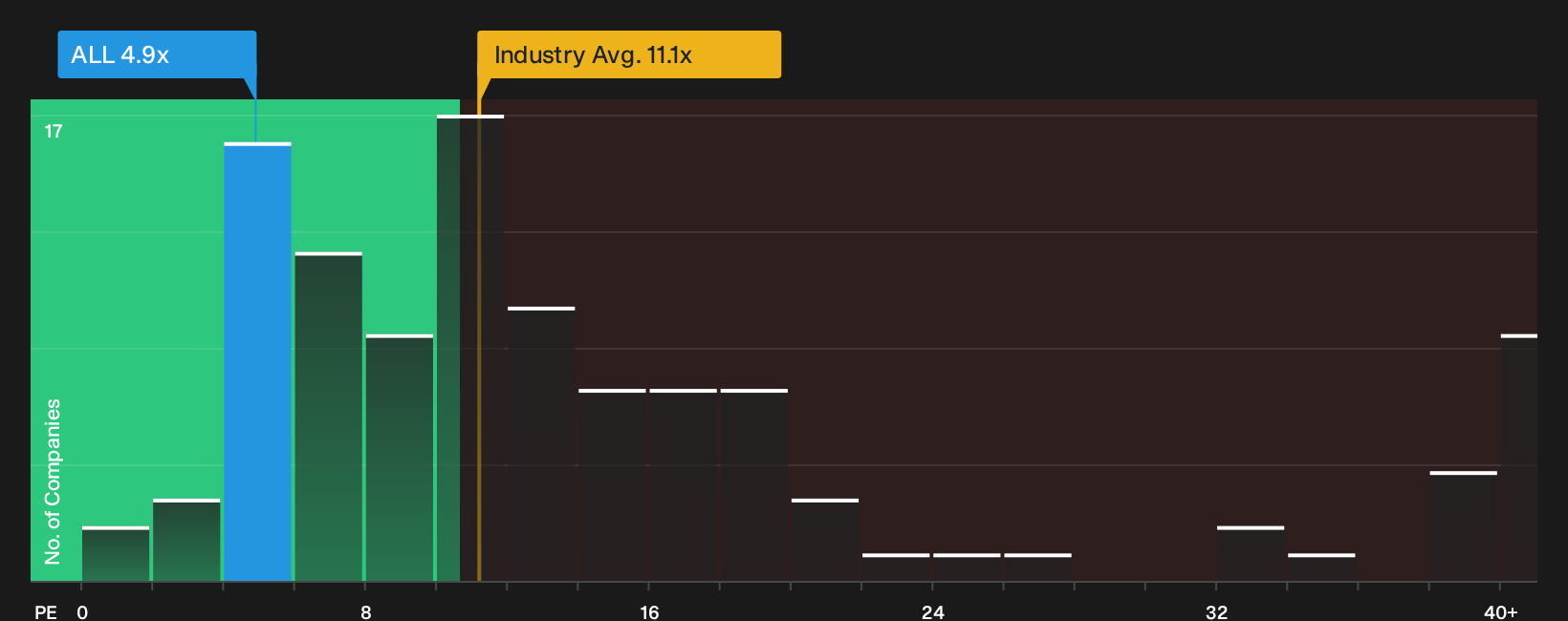
P/E is usually the cleanest yardstick for an insurer like Allstate because earnings already reflect underwriting and investment results in one figure. Allstate trades on a P/E of 4.9x, which is less than half the Insurance industry average of 11.1x and well below the peer group on 10.3x. That is a wide gap for a large, established player.
The tailored fair P/E for Allstate sits at 7.3x, based on its earnings profile, scale and risk characteristics. The current 4.9x level is materially lower than that benchmark. This suggests that the stock price reflects a generous margin of safety on this measure. AM Best’s recent affirmation of the group’s A+ rating underlines that this low multiple is not simply a function of weak balance sheet quality.
On a P/E basis, Allstate stock appears undervalued compared with both its industry and the more tailored fair multiple.
See what the numbers say about this price — find out in our valuation breakdown.
The Allstate Narrative: What Would Justify Today's Price?
Simply Wall St Narratives pick up where the Allstate valuation puzzle leaves off, explaining what mix of future growth, margins and earnings would need to occur for the stock to appear meaningfully cheaper or more expensive than it does today. Each narrative treats Allstate's implied fair value as a thesis about the business that you can keep revisiting as new results and industry data either support it or undermine it, and they are available on Simply Wall St's Community page.
Community views on Allstate could hardly be further apart, with one camp focused on execution upside and the other on structural headwinds.
Bull case: 8% undervalued
"Ongoing investment in technology, distribution, and customer retention programs (e.g., SAVE initiative, bundling) is yielding productivity gains and strengthening competitive differentiation, likely supporting sustained growth in policies-in-force and upward pressure on overall earnings…"
Read the full Bull Case to see why Allstate could be undervalued
Bear case: 32% overvalued
"The ongoing adoption of autonomous vehicles and advanced safety technology is expected to cause a gradual but persistent decline in accident frequency, directly reducing demand for traditional auto insurance, which currently accounts for roughly two-thirds of Allstate's property-liability premiums…"
Read the full Bear Case to see why Allstate could be overvalued
Do you think there's more to the story for Allstate? Head over to our Community to see what others are saying!
The Bottom Line
Allstate still screens as undervalued on earnings, which puts the burden on the bear case to explain why the discount should persist. The market is effectively saying that concerns over margins, technology change and long term demand for auto cover outweigh the current profitability picture. The crux for investors is whether underwriting discipline and execution on cost and retention can hold up well enough for the P/E gap to close, or whether that gap is simply fair compensation for the structural risks already on display in the narratives above.
This article by Simply Wall St is general in nature. We provide commentary based on historical data and analyst forecasts only using an unbiased methodology and our articles are not intended to be financial advice. It does not constitute a recommendation to buy or sell any stock, and does not take account of your objectives, or your financial situation. We aim to bring you long-term focused analysis driven by fundamental data. Note that our analysis may not factor in the latest price-sensitive company announcements or qualitative material. Simply Wall St has no position in any stocks mentioned.
Have feedback on this article? Concerned about the content? Get in touch with us directly. Alternatively, email editorial-team@simplywallst.com