
Is United Therapeutics (UTHR) Still A Bargain, Or Largely Priced In?
United Therapeutics has returned 148.5% over the past five years, yet recent months have been much flatter. This puts extra focus on whether the current price around US$497 still lines up with what the valuation checks imply.
- A 148.5% gain over five years points to a stock that has already rewarded patient holders, so fresh buyers need to think carefully about what is already priced in.
- The FDA review process for Tyvaso in idiopathic pulmonary fibrosis, along with the separate filing for ralinepag in pulmonary arterial hypertension, can influence expectations for future cash flows. At the same time, execution and regulatory risk around these therapies may affect how much value investors are willing to assign today.
- A high value score of 6 suggests United Therapeutics screens as relatively cheap across the broader set of valuation checks rather than fully priced.
For investors, the debate is whether a stock that has already delivered strong multi year gains is still offering a genuine value opportunity or has largely reflected its strengths in the current valuation.
Spot opportunities beyond United Therapeutics by scanning our hand picked list of 31 high quality undervalued stocks, which also combine strong fundamentals with disciplined pricing.Is United Therapeutics Still Cheap on Earnings?
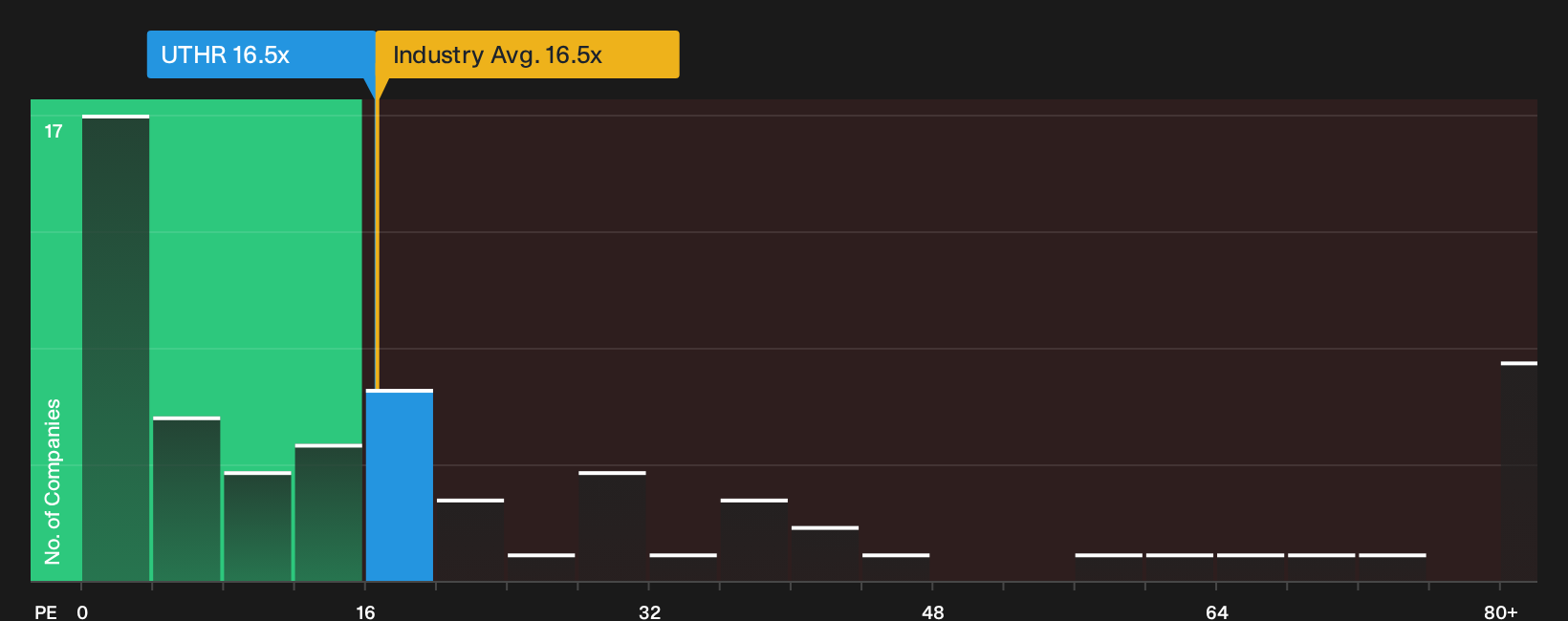
The P/E ratio fits United Therapeutics well because earnings remain a key reference point for how the market is weighing its therapies and pipeline. On this measure, United Therapeutics trades on about 16.3x earnings, which is almost identical to the broader biotech sector at roughly 16.3x. Against a wide peer set that averages about 57.0x, the current multiple looks far more restrained.
The fair P/E from the model sits higher at around 24.6x. This indicates that the stock trades at a sizeable discount to what that earnings based framework would suggest. Despite the recent FDA progress on Tyvaso for idiopathic pulmonary fibrosis and the ralinepag filing, the valuation multiple has not moved toward peer levels.
On a pure P/E basis, United Therapeutics appears undervalued relative to both its tailored fair multiple and higher priced biotech peers.
See what the numbers say about this price — find out in our valuation breakdown.
The United Therapeutics Narrative: What Would Justify Today's Price?
Simply Wall St Narratives for United Therapeutics pick up where the valuation checks leave off and spell out which paths for growth, profitability, and earnings would need to play out for the current share price to look meaningfully cheap or rich. Instead of one headline P/E or model output, Narratives explain the future assumptions that sit underneath those figures so you can track whether United Therapeutics' real world progress continues to match the story implied by the numbers on Simply Wall St's Community page.
One of the top community narratives on United Therapeutics: 9% undervalued
"Heavy dependence on a few core drugs heightens risk from patent expirations, increasing vulnerability to revenue declines and competition from generics."
Read one of the top narratives on United Therapeutics
Do you think there's more to the story for United Therapeutics? Head over to our Community to see what others are saying!
The Bottom Line
On current P/E metrics, United Therapeutics still screens as undervalued relative to its broader biotech peer set and to the tailored fair multiple implied by earnings. That gap only matters if the pipeline drugs that drive sentiment today continue to support earnings strength over time rather than eroding once key patents roll off. For prospective holders, the real question is whether the discount reflects an overly cautious view on concentration and regulatory risk or a fair warning that cash flows tied to a handful of therapies deserve a lower valuation.
This article by Simply Wall St is general in nature. We provide commentary based on historical data and analyst forecasts only using an unbiased methodology and our articles are not intended to be financial advice. It does not constitute a recommendation to buy or sell any stock, and does not take account of your objectives, or your financial situation. We aim to bring you long-term focused analysis driven by fundamental data. Note that our analysis may not factor in the latest price-sensitive company announcements or qualitative material. Simply Wall St has no position in any stocks mentioned.
Have feedback on this article? Concerned about the content? Get in touch with us directly. Alternatively, email editorial-team@simplywallst.com