
Intercontinental Exchange (ICE) Stock May Be Pricey Despite Its 42% 5 Year Gain
Intercontinental Exchange stock has delivered a 42.4% gain over the past 5 years, yet the current valuation screens on the expensive side and the broader checks do not flag it as a clear bargain.
- A 42.4% return across 5 years points to solid long run progress, even though shorter term performance has been more mixed.
- Record trading volumes, open interest and new initiatives around tokenized securities can support long term fee potential. However, any slowdown in activity on key exchanges or regulatory friction around new products may weigh on what investors are willing to pay for Intercontinental Exchange.
- With a low value score of 2 out of 6, the stock currently leans expensive on broad valuation checks rather than looking like an obvious value opportunity.
The issue now is whether Intercontinental Exchange’s growth plans and trading activity are strong enough to justify this richer pricing, or if expectations already do most of the work in the current share price.
Spot opportunities beyond Intercontinental Exchange by scanning 31 high quality undervalued stocks, which combine stronger value signals with solid fundamentals.Does Intercontinental Exchange Look Pricey on Earnings?
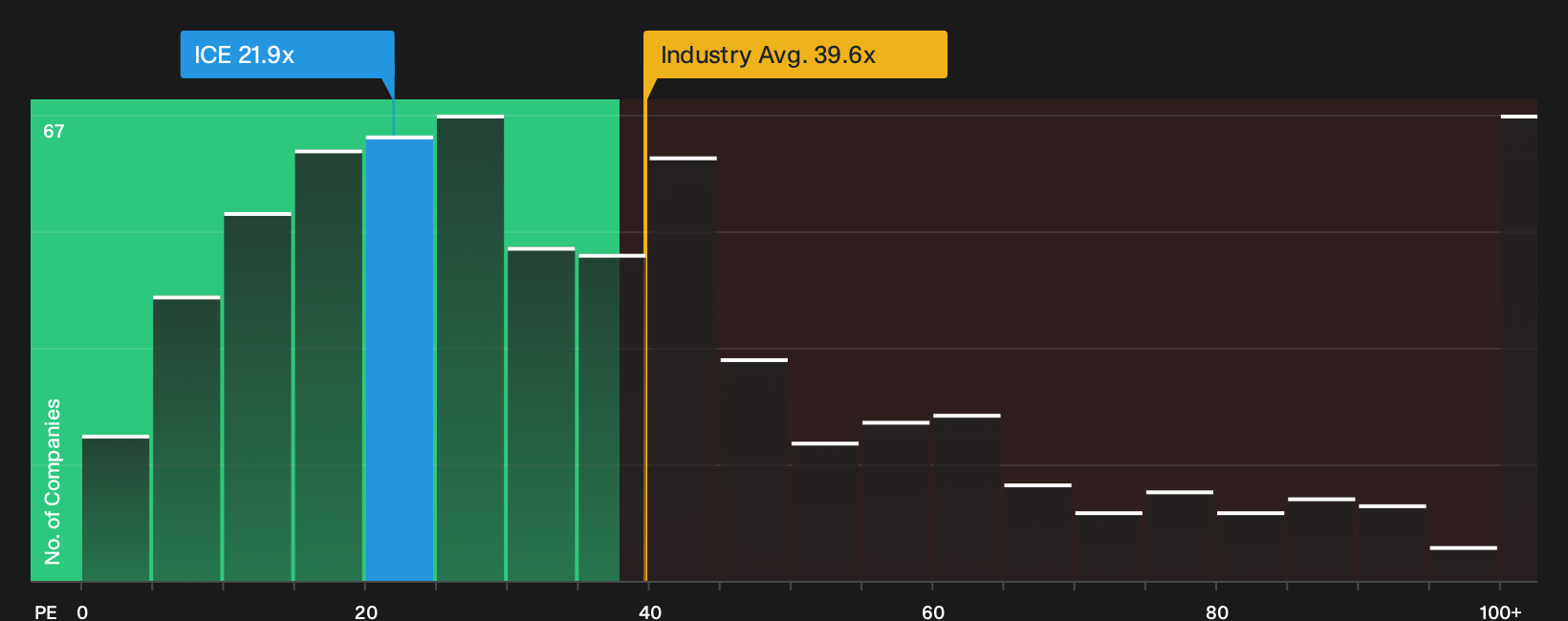
The P/E ratio suits Intercontinental Exchange because earnings power sits at the center of how investors usually judge exchange groups. The stock trades around 21.9x earnings, which is below the capital markets industry average of 39.6x and below the peer group near 25.8x. That looks modest at first glance if you only compare it to the sector backdrop.
The tailored fair P/E multiple for Intercontinental Exchange is estimated at 16.2x, based on its profitability profile, risk and scale. The current 21.9x therefore represents a premium to what this framework suggests would be a more balanced price tag. Despite record trading volumes and open interest in recent months, the market is still pricing Intercontinental Exchange above this fair level on earnings.
On the P/E test, Intercontinental Exchange appears overvalued relative to the earnings multiple that the modeled fundamentals would support.
See what the numbers say about this price — find out in our valuation breakdown.
The Intercontinental Exchange Narrative: What Would Justify Today's Price?
Simply Wall St Narratives for Intercontinental Exchange pick up where the P/E puzzle leaves off by spelling out what future growth, margins and earnings would need to look like for the stock to be worth materially more or less than today’s price on the Community page. Each scenario sets out its own fair value assumptions rather than relying on a single multiple, which lets you compare those building blocks with Intercontinental Exchange's actual results as they arrive.
One of the top community narratives on Intercontinental Exchange: 14% undervalued
"Prediction markets are highlighted as an additional opportunity to expand the addressable market, which could reinforce the growth profile that bullish analysts use…"
Read one of the top narratives on Intercontinental Exchange
Do you think there's more to the story for Intercontinental Exchange? Head over to our Community to see what others are saying!
The Bottom Line
Intercontinental Exchange trades on earnings that already build in a healthy outcome for growth and profitability, which leaves less room for error if trading activity or new product traction disappoints. The multiple workup points to an overvalued profile, so the current set up leans more towards paying up for quality than picking up a discount. For many investors, the real question now is whether Intercontinental Exchange can keep justifying that premium by sustaining robust activity on its venues and turning new initiatives into durable fee streams.
This article by Simply Wall St is general in nature. We provide commentary based on historical data and analyst forecasts only using an unbiased methodology and our articles are not intended to be financial advice. It does not constitute a recommendation to buy or sell any stock, and does not take account of your objectives, or your financial situation. We aim to bring you long-term focused analysis driven by fundamental data. Note that our analysis may not factor in the latest price-sensitive company announcements or qualitative material. Simply Wall St has no position in any stocks mentioned.
Have feedback on this article? Concerned about the content? Get in touch with us directly. Alternatively, email editorial-team@simplywallst.com