
Fortinet (FTNT) Stock Could Command A 12% Premium Following Gartner Leader Recognition
Fortinet has delivered a powerful 5 year run, yet both its market multiples and a Discounted Cash Flow (DCF) intrinsic value estimate currently point to the stock trading at a premium. For anyone looking at Fortinet today, the question is less about momentum and more about how much is already priced into the shares.
- Over the past 5 years, Fortinet has returned about 160.6%, which leaves investors asking whether the recent strength already reflects much of the company’s long term potential.
- Recognition as a Leader in Gartner’s 2026 Hybrid Mesh Firewall report can support confidence in Fortinet’s competitive position. However, reliance on high expectations for continued adoption across complex hybrid environments may pose a risk if growth or execution disappoints.
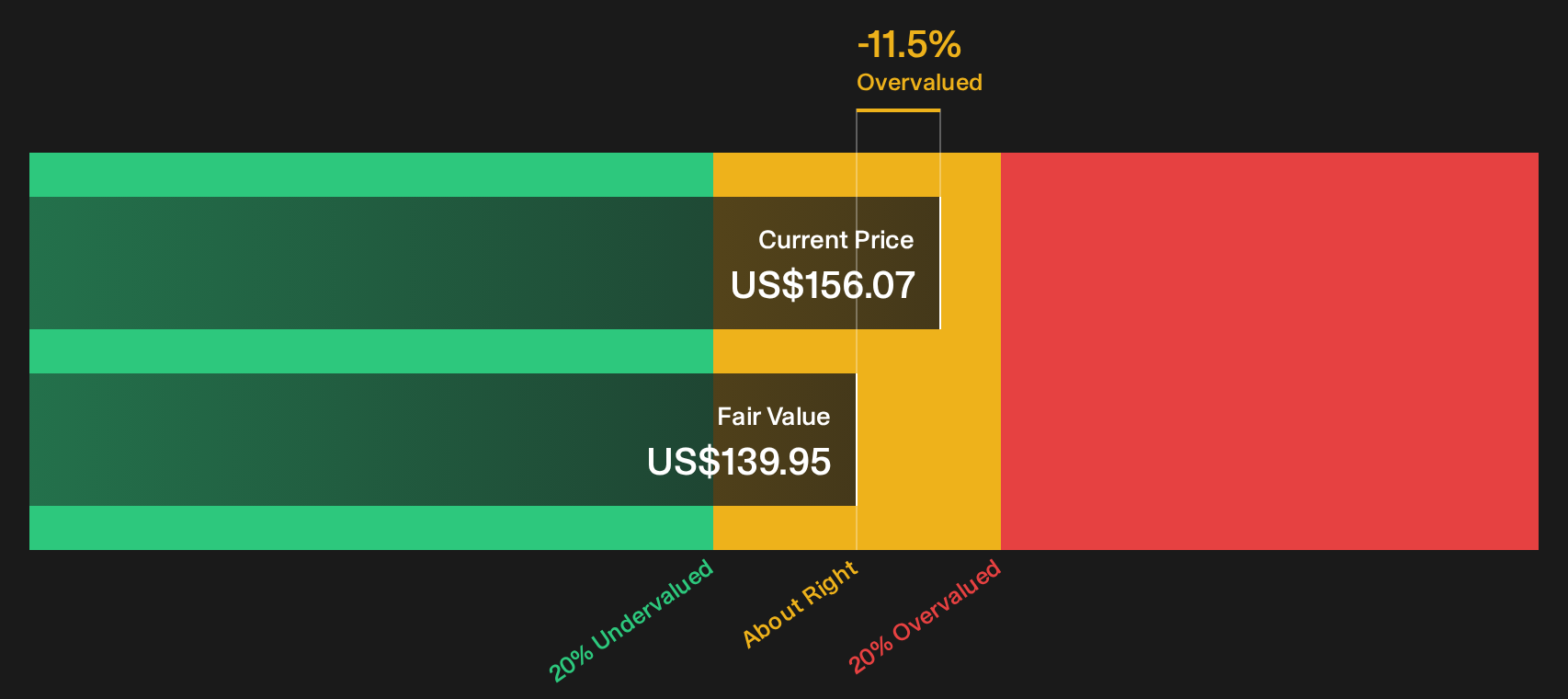
- On broader checks, including the Discounted Cash Flow (DCF) intrinsic value estimate that sits about 11.5% below the market price and earnings based multiples, Fortinet screens as expensive rather than a clear bargain, with the value score indicating it is undervalued in 0 of 6 tests.
The issue now is whether Fortinet’s current share price still leaves enough room for investors to be fairly compensated for the risks that come with such a rich valuation profile.
Capitalize on Fortinet’s rich valuation debate by comparing it with hand picked cybersecurity peers in 89 AI infrastructure stocks.Does Fortinet Look Pricey on Cash Flow?
The Discounted Cash Flow (DCF) model here values Fortinet by projecting the cash it could return to shareholders over time and then discounting those estimates back to today’s dollars. On this view, the business is treated as a growing cash generator rather than just a collection of near term earnings.
Fortinet produced about $3.0b of free cash flow over the latest twelve months, and the model assumes that these cash flows keep growing from this base. Feeding those projections into the 2 Stage Free Cash Flow to Equity framework leads to an estimated intrinsic value of about $140 per share, which sits roughly 11.5% below the current market price. Recognition as a Leader in Gartner’s 2026 Hybrid Mesh Firewall report may help explain why investors are willing to pay a premium to this cash flow based value.
On this DCF view, Fortinet stock currently screens as overvalued, with the market price sitting above what its projected cash flows would justify.
Our Discounted Cash Flow (DCF) analysis suggests Fortinet may be overvalued by 11.5%. Discover 31 high quality undervalued stocks or create your own screener to find better value opportunities.
Has Fortinet Run Too Far on Earnings?
P/E works well for Fortinet because investors tend to focus on the profit stream behind its cybersecurity platform rather than just revenue scale.
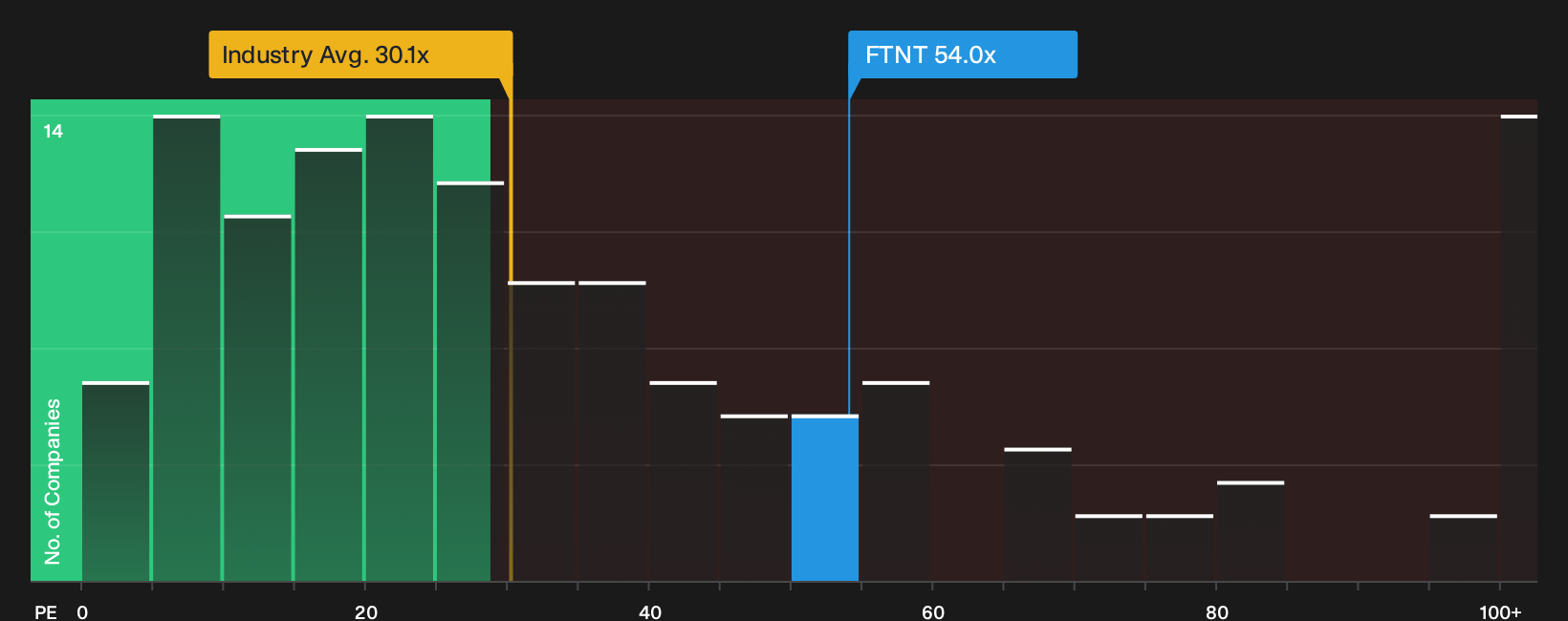
The stock trades on a P/E of about 54.0x, compared with roughly 30.1x for the broader Software industry and around 33.8x for the selected peer group. A fair P/E based on Fortinet’s profile is estimated at about 37.2x, which is materially lower than where the shares change hands today. That spread suggests buyers are paying a sizeable extra premium on top of both sector norms and what the tailored fair ratio implies.
The gap between the current P/E and the modelled fair level could mean there is limited margin for disappointment if Fortinet’s earnings trajectory or competitive position were to come under pressure.
On this earnings yardstick, Fortinet stock appears overvalued, with the present P/E sitting well above both peers and the estimated fair multiple.
See what the numbers say about this price — find out in our valuation breakdown.
The Fortinet Narrative: What Would Justify Today's Price?
Simply Wall St Narratives for Fortinet pick up where this valuation puzzle leaves off. They spell out what would need to happen to Fortinet's growth, profitability and earnings power for the stock to end up worth significantly more or less than the current price, and each one ties its number to a clear view of how expansion, margins and risk might evolve. You can return to these views as new information comes through on the Community page.
Community views on Fortinet sit far apart, with one camp seeing a powerful AI and SASE runway while the other worries rich expectations leave little room for error.
Bull case: 29% undervalued
"Fortinet's unique global self-owned infrastructure, with $2 billion already invested and sovereign SASE solutions now gaining traction, gives it a competitive moat as regulatory and data sovereignty requirements increase worldwide…"
Read the full Bull Case to see why Fortinet could be undervalued
Bear case: 24% overvalued
"Fortinet’s current valuation undoubtedly prices in a lot of future perfection, making it an expensive stock by traditional metrics…"
Read the full Bear Case to see why Fortinet could be overvalued
Do you think there's more to the story for Fortinet? Head over to our Community to see what others are saying!
The Bottom Line
Fortinet screens as overvalued on both Discounted Cash Flow (DCF) and earnings multiples, so the burden of proof now sits firmly on future execution. The intrinsic value estimate sits below the market price, while the current P/E already bakes in a generous earnings path and sustained competitive strength. That combination leaves less room for setbacks in areas like hybrid security demand, AI driven use cases or margin resilience. The real dividing line between bulls and bears is simple: either Fortinet grows into this valuation smoothly, or the premium rating proves too demanding if expectations slip.
This article by Simply Wall St is general in nature. We provide commentary based on historical data and analyst forecasts only using an unbiased methodology and our articles are not intended to be financial advice. It does not constitute a recommendation to buy or sell any stock, and does not take account of your objectives, or your financial situation. We aim to bring you long-term focused analysis driven by fundamental data. Note that our analysis may not factor in the latest price-sensitive company announcements or qualitative material. Simply Wall St has no position in any stocks mentioned.
Have feedback on this article? Concerned about the content? Get in touch with us directly. Alternatively, email editorial-team@simplywallst.com