
Repligen (RGEN) Stock May Be Near Fair Value As Sales Premium Persists
Repligen stock has rebounded strongly over the past year, yet the longer 5 year record and the valuation checks point to a company that is not obviously cheap, with the intrinsic value estimate sitting close to the current share price while market multiples screen richer.
- The share price is down 46.2% over 5 years, which leaves longer term holders with a material drawdown even after recent gains.
- Expectations for sustained cash generation from its bioprocessing products can support the case for the stock, while any disappointment in demand or margin pressure may weigh heavily on what is already a full earnings multiple.
- The broader checklist is cautious, with Repligen scoring 1 out of 6 on value tests, which leans expensive rather than a clear bargain.
The issue now is whether Repligen's current share price already reflects most of the intrinsic value suggested by the Discounted Cash Flow model, leaving limited room for error in the investment case.
Compare Repligen's valuation reset with other businesses that look mispriced on fundamentals by scanning 31 high quality undervalued stocks for your next set of ideas.
Where Does Repligen Sit on Cash Flow?
The Discounted Cash Flow (DCF) model values Repligen by projecting future free cash flows and discounting them back to today. On this math, the company is expected to move from its latest twelve month free cash flow of about $100.9 million to higher levels over time. The 2 Stage Free Cash Flow to Equity framework assumes a growing cash generation profile rather than a shrinking one.
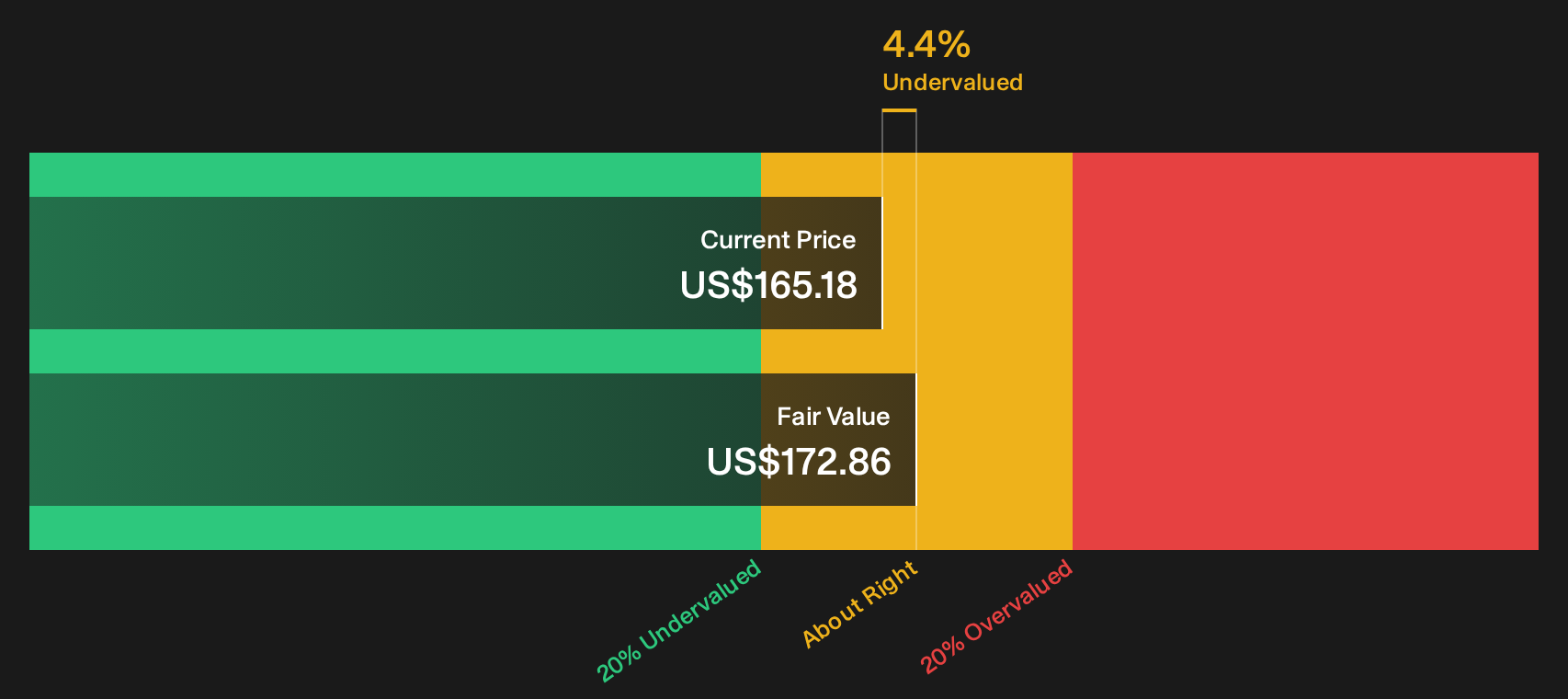
Those projections feed into an estimated intrinsic value of about $172.86 per share in $ terms, which sits only slightly above the recent market price. The implied discount is about 4.4%, so the stock screens close to what the DCF suggests it is worth rather than indicating a large gap. That kind of margin leaves limited protection if Repligen falls short of the cash flow path built into the model.
On this DCF view, Repligen stock appears roughly fairly valued with only a modest implied discount to intrinsic value.
Repligen is fairly valued according to our Discounted Cash Flow (DCF), but this can change at a moment's notice. Track the value in your watchlist or portfolio and be alerted on when to act.
Has Repligen Run Too Far on Sales?
P/S is a clean way to look at Repligen because investors often focus on how much they pay for each dollar of sales in life sciences tools businesses.
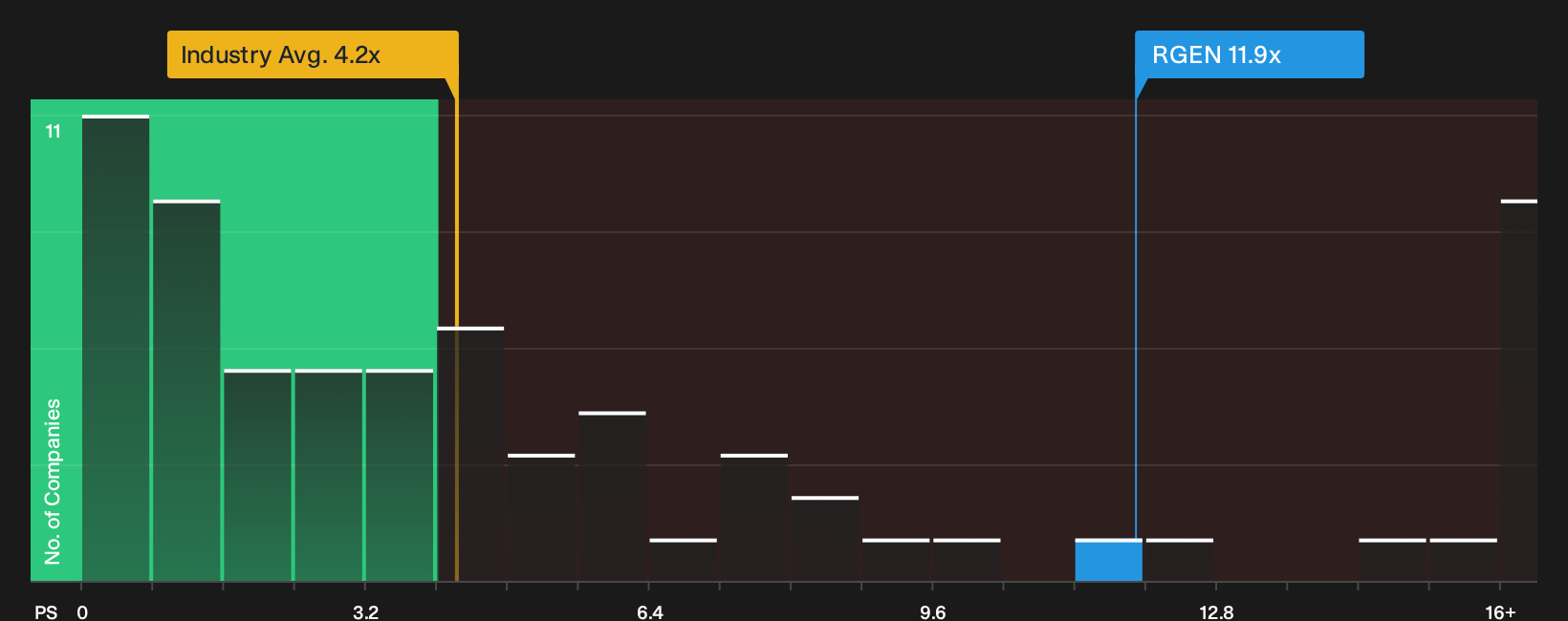
On this yardstick, Repligen trades at about 11.9x P/S. The broader Life Sciences group sits closer to 4.2x, while peers cluster around 7.6x. So the stock carries a clear premium to both the sector and a more direct peer set.
The fair P/S ratio implied by Simply Wall St’s model is about 5.8x. That level already bakes in assumptions about Repligen’s growth profile, margins, size and risk. The current 11.9x multiple is roughly double that reference point, which leaves the shares looking expensive on sales even before considering any stock specific execution risks.
On the P/S framework, Repligen stock screens as overvalued, with investors paying a high price for each dollar of revenue.
See what the numbers say about this price — find out in our valuation breakdown.
The Repligen Narrative: What Would Justify Today's Price?
Repligen's valuation puzzle only really comes into focus once the underlying expectations for growth, profitability and future earnings are spelled out. This is what Simply Wall St Narratives aim to do on the Community page. Each scenario treats fair value as a concrete, testable idea about Repligen's business that can be tracked over time, so you can see how the original assumptions age as new information arrives.
Community views on Repligen could hardly be further apart, with one camp leaning into cancer vaccine exposure and another fixated on deal and funding risks.
Bull case: 12% undervalued
"Strategic push into fast-growing modalities like cell therapy and ADCs, combined with continued innovation in filtration and PAT-enabled systems, is expected to enhance product mix toward higher-margin offerings…"
Read the full Bull Case to see why Repligen could be undervalued
Bear case: 13% overvalued
"Exposure to macroeconomic instability, supply chain disruption, and customer concentration risks could dampen Repligen's future revenue growth and margin expansion efforts…"
Read the full Bear Case to see why Repligen could be overvalued
Do you think there's more to the story for Repligen? Head over to our Community to see what others are saying!
The Bottom Line
Repligen now appears close to its intrinsic value on a Discounted Cash Flow (DCF) basis, with only a small implied discount that does not leave much room for missteps. Market multiples present a tougher picture, since investors are already paying a premium P/S tag for the current revenue base. Broader valuation checks lean cautious, so the burden of proof sits with the business to continue delivering on cash generation. The key question from here is whether demand and margins can sustain expectations that support both the intrinsic value estimate and the elevated sales multiple.
This article by Simply Wall St is general in nature. We provide commentary based on historical data and analyst forecasts only using an unbiased methodology and our articles are not intended to be financial advice. It does not constitute a recommendation to buy or sell any stock, and does not take account of your objectives, or your financial situation. We aim to bring you long-term focused analysis driven by fundamental data. Note that our analysis may not factor in the latest price-sensitive company announcements or qualitative material. Simply Wall St has no position in any stocks mentioned.
Have feedback on this article? Concerned about the content? Get in touch with us directly. Alternatively, email editorial-team@simplywallst.com