
Workiva (WK) Stock Looks Fully Valued After A 53% Five Year Fall
Workiva has seen its share price fall over the longer term, yet the stock still screens as relatively expensive on market multiples. This leaves investors weighing whether the current level fairly reflects its prospects. With a mixed value score and a long stretch of negative returns, the question is how much optimism is already baked into Workiva’s valuation today.
- Workiva shares have declined 53.4% over 5 years, which suggests long term holders have absorbed significant capital pressure even before thinking about valuation.
- The business leans on recurring software revenue and compliance focused customers, which can support steady cash generation. However, any slowdown in client spending or higher costs may weigh on profitability and on what investors are willing to pay for that profile.
- The broader valuation checks paint a mixed picture rather than a clear bargain or clear overvaluation. The value score of 3 hints that some metrics look stretched while others appear more reasonable.
The stock’s next move may depend on whether Workiva’s current price already reflects its operational strengths or whether it still builds in expectations that leave little room for further disappointment.
Compare Workiva’s mixed 5 year record with other software names by scanning hand picked 31 high quality undervalued stocks that pair valuation support with stronger recent momentum.
Has Workiva Run Too Far on Earnings?
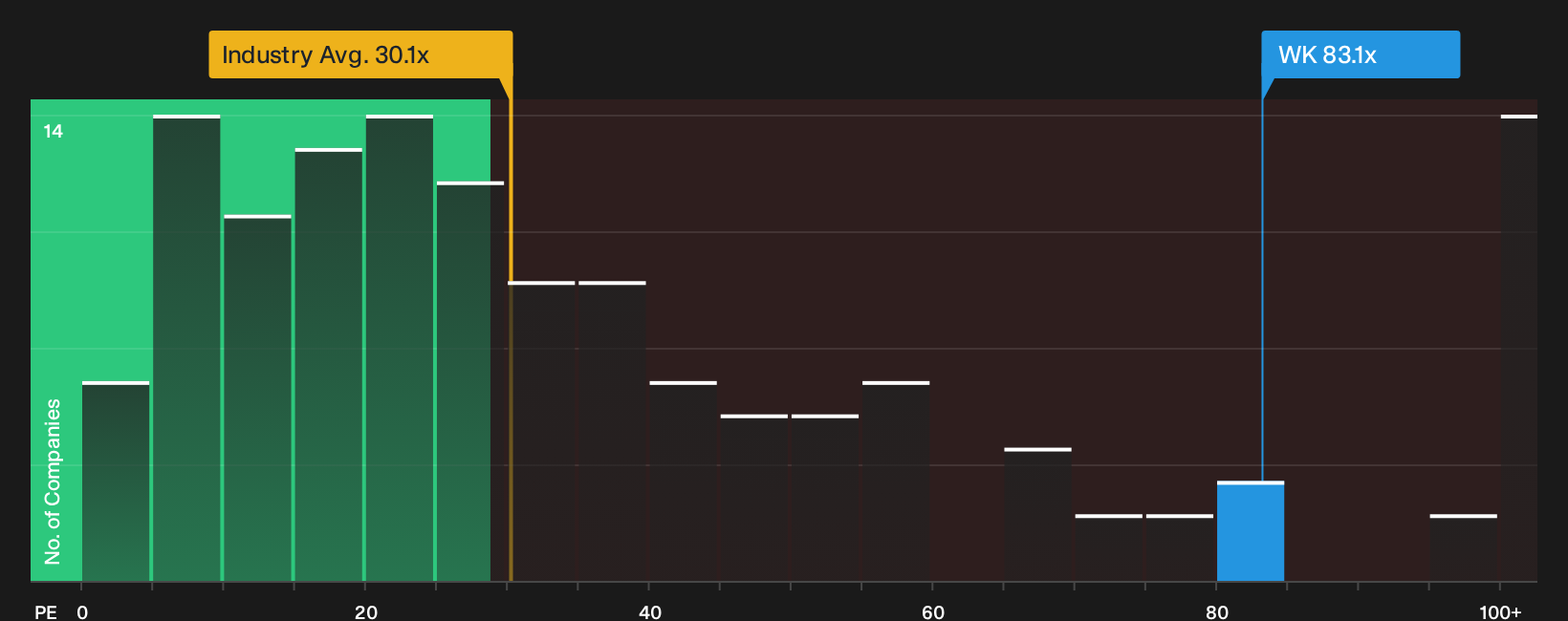
P/E suits Workiva because shareholders focus heavily on the earnings stream that backs its subscription model. On this lens, the stock changes hands at about 83.1x earnings, which is well above the Software sector average of roughly 30.1x and also higher than peers that cluster closer to 55.6x. That places Workiva firmly in premium territory compared with much of its industry.
The fair P/E multiple implied by the broader model is near 42.1x, which is roughly half of where Workiva actually trades. This gap suggests the current market price already reflects a rich view of the company’s earnings profile and risk. For investors, the key question is whether Workiva can keep justifying such a mark up in the face of past share price pressure and the mixed valuation signals elsewhere.
On the P/E yardstick, Workiva stock currently screens as overvalued relative to both tailored and simple comparison benchmarks.
See what the numbers say about this price — find out in our valuation breakdown.
The Workiva Narrative: What Would Justify Today's Price?
Simply Wall St Narratives pick up where Workiva's valuation puzzle leaves off by spelling out which combinations of future growth, margins and earnings would need to play out for the stock to be worth materially more or less than it is today, all housed on the Community page. Each narrative ties a specific number to a clear view of how Workiva's trajectory and risks might evolve, giving you a reference point you can revisit as new information comes through.
Community views on Workiva sit far apart, with one side focusing on regulatory and AI tailwinds while the other worries about execution and contract risk.
Bull case: 24% undervalued
"AI adoption in the office of the CFO is accelerating, but tolerance for error is low."
Read the full Bull Case to see why Workiva could be undervalued
Bear case: 11% overvalued
"The business is pursuing larger multi-solution, multi–six-figure contracts with complex enterprises, banks and governments."
Read the full Bear Case to see why Workiva could be overvalued
Do you think there's more to the story for Workiva? Head over to our Community to see what others are saying!
The Bottom Line
Workiva screens as overvalued on market multiples, which means the current share price already leans on a generous view of its earnings power and risk profile. For you as an investor, the key judgment is whether that premium can hold if growth expectations, cost discipline or client demand fall short of the optimistic case. The crux of the bull versus bear debate is simple. Either recurring, compliance driven revenue keeps justifying a rich P/E, or the valuation compresses if confidence in that earnings trajectory cools.
This article by Simply Wall St is general in nature. We provide commentary based on historical data and analyst forecasts only using an unbiased methodology and our articles are not intended to be financial advice. It does not constitute a recommendation to buy or sell any stock, and does not take account of your objectives, or your financial situation. We aim to bring you long-term focused analysis driven by fundamental data. Note that our analysis may not factor in the latest price-sensitive company announcements or qualitative material. Simply Wall St has no position in any stocks mentioned.
Have feedback on this article? Concerned about the content? Get in touch with us directly. Alternatively, email editorial-team@simplywallst.com