
United Bankshares (UBSI) Stock Looks Cheap On Fair Value But Pricey On Earnings
United Bankshares has delivered strong share price gains over the past few years, yet the valuation checks send a mixed message, with an Excess Returns intrinsic value estimate pointing to upside while earnings based multiples lean the other way. For investors, the puzzle is whether the current US$47.22 price still leaves enough breathing room if expectations cool.
- Over the past 3 years, United Bankshares has returned about 88.9%, which puts extra focus on whether the current level already reflects most of the easy gains.
- The key support for the valuation can come from how consistently the bank converts its lending and fee operations into steady profitability, while the main risk is any hit to credit quality or funding costs that compresses those returns.
- On a broader set of checks, United Bankshares carries a value score of 3, which points to a mixed picture rather than a clear bargain or clear overvaluation.
The issue now is whether the Excess Returns estimate or the richer market multiples end up closer to the mark for United Bankshares at today’s price.
Capitalize on the mixed signals around United Bankshares by comparing it with 31 high quality undervalued stocks, which pairs solid balance sheets with valuations the market may not be fully pricing in yet.Is United Bankshares Still Cheap on Excess Returns?
The Excess Returns approach looks at how much profit United Bankshares can generate above its cost of equity and then capitalizes that surplus into an intrinsic value per share. For this bank, the model starts with a Book Value of $40.33 per share and a Stable EPS estimate of $3.90 per share, based on weighted future Return on Equity projections from 6 analysts. Against a Cost of Equity of $3.08 per share, that leaves an Excess Return of $0.82 per share, supported by an Average Return on Equity of 9.17% and a projected Stable Book Value of $42.58 per share.
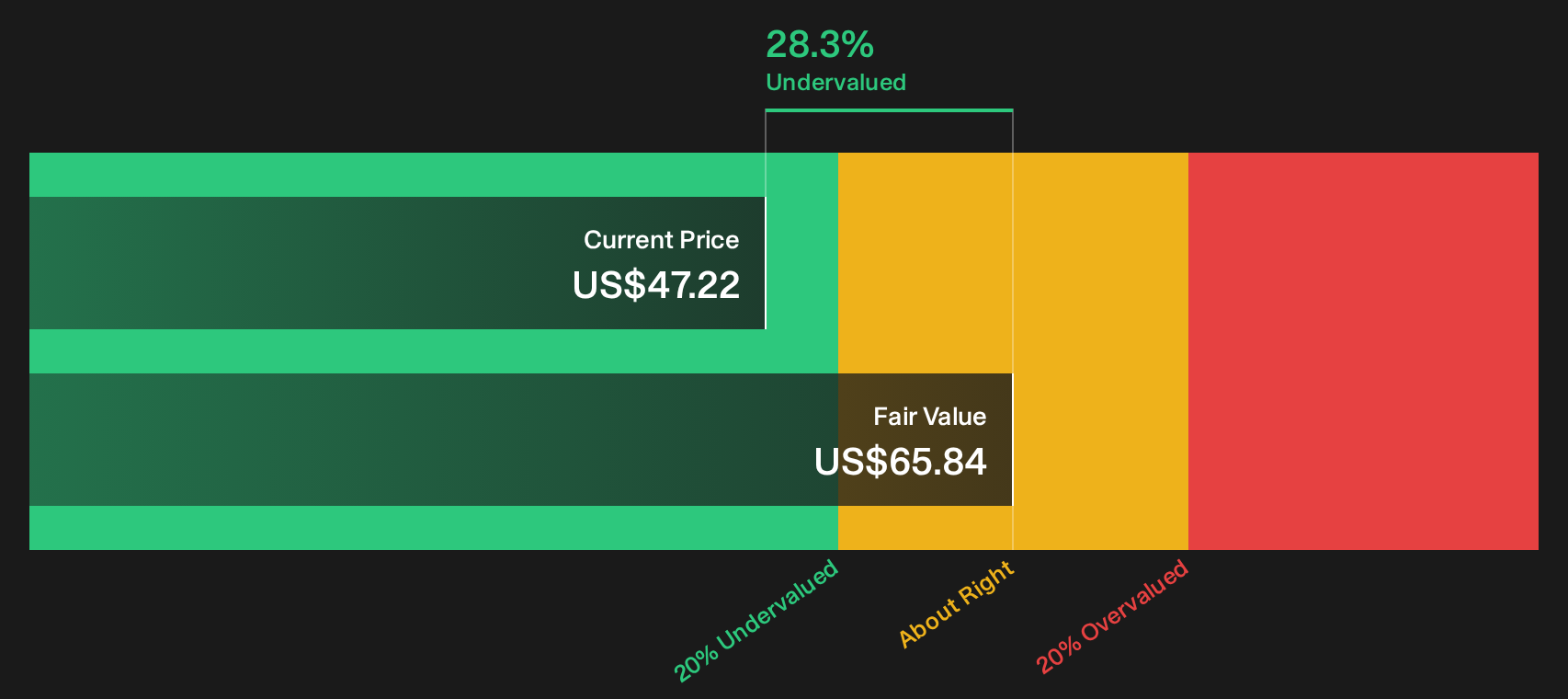
Feeding those inputs into the Excess Returns framework produces an estimated intrinsic value of $65.84 per share. Compared with the recent price around $47.22, the model indicates the stock trades at roughly a 28.3% discount. The gap suggests the market is pricing United Bankshares more cautiously than the model, which assumes sustained, but measured, profitability on the current capital base.
On this Excess Returns view, United Bankshares appears undervalued at recent trading levels.
Our Excess Returns analysis suggests United Bankshares is undervalued by 28.3%. Track this in your watchlist or portfolio, or discover 31 more high quality undervalued stocks.
Does United Bankshares Look Pricey on Earnings?
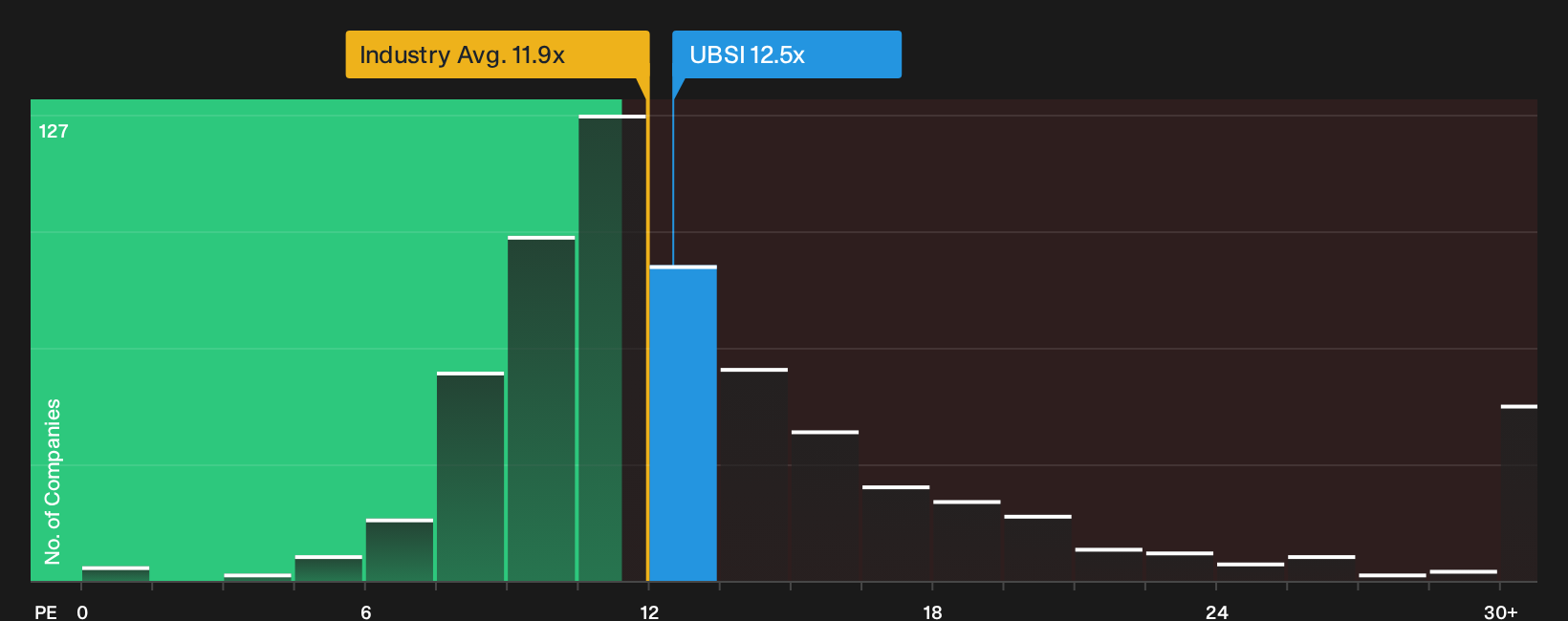
P/E is a clean fit for United Bankshares because earnings power sits at the center of how investors usually judge regional banks. On this measure, the stock trades on about 12.5x earnings, which is slightly above the broader Banks industry on 11.9x and below the peer group average of 14.4x. That places United Bankshares in the middle of the pack rather than at an obviously stretched or rock bottom level compared with other listed banks.
The tailored fair P/E for United Bankshares is 11.2x based on its sector, size and risk profile. Against the current 12.5x, the market is assigning a modest premium to what that framework would suggest is reasonable. For you as a shareholder or potential buyer, the key question is whether the earnings profile and balance sheet quality justify paying a little more than this modeled fair multiple.
On this P/E yardstick, United Bankshares looks slightly overvalued compared with where the fair multiple suggests it should trade.
See what the numbers say about this price — find out in our valuation breakdown.
The United Bankshares Narrative: What Would Justify Today's Price?
Narratives on Simply Wall St extend this valuation puzzle around United Bankshares by spelling out which assumptions on future growth, margins and earnings would need to hold for the shares to be worth materially more or materially less than today’s price, and they sit on the stock's Community page. Each scenario ties a fair value to a particular path for United Bankshares' catalysts and risks so you can track over time which storyline looks closer to reality.
Use this moment to add your own narrative on United Bankshares' valuation and risk trade off so other investors can see how your number driven view stacks up over time. Share a thesis on where its growth, margins and execution go from here, and track how closely United Bankshares' actual results line up with your expectations.
Do you think there's more to the story for United Bankshares? Head over to our Community to see what others are saying!
The Bottom Line
United Bankshares screens as undervalued on the Excess Returns intrinsic value work, while the P/E comparison tilts slightly toward overvalued. That split comes from different levers. The intrinsic value estimate leans on how efficiently the bank can keep turning its equity base into surplus returns, while the market multiple reflects what peers and sentiment are willing to pay for that earnings stream right now. With broader checks pointing to a mixed picture, the key consideration for the next phase is whether profitability and credit quality remain robust enough for the intrinsic value view to prevail instead of the market premium compressing.
This article by Simply Wall St is general in nature. We provide commentary based on historical data and analyst forecasts only using an unbiased methodology and our articles are not intended to be financial advice. It does not constitute a recommendation to buy or sell any stock, and does not take account of your objectives, or your financial situation. We aim to bring you long-term focused analysis driven by fundamental data. Note that our analysis may not factor in the latest price-sensitive company announcements or qualitative material. Simply Wall St has no position in any stocks mentioned.
Have feedback on this article? Concerned about the content? Get in touch with us directly. Alternatively, email editorial-team@simplywallst.com