
Repsol (BME:REP) Stock Could Trade At A 42% Discount On Cash Flow
Repsol has delivered very strong share price gains over the past five years, yet its current market price and an intrinsic value estimate based on a Discounted Cash Flow (DCF) approach still point in different directions on how much is already reflected.
- Over the past 5 years the stock has returned 267.0%, which sets a high bar for any further upside argument.
- Future cash flow from the energy portfolio can support the DCF estimate. At the same time, exposure to commodity cycles may limit how much value investors are willing to ascribe to those cash streams.
- The broader checks give a mixed picture rather than a clear bargain or clear overvaluation, with Repsol scoring 4 out of 6 on value tests.
The issue now is whether Repsol's current share price already reflects most of that underlying cash flow potential or still leaves a reasonable gap to the intrinsic value estimate.
Compare Repsol's run with a curated set of other value ideas by scanning the 183 high quality undervalued stocks, which highlights companies that combine solid cash generation with potential for sentiment to improve.
Is Repsol a Bargain on Cash Flow?
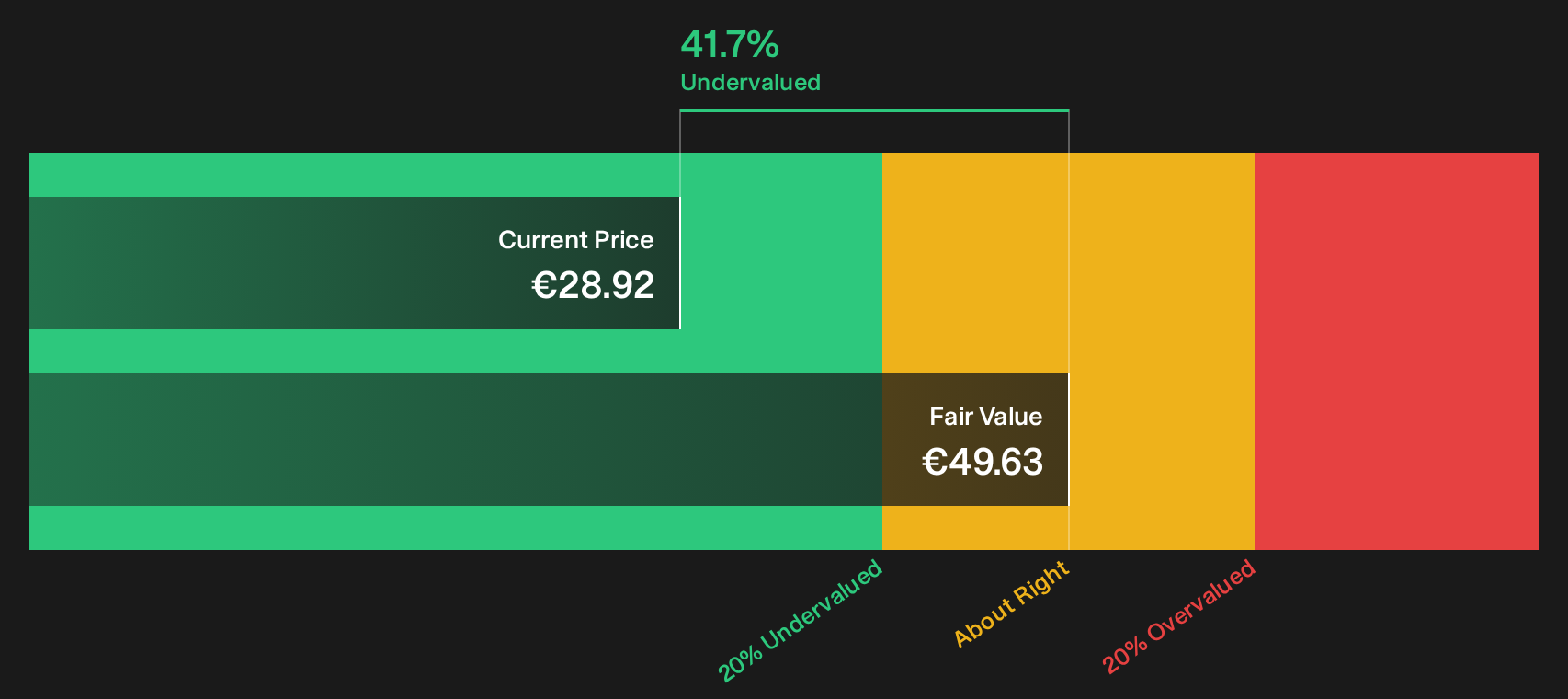
The Discounted Cash Flow model projects the cash that Repsol might generate for shareholders and then works back to what that stream could be worth today. Repsol currently produces around €1.27b in free cash flow over the latest twelve months, with the model assuming that these cash flows grow rather than shrink over time. On that basis, the 2 Stage Free Cash Flow to Equity framework points to an estimated intrinsic value of about €49.63 per share.
Set against the current market price, that intrinsic value implies the stock trades at roughly a 41.7% discount. For a business closely tied to oil and gas prices, the key question is how comfortable you are with the long term cash flow path that underpins that gap. The DCF outcome suggests the market is placing a sizable caution discount on those projected cash streams.
On this DCF view, Repsol stock appears undervalued relative to the cash flows currently built into the model.
Our Discounted Cash Flow (DCF) analysis suggests Repsol is undervalued by 41.7%. Track this in your watchlist or portfolio, or discover 183 more high quality undervalued stocks.
Is Repsol Fairly Priced on Earnings?
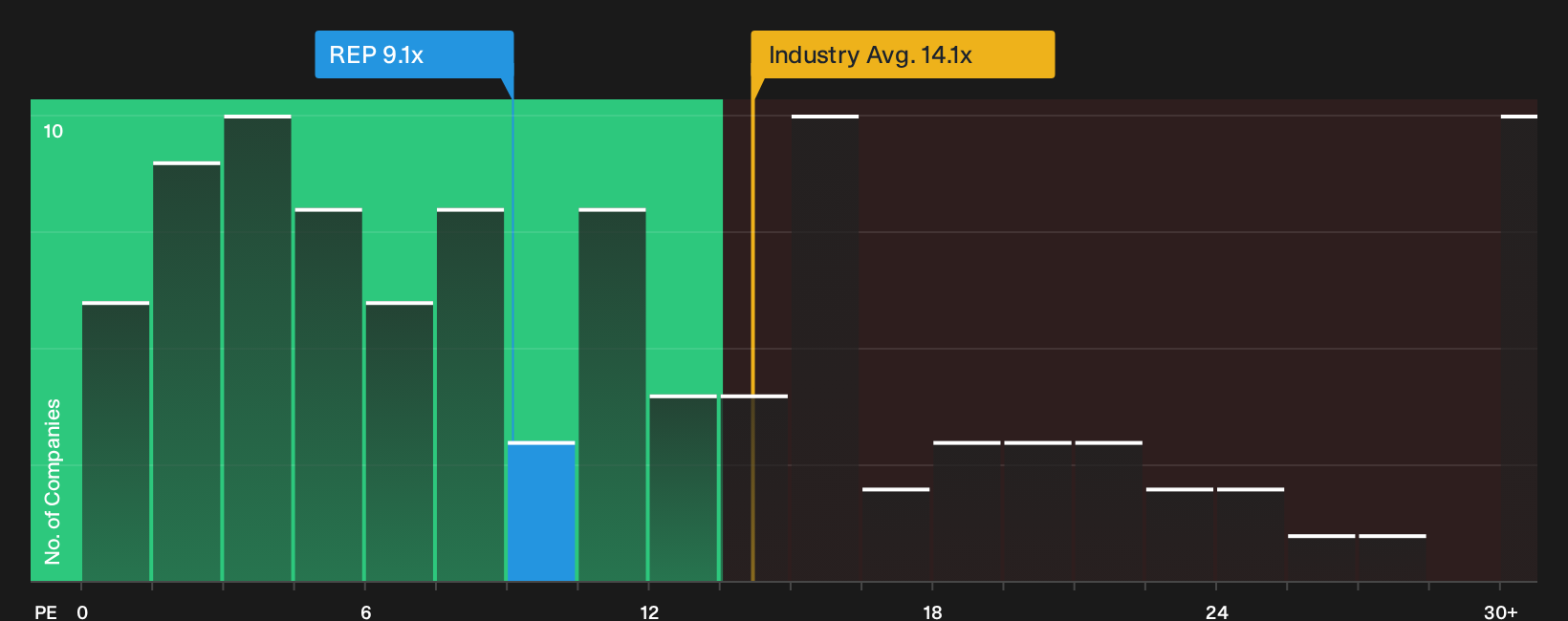
P/E is a useful measure for Repsol because earnings are a central yardstick for a mature energy producer with a long record of generating profit through cycles.
The stock currently trades on a P/E of about 9.1x. That is below the wider oil and gas sector average of roughly 13.3x, yet slightly above the peer group figure of around 8.3x. A tailored fair P/E for Repsol, which takes account of its profitability profile, risk and size, is near 9.9x. The gap between the current multiple and this fair ratio is modest, which suggests the market is not applying an extreme discount or premium to Repsol's earnings.
For an investor weighing the DCF gap against what the earnings multiple implies, the P/E picture points to a stock that already carries a broadly reasonable earnings tag rather than a clear mispricing.
On the P/E yardstick, Repsol appears roughly fairly valued relative to what the model treats as a reasonable earnings multiple.
See what the numbers say about this price — find out in our valuation breakdown.
The Repsol Narrative: What Would Justify Today's Price?
Simply Wall St Narratives pick up where the Repsol valuation puzzle leaves off by spelling out which combinations of growth, margins and earnings would logically support a meaningfully higher or lower share price than today’s. Each story ties Repsol's possible catalysts and risks to a specific fair value anchor, so you can track over time which version of events comes closest to how the business actually develops.
Community views on Repsol split into two very different stories about what drives value from here.
Bull case: 19% undervalued
"Repsol's trading, refining, and chemicals platforms are set to deliver upside as structural shifts in European energy markets and persistent supply-demand imbalances are supporting record refining and product margins…"
Read the full Bull Case to see why Repsol could be undervalued
Bear case: roughly fairly valued
"Growing regulatory pressure and increasing carbon pricing in Europe and internationally will raise Repsol's operational costs and reduce net margins for hydrocarbon-based activities over time…"
Read the full Bear Case to see why Repsol could be overvalued
Do you think there's more to the story for Repsol? Head over to our Community to see what others are saying!
The Bottom Line
Repsol screens as undervalued on a Discounted Cash Flow (DCF) view, with the intrinsic value estimate pointing to a sizeable gap to the current share price. The P/E work suggests the market is pricing the business at about the going rate for its earnings profile, so the multiple view is more neutral.
That split rests on how much faith you place in future free cash flow from a capital intensive, commodity exposed portfolio. The key question from here is whether the discount to intrinsic value compensates you for that risk or whether the market is correctly treating it as a potential value trap.
This article by Simply Wall St is general in nature. We provide commentary based on historical data and analyst forecasts only using an unbiased methodology and our articles are not intended to be financial advice. It does not constitute a recommendation to buy or sell any stock, and does not take account of your objectives, or your financial situation. We aim to bring you long-term focused analysis driven by fundamental data. Note that our analysis may not factor in the latest price-sensitive company announcements or qualitative material. Simply Wall St has no position in any stocks mentioned.
Have feedback on this article? Concerned about the content? Get in touch with us directly. Alternatively, email editorial-team@simplywallst.com