
Could Atogepant Trial Win Change The Bull Case For AbbVie Stock (ABBV)?
- AbbVie reported that atogepant reduced menstrual migraine days by 0.80 more days than placebo in the Phase 3 LUNA trial, meeting the primary and all ranked secondary endpoints in adults.
- The targeted seven day dosing window around menstruation suggests AbbVie may be able to position atogepant as a focused, intermittent prevention option within its broader neuroscience portfolio.
- We will now assess how AbbVie’s broad earnings narrative could shift if intermittent atogepant use expands its migraine treatment reach.
Scan how AbbVie’s dividend and late stage pipeline news compare with other potential opportunities by reviewing our hand picked 6 dividend fortresses alongside your existing income ideas.
AbbVie Investment Narrative Recap
To own AbbVie, you need to believe its immunology and neuroscience engines can comfortably shoulder life after Humira while pricing and regulatory pressure stay manageable. In the near term, the story still leans on execution in Skyrizi, Rinvoq and the migraine portfolio. The LUNA result fits that script, but the key short term catalyst remains overall earnings delivery rather than a single trial win.
The biggest current risk is concentration in a few blockbuster franchises, layered on top of high debt and negative equity, with a dividend that is not fully covered by earnings. The new quarterly dividend of US$1.73 per share does not change that equation in a material way right now.
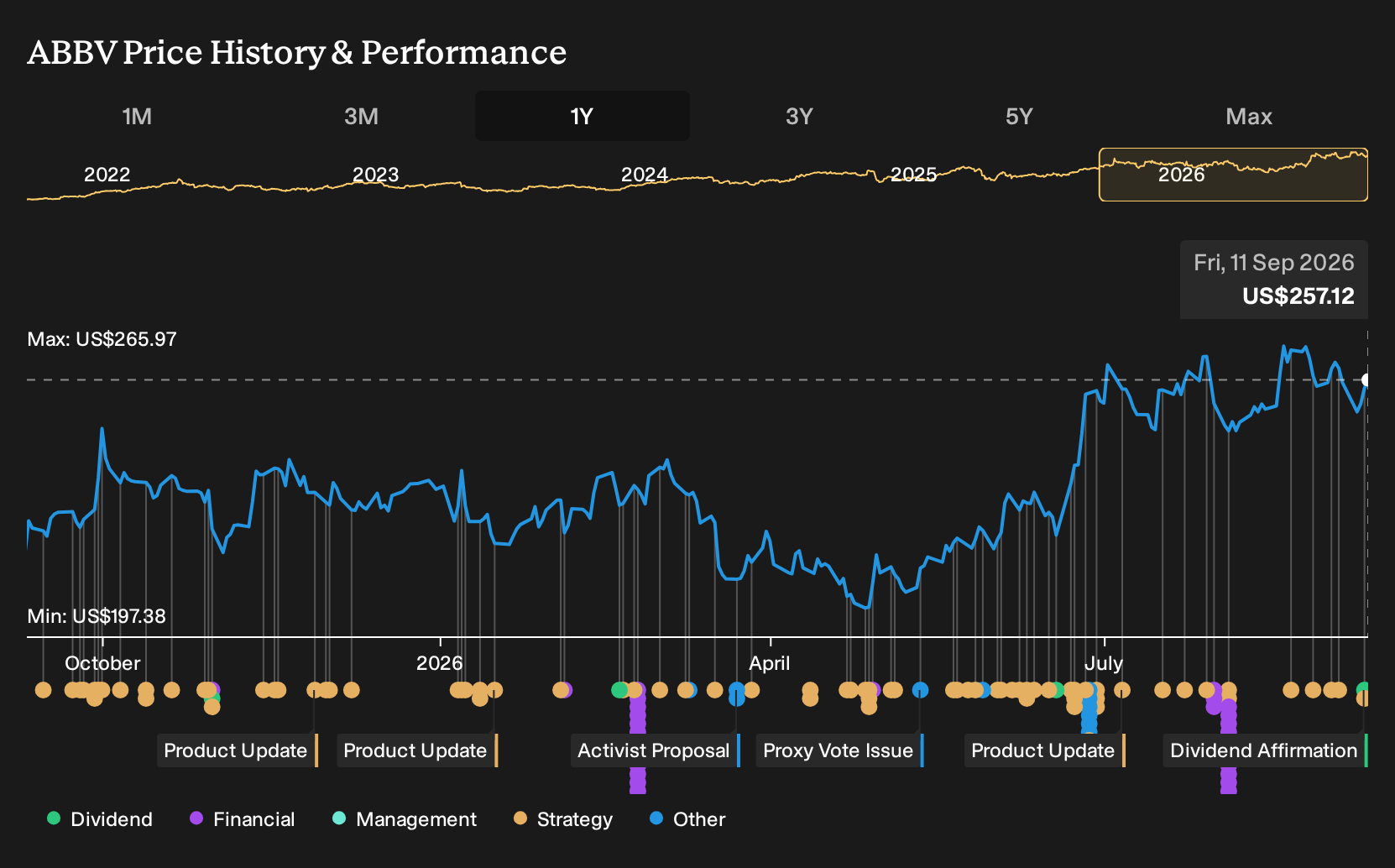
The dividend affirmation on 10 September 2026 is the most directly relevant announcement here. AbbVie’s board declared a quarterly cash payout of US$1.73 per share, payable on 16 November to holders of record on 15 October. For income focused investors, that keeps the income stream visible while the business relies on newer therapies to support cash generation.
There is a trade off for you to weigh. Earnings are expected to grow at a healthy clip, yet the payout is flagged as not well covered and the balance sheet carries high leverage and negative equity. In that context, the reaffirmed dividend becomes part of the catalyst set alongside drug data like LUNA, because both ultimately need to be backed by durable, cash producing franchises.
What AbbVie’s Long Range Forecast Implies
AbbVie now sits on a detailed earnings road map that analysts have tried to quantify in hard numbers rather than general optimism. The core of that picture is a call for 8.2% yearly revenue growth over the next three years and a sharp improvement in profit margins from 9.7% today to 30.2% by 2029. That shift would move the business from a relatively thin margin profile to something far closer to a high cash conversion engine, which matters for dividend support and debt reduction.
Consensus forecasts currently point to earnings rising from US$6.3b today to US$24.6b by 2029. That is roughly a 4x increase in profit over the period, with the most optimistic analysts at US$30.3b and the most cautious closer to US$19.2b. The wide range underlines how much uncertainty remains around execution in immunology, neuroscience and the rest of the late stage pipeline. For you as an investor, this band of outcomes is a reminder to treat any single point forecast as a scenario, not a certainty.
Analysts are using those 2029 earnings of US$24.6b and an earnings per share figure of US$14.1 to back into a future P/E of 24.5x, compared with 68.7x today and about 17.6x for the wider GB biotech group. That required multiple still sits above the sector average, which implies the market would need to keep assigning AbbVie a premium rating in exchange for its mix of franchises and pipeline candidates. Share count is assumed to be broadly flat over the next three years, so any change in earnings power feeds straight through to per share figures rather than being diluted by heavy issuance.
On the revenue side, the same framework ties the analyst price targets to a 2029 top line of US$81.5b. The discount rate used in this build up is around 7.6% to 7.64%, which is intended to reflect both business risk and the time value of money when turning those future earnings into a present value. You do not need to agree with that exact rate, but you do need some view on what kind of compensation you want for holding a highly concentrated large cap drug producer through multiple product cycles.
AbbVie’s narrative projects US$81.5b revenue and US$24.6b earnings by 2029. This assumes 8.2% yearly revenue growth and roughly a 4x earnings increase from US$6.3b today.
Uncover why AbbVie's fair value indicates a 6% potential upside to its current price that could narrow quickly.
Exploring Other Perspectives
Three members of the Simply Wall St Community currently place AbbVie’s fair value between about US$273 and US$448 per share, a very wide band for one ticker. You are seeing private investors handicapping patent risk, drug pricing pressure and late stage trial outcomes differently. That spread invites you to compare several sharply contrasting views.
Explore 2 other AbbVie fair value estimates, including one that suggests it could be worth just $273.39.
The Verdict Is Yours
Don't just follow the ticker. Dig into the data and build a conviction that's truly your own.
- A great starting point for your AbbVie research is our analysis highlighting 3 key rewards and 4 important warning signs that could impact your investment decision.
- See our latest analysis for AbbVie. The report includes a comprehensive fundamental analysis summarized in a single visual, the Snowflake, making it easy to evaluate AbbVie's overall financial health at a glance.
Looking For More Investment Ideas Beyond AbbVie?
If AbbVie has sharpened your thinking about income, risk and concentration, it can be useful to compare it with a wider watchlist built from clear filters on quality, balance sheet strength and payout profile.
- If capital preservation is high on your list, start with resilient businesses by reviewing 11 resilient stocks with low risk scores that may better match your comfort with volatility.
- For investors who want growth potential without paying up blindly, scan a curated set of attractively priced opportunities through the 31 high quality undervalued stocks that could complement or compete with AbbVie in your portfolio.
- If financial resilience matters more to you than headline stories, focus on companies with robust finances via the list of solid balance sheet and fundamentals (23 results) and see which ones earn a spot on your radar.
This article by Simply Wall St is general in nature. We provide commentary based on historical data and analyst forecasts only using an unbiased methodology and our articles are not intended to be financial advice. It does not constitute a recommendation to buy or sell any stock, and does not take account of your objectives, or your financial situation. We aim to bring you long-term focused analysis driven by fundamental data. Note that our analysis may not factor in the latest price-sensitive company announcements or qualitative material. Simply Wall St has no position in any stocks mentioned.
Have feedback on this article? Concerned about the content? Get in touch with us directly. Alternatively, email editorial-team@simplywallst.com