
How Upcoming Earnings At AmEx Stock Has Changed Its Investment Story
- American Express is back in focus as investors look ahead to an October 23, 2026 earnings release that analysts currently expect to show year over year gains in both revenue and profit, supported by slightly higher forecast estimates in recent days.
- The card issuer's role as a major holding in Berkshire Hathaway's portfolio, combined with five consecutive years of dividend increases, highlights how the business continues to lean on consistent cash generation and shareholder returns as central parts of its story.
- We will look at how American Express's investment narrative is influenced by anticipated earnings growth and recent positive estimate revisions.
Scan beyond American Express and line up other potential value plays with steady fundamentals using our curated 16 high quality undiscovered gems.
American Express Investment Narrative Recap
To own American Express, you need to believe the integrated payments model and premium focus can keep attracting high spending customers while preserving attractive economics. The near term hinge point is execution around the October earnings release and what it says about billed business, card fee momentum, and credit quality across consumer and commercial borrowers.
The biggest operational risk right now is competitive pressure in premium cards and rewards, which can push up variable customer engagement costs faster than revenue. Shifts toward mobile wallets, BNPL, and real time payment options matter, but this earnings print is unlikely to change those structural challenges in a material way.
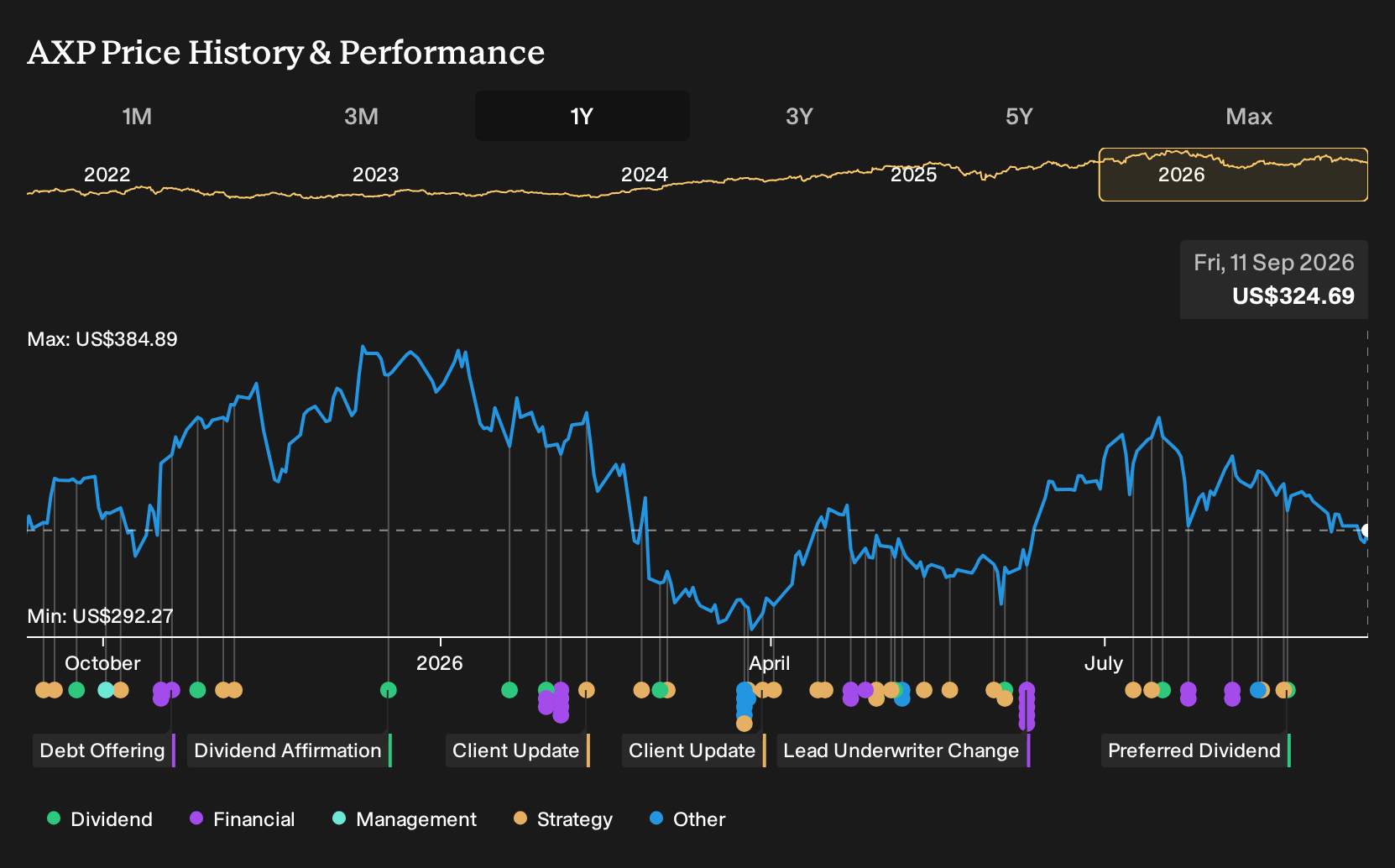
The recent spotlight on American Express as a key Berkshire Hathaway holding, alongside a 13.3% year to date share price decline, puts capital allocation and cash generation back under the microscope. Five consecutive years of dividend increases and ongoing buybacks reflect management’s emphasis on shareholder returns, which link directly to earnings durability.
For you as an investor, the Berkshire endorsement and dividend track record are only as useful as the underlying engines that support them. The October 23, 2026 report will provide new evidence on whether premium cardmember acquisition, international billed business, and credit trends are strong enough to support that capital return profile without stretching the balance sheet.
American Express Forecasts Behind The Current Debate
American Express' long term story in analyst models leans heavily on what the income statement might look like in the late 2020s rather than just the next quarter. Forecasts point to revenue rising by 11.4% each year over the next three years, with profit margins easing from 16.1% today to 15.5% by year three.
Consensus projections currently anchor around earnings reaching US$14.8b by 2029, compared with US$11.1b in earnings today, which is an increase of about US$3.7b. Some forecasts stretch higher toward US$16.5b, yet the central case you see repeated is that US$14.8b figure tied to earnings per share of US$23.16.
To keep those numbers internally consistent, analysts build in a modest reduction in the share count, with projected declines of 1.95% per year over the next three years as buybacks retire stock. That shrinking base of shares is what allows earnings per share to grow faster than total profit if everything in the model holds together.
Valuation work on American Express then layers a P/E assumption on top of those future profits. The current framing uses a P/E of 20.7x on the 2029 earnings estimate, compared with 21.6x today and the US consumer finance peer group at 8.7x, combined with a discount rate around 8.2% to pull those future cash flows back into today’s money.
American Express' narrative projects US$95.1b revenue and US$14.8b earnings by 2029. This requires 11.4% yearly revenue growth and an earnings increase of about US$3.7b from US$11.1b.
Uncover why American Express' fair value indicates a 15% potential upside to its current price that may not last much longer.
Exploring Other Perspectives
You might see the Visa and Mastercard KYA project and wonder if American Express can keep up with that kind of AI heavy payment infrastructure. The most optimistic analysts were already penciling in about US$98.7b of revenue and US$16.3b in earnings by 2029. Those pre news forecasts could shift as this interoperability story develops.
Explore 6 other American Express fair value estimates, including one that suggests as much as 36% potential upside from the current price.
The Verdict Is Yours
Don't just follow the ticker. Dig into the data and build a conviction that's truly your own.
- A great starting point for your American Express research is our analysis highlighting 3 key rewards and 1 important warning sign that could impact your investment decision.
- See our latest analysis for American Express. The report includes a comprehensive fundamental analysis summarized in a single visual, the Snowflake, making it easy to evaluate American Express' overall financial health at a glance.
Looking For More Investment Ideas Beyond American Express?
Once you have a handle on American Express, it can help to widen the lens and compare it with other businesses that fit different risk and income profiles using the Simply Wall St Screener.
- If you want potential mispricings with strong fundamentals on your radar, scan through our 31 high quality undervalued stocks and see which companies line up with your return and quality expectations.
- For investors who care most about income resilience, focus on our 6 dividend fortresses and spot which payouts may better match your dividend goals.
- When capital preservation ranks high on your list, filter for companies via our 11 resilient stocks with low risk scores to find candidates that may better fit a more cautious approach.
This article by Simply Wall St is general in nature. We provide commentary based on historical data and analyst forecasts only using an unbiased methodology and our articles are not intended to be financial advice. It does not constitute a recommendation to buy or sell any stock, and does not take account of your objectives, or your financial situation. We aim to bring you long-term focused analysis driven by fundamental data. Note that our analysis may not factor in the latest price-sensitive company announcements or qualitative material. Simply Wall St has no position in any stocks mentioned.
Have feedback on this article? Concerned about the content? Get in touch with us directly. Alternatively, email editorial-team@simplywallst.com