
3 Financial Stocks Worth Watching As Higher Rates Lift Bank And Insurer Earnings
Central banks are turning more hawkish at the same time energy prices stay stubbornly high, and that mix is quietly rewiring how money flows through global markets. Higher policy rates can punish stretched valuations, yet they also reshape what banks and insurers earn on loans and investment portfolios. This article unpacks that story and profiles 3 stocks from our Global Banks and Insurers Benefiting from Higher Interest Rates screener that appear particularly exposed to this new rate reality.
The three stocks below are just a sample from this theme. The full screen surfaced 31 more large banks, insurers and diversified financials with equally compelling rate-related narratives that are not covered here. To go straight to the source, analyze and identify your own highest conviction ideas using the Global Banks and Insurers Benefiting from Higher Interest Rates screener.
Sony Financial Group (TSE:8729)
Overview: Sony Financial Group is a Tokyo based financial services group focused on life and non life insurance, banking and related services in Japan.
Operations: Sony Financial Group generates about ¥2.5t from life insurance, ¥197.8b from non life insurance and ¥137.1b from banking, almost entirely in Japan.
Market Cap: ¥1.1t
Sony Financial Group sits in the center of this theme, with a mix of insurance float and banking assets that can react to changes in Bank of Japan policy rates.
"A rising interest rate environment that supports Sony Bank's net interest margin and improves lending deposit spreads, which can help reinforce banking segment revenue and adjusted net income."
What really decides how much of that rate benefit reaches shareholders is one unresolved pressure on earnings quality and capital deployment.
That pressure point is exactly what the full narrative for Sony Financial Group unpacks, highlighting where rate tailwinds could accelerate and where capital allocation choices might still be masking the full story.

Prudential (LSE:PRU)
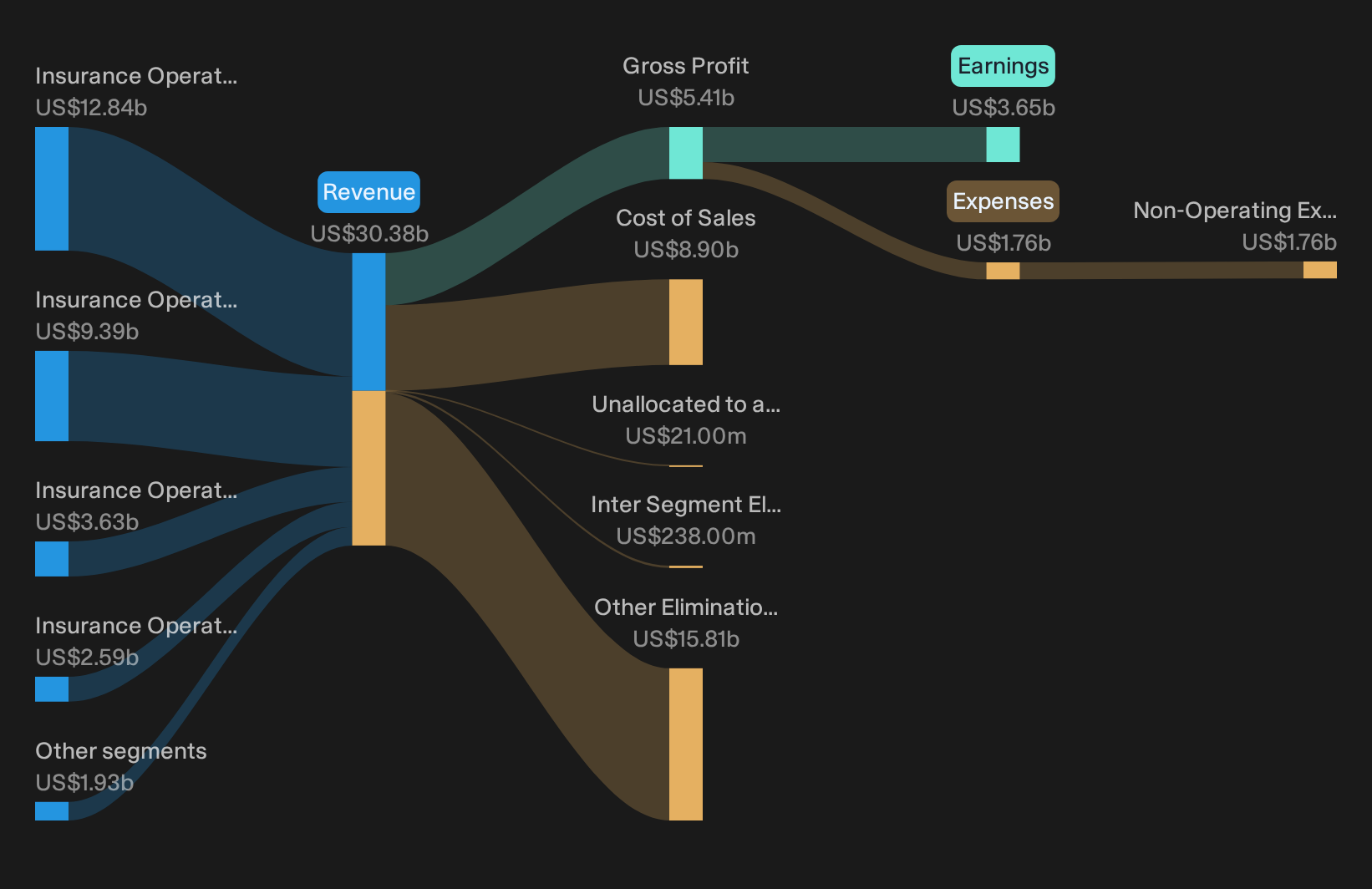
Overview: Prudential is a long established life and health insurer and asset manager focused on savings, protection and investment products across Asia and Africa, where higher interest rates influence what it earns on large bond portfolios.
Operations: Prudential generates about US$12.8b from Hong Kong insurance, US$9.4b from Singapore, US$3.6b from growth markets, US$2.6b from Malaysia and US$1.3b from Indonesia, alongside US$671m from Eastspring asset management.
Market Cap: £24.3b
Prudential sits neatly within this higher rate theme because its large pool of policyholder funds and investment assets can earn more income when bond yields rise. At the same time, its Asia focused insurance franchise gives it room to reshape products and pricing as funding costs, inflation and customer needs all shift at once.
"Significant ongoing investment in digital transformation, predictive analytics, technology modernization, and product innovation is set to drive operational efficiency, improve customer engagement, and enhance underwriting and claims management, supporting upward movement in net margins and earnings as these enhancements scale."
What happens to those margin ambitions if one quiet pressure on how Prudential funds and prices this growth moves against expectations?
If that funding piece is what you keep circling back to, the full narrative for Prudential shows where Prudential’s growth story may be accelerating or quietly stalling.
Standard Chartered (LSE:STAN)
Overview: Standard Chartered is a London headquartered international bank that provides lending, deposits, wealth and transaction services across Asia, Africa and other key markets.
Operations: Standard Chartered generates about US$12.5b from Corporate & Investment Banking and US$8.6b from Wealth & Retail Banking, with smaller central adjustments.
Market Cap: £50.1b
Standard Chartered is almost purpose built for a higher rate world, with a balance sheet tilted to Asia and emerging markets where stronger net interest margins can matter most for returns.
"The company is strongly positioned to benefit from robust economic growth and growing financial services demand in Asia and other emerging markets, as evidenced by double-digit income growth in Global Banking, Global Markets, and Wealth Solutions; continued geographic expansion and growing client onboarding is likely to drive sustainable top-line growth."
What really decides how much of that rate support turns into lasting profit is whether one quiet pressure on asset quality stays contained.
If that asset quality question is what you keep coming back to, the full narrative for Standard Chartered shows where risks may be contained and where earnings power could be accelerating.
Seeking Fresh Alternatives Before They Fly
Market breakouts rarely wait. Momentum builds, early data points start dropping, and the chance to spot fresh stock ideas under the radar for now can vanish quickly, so get in early.
- Spot income workhorses with sturdy cash flows and resilient payouts by scanning a curated 19 dividend fortresses before yield hunters swarm the same opportunities.
- Track early movers powering data centers, chips and networking as AI demand ramps up by filtering a focused set of 89 AI infrastructure stocks while these stories are still forming.
- Hunt for underfollowed producers that can respond when metal prices swing by zeroing in on a hand picked 29 top copper producer stocks before market attention catches up.
This article by Simply Wall St is general in nature. We provide commentary based on historical data and analyst forecasts only using an unbiased methodology and our articles are not intended to be financial advice. It does not constitute a recommendation to buy or sell any stock, and does not take account of your objectives, or your financial situation. We aim to bring you long-term focused analysis driven by fundamental data. Note that our analysis may not factor in the latest price-sensitive company announcements or qualitative material. Simply Wall St has no position in any stocks mentioned.
Have feedback on this article? Concerned about the content? Get in touch with us directly. Alternatively, email editorial-team@simplywallst.com