
What Kroger (KR)'s Earnings Beat Means For Shareholders
- Kroger reported second quarter 2026 results with US$34.62b in sales and US$641m in net income, with earnings per share of US$1.05 from continuing operations.
- Management paired this profit beat with a lower full year sales outlook, pointing to pharmacy headwinds, produce issues, cautious shoppers, and ongoing investment in e commerce and the planned Giant Eagle acquisition.
- The focus now turns to how Kroger's profit beat but softer sales outlook could reshape the longer term investment narrative.
Kroger Investment Narrative Recap
To own Kroger, you need to be comfortable with a slow growing, heavily invested grocery chain that is leaning on cost savings, private label, and e commerce to support earnings while top line momentum is constrained. The latest quarter fits that picture. Profitability looked healthy, but the softer sales outlook and pharmacy and produce issues keep near term revenue progress muted.
The key short term swing factor is whether Kroger can keep lifting profits through cost control and mix while identical sales guidance sits at 0.2% to 0.8%. The biggest current risk is that pharmacy headwinds, regulatory scrutiny on pricing accuracy, and ongoing digital and Giant Eagle spending erode that margin cushion faster than management can offset.
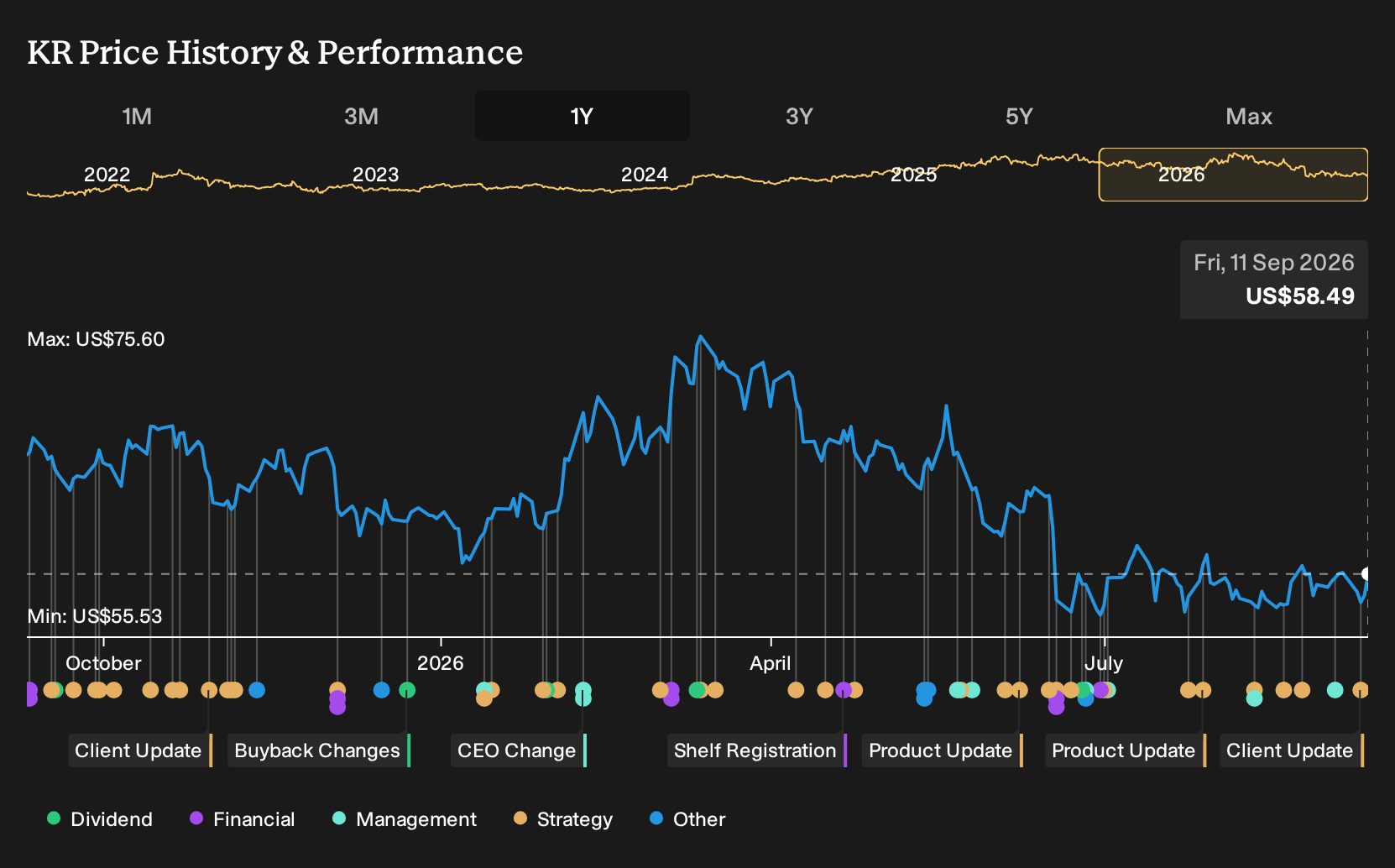
The most relevant recent move for shareholders is the large buyback program. From May 24 to August 15, Kroger repurchased about 16.6 million shares for roughly US$986m, completing a broader plan that retired around 133.7 million shares for US$8.69b. That is a sizeable shrink in the share count against a market value of about US$35b.
For you, the buyback ties directly into the near term catalyst. If Kroger can hold its earnings guidance while reducing shares outstanding, reported EPS can remain supported even with slower identical sales. The operational test is whether cash generation stays solid enough to fund e commerce, store investments, and the planned Giant Eagle deal without stretching a balance sheet that already carries a high level of debt.
Kroger's narrative projects US$159.0b revenue and US$3.2b earnings by 2029. This requires 2.3% yearly revenue growth and a roughly US$2.2b earnings increase from US$1.0b today.
Uncover why Kroger's fair value indicates a 21% potential upside to its current price that could narrow quickly.
Exploring Other Perspectives
Some of the lowest Kroger analysts focus on retail media as the swing factor. They were penciling in about US$156.3b of revenue and US$2.7b of earnings by 2029, which is much more cautious than consensus. If this earnings beat, softer sales guidance, and the new buyback tranche change that view, you may see those pessimistic narratives shift.
Explore 3 other Kroger fair value estimates, including one that suggests it could be worth just $70.71.
Decide For Yourself
Disagree with existing narratives? Extraordinary investment returns rarely come from following the herd, so go with your instincts.
- A great starting point for your Kroger research is our analysis highlighting 2 key rewards and 4 important warning signs that could impact your investment decision.
- See our latest analysis for Kroger. The report includes a comprehensive fundamental analysis summarized in a single visual, the Snowflake, making it easy to evaluate Kroger's overall financial health at a glance.
Looking for more ideas beyond Kroger?
If the Kroger story has sharpened your thinking and you want to broaden your watchlist, the Simply Wall St Screener can help you quickly filter for other opportunities that match the kind of risk and quality profile you prefer.
- If you want potential growth with strict balance sheet discipline, start by scanning the 11 resilient stocks with low risk scores that keep overall risk scores in check.
- For those hunting for resilient cash generators at appealing valuations, focus on companies in the 31 high quality undervalued stocks that combine financial strength with pricing that may look undemanding.
- Income focused investors who care about consistency and payout strength can filter opportunities using the 6 dividend fortresses that target higher yielding dividend payers.
This article by Simply Wall St is general in nature. We provide commentary based on historical data and analyst forecasts only using an unbiased methodology and our articles are not intended to be financial advice. It does not constitute a recommendation to buy or sell any stock, and does not take account of your objectives, or your financial situation. We aim to bring you long-term focused analysis driven by fundamental data. Note that our analysis may not factor in the latest price-sensitive company announcements or qualitative material. Simply Wall St has no position in any stocks mentioned.
Have feedback on this article? Concerned about the content? Get in touch with us directly. Alternatively, email editorial-team@simplywallst.com