
Qorvo (QRVO) Stock Could Be 33% Overvalued As Merger Review Nears Completion
Qorvo has delivered a strong run this year, yet both the Discounted Cash Flow (DCF) intrinsic value estimate and market multiple checks point to the shares trading at a premium rather than offering clear value. The recent merger driven optimism around the proposed tie up with Skyworks Solutions adds extra attention to a stock that already screens as expensive on broad valuation tests.
- Year to date, Qorvo is up 35.2%, which puts recent gains front and center when assessing whether the current price leaves enough room for error.
- Progress toward completion of the Skyworks merger can support expectations for future cash flows, while any delay or change in terms may challenge how much investors are willing to pay for those prospects.
- With a value score of 2 out of 6, Qorvo currently leans expensive and does not screen as a straightforward bargain on the broader valuation checks.
The issue now is whether Qorvo's recent climb and merger optimism leave the stock priced above a reasonable view of its intrinsic value.
Spot opportunities beyond Qorvo's merger surge by scanning 31 high quality undervalued stocks. Focus on candidates that combine recent momentum with balance sheets and cash flows that currently screen as more reasonably priced.Is Qorvo Getting Expensive on Cash Flow?
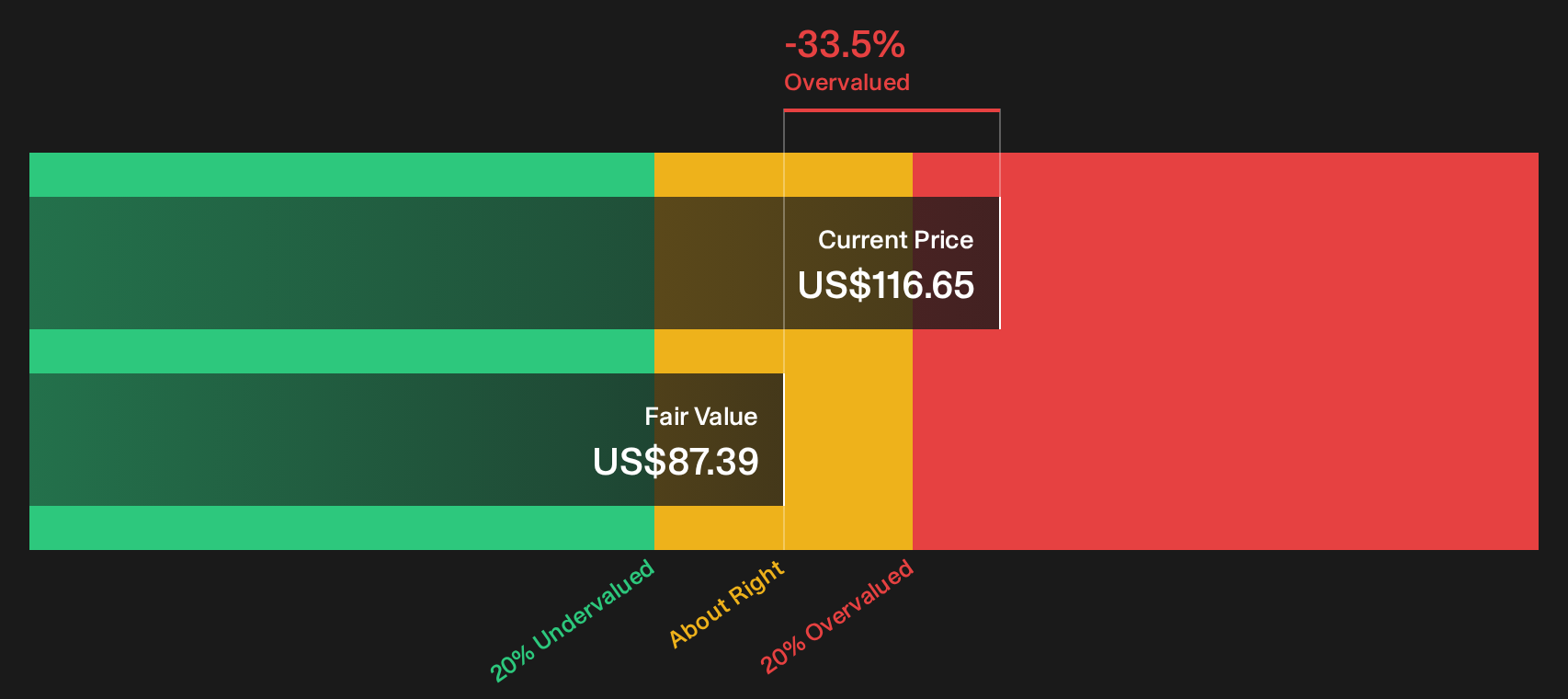
The Discounted Cash Flow (DCF) model values Qorvo by projecting future free cash generation and discounting it back to today. On the latest twelve month numbers, the business is producing roughly $643 million of free cash flow, and the model assumes cash flows continue growing rather than shrinking from here. That stream of cash outputs an estimated intrinsic value of about $87 per share.
Compared with the current market price, which implies roughly a 33.5% premium to that $87 figure, Qorvo screens as overvalued on this cash flow view. The recent surge around the Skyworks merger timetable helps explain why the share price has run ahead of what the DCF suggests those cash flows justify.
On this Discounted Cash Flow view, Qorvo currently looks overvalued relative to the cash the business is expected to generate.
Our Discounted Cash Flow (DCF) analysis suggests Qorvo may be overvalued by 33.5%. Discover 31 high quality undervalued stocks or create your own screener to find better value opportunities.
Does Qorvo Look Pricey on Earnings?
P/E is a useful yardstick for Qorvo because earnings remain a key reference point for how the market values established semiconductor businesses.
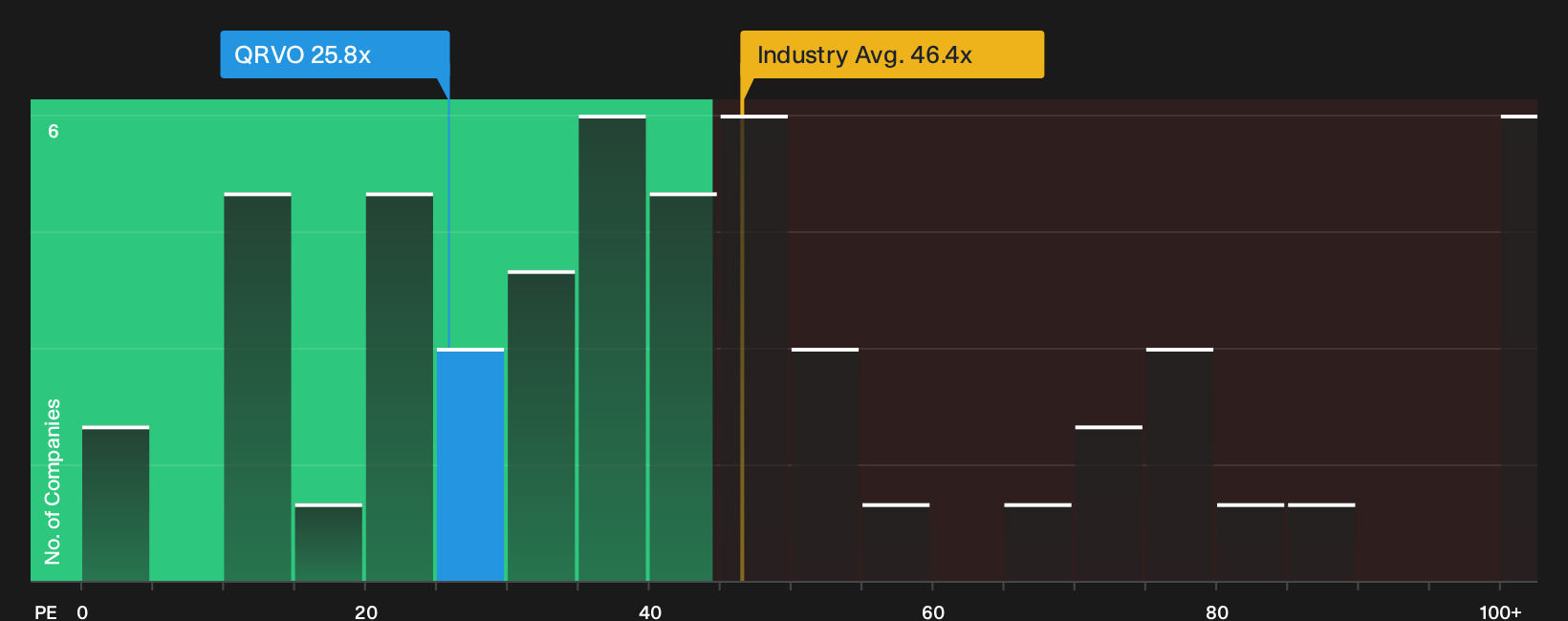
On this measure, Qorvo trades at about 25.8x earnings, which is below the broader semiconductor industry average of 47.9x and also under the peer group average of 33.1x. That relative discount does not automatically signal a bargain, but it shows the stock is not priced at the upper end of sector optimism despite the merger headlines.
The fair P/E multiple for Qorvo is estimated at 21.8x, which is lower than the current 25.8x level. That gap suggests investors are paying a premium to what the model implies based on Qorvo’s profile, so earnings are carrying a richer tag than the tailored benchmark would indicate.
On the P/E check, Qorvo screens as overvalued, with the share price carrying a higher earnings multiple than the modelled fair ratio supports.
See what the numbers say about this price — find out in our valuation breakdown.
The Qorvo Narrative: What Would Justify Today's Price?
Qorvo's valuation puzzle sets up the role of Simply Wall St Narratives, which sit on the Community page and spell out which future paths for growth, margins and earnings would need to play out for the stock to be worth materially more or materially less than today. Rather than leaning on a single multiple or one DCF output, each storyline lays out its own fair value assumptions so you can compare those expectations with Qorvo's actual results as they arrive.
One of the top community narratives on Qorvo: 11% overvalued
"Qorvo's ongoing factory consolidation, cost discipline, and vertical integration, especially in high-value fabs and critical US-based supply, are likely to deliver lasting gross margin leverage…"
Read one of the top narratives on Qorvo
Do you think there's more to the story for Qorvo? Head over to our Community to see what others are saying!
The Bottom Line
Qorvo screens as overvalued on both the Discounted Cash Flow (DCF) intrinsic value estimate and on the tailored earnings multiple, so neither framework flags the current price as a clear bargain. The broader checks line up with that message, which means the burden of proof now sits with future cash generation and execution on the Skyworks merger story. The real debate from here is whether margins and cash flows can be sufficient to close the gap to intrinsic value, or whether the current premium simply reflects optimism that may prove hard to sustain.
This article by Simply Wall St is general in nature. We provide commentary based on historical data and analyst forecasts only using an unbiased methodology and our articles are not intended to be financial advice. It does not constitute a recommendation to buy or sell any stock, and does not take account of your objectives, or your financial situation. We aim to bring you long-term focused analysis driven by fundamental data. Note that our analysis may not factor in the latest price-sensitive company announcements or qualitative material. Simply Wall St has no position in any stocks mentioned.
Have feedback on this article? Concerned about the content? Get in touch with us directly. Alternatively, email editorial-team@simplywallst.com