
Deere (DE) Stock May Be 11% Undervalued As Recovery Hopes Grow
Deere has more than doubled over the past five years, yet the stock now sits in an unusual spot where a Discounted Cash Flow (DCF) estimate points to some undervaluation while broader checks flag it as far from a clear bargain.
- The share price has returned 106.7% over the past five years, which puts Deere firmly in the camp of long term winners that now demand closer scrutiny on price.
- Investor optimism around a future recovery in farm machinery demand and precision agriculture adoption can support the case for stronger cash flows, while any prolonged pressure on farm incomes may limit how much buyers are willing to pay for new equipment.
- On a composite basis Deere scores 2 out of 6, which leans expensive and suggests the stock is not an obvious bargain when viewed across multiple valuation checks.
The issue now is whether Deere's recent strength, coupled with an intrinsic value estimate that sits about 11.1% above the market price, still offers enough valuation headroom for new money coming in today.
Scan beyond Deere to see how other heavy equipment and industrial names with similar valuation tension line up inside 31 high quality undervalued stocks
Does Deere Look Undervalued on Cash Flow?
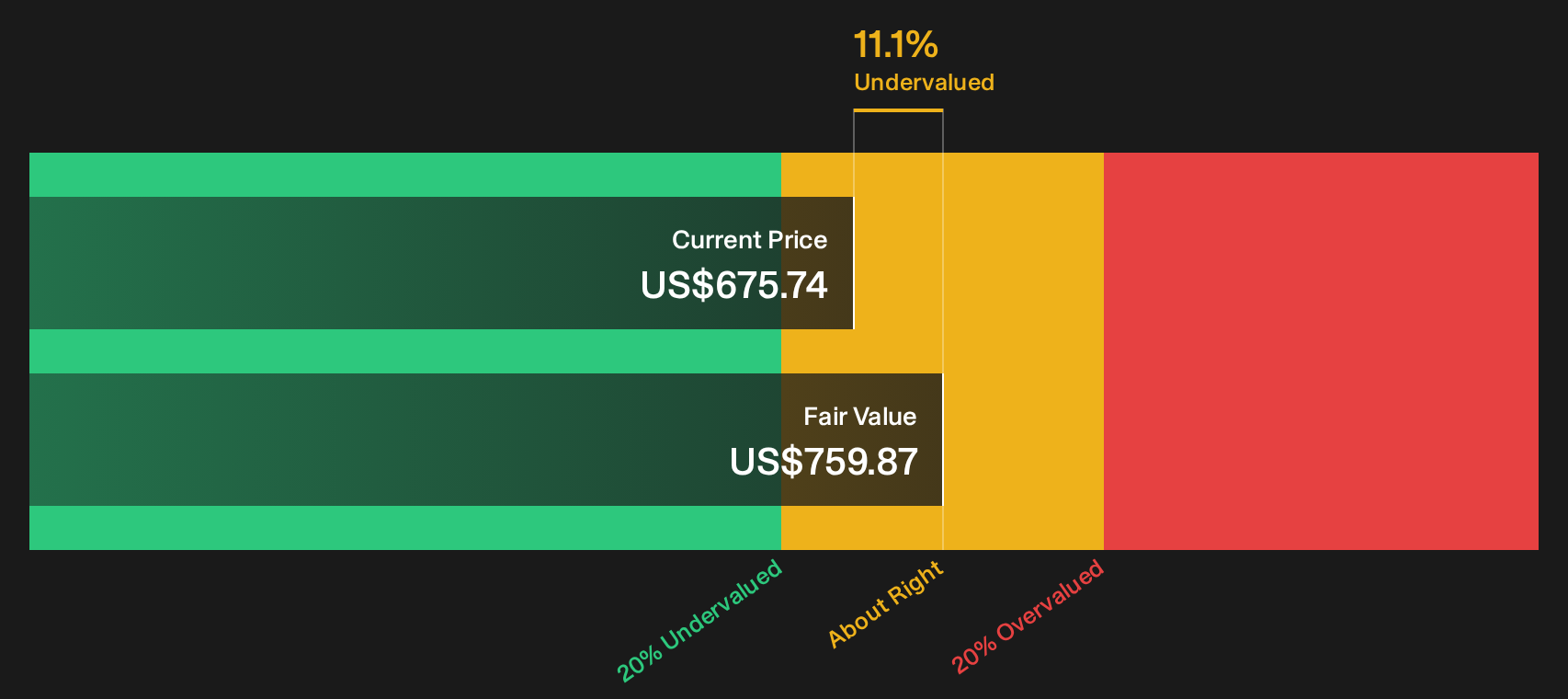
The Discounted Cash Flow (DCF) model here is built on Deere’s future cash generation rather than headline earnings. Deere produced about $2.9b of free cash flow over the last twelve months, and the model assumes those cash flows keep growing from this base rather than shrinking. On that setup, the intrinsic value comes out at roughly $760 per share in dollar terms.
That compares to a market price that implies about an 11.1% discount, so the DCF points to Deere trading below what its projected cash flows suggest. Baird’s recent upgrade to Outperform with an $800 target helps explain why investors are willing to pay more, even if the DCF still shows some remaining gap.
On these cash flow assumptions, Deere screens as undervalued relative to the DCF estimate of its intrinsic worth.
Our Discounted Cash Flow (DCF) analysis suggests Deere is undervalued by 11.1%. Track this in your watchlist or portfolio, or discover 31 more high quality undervalued stocks.
Is Deere Fairly Priced on Earnings?
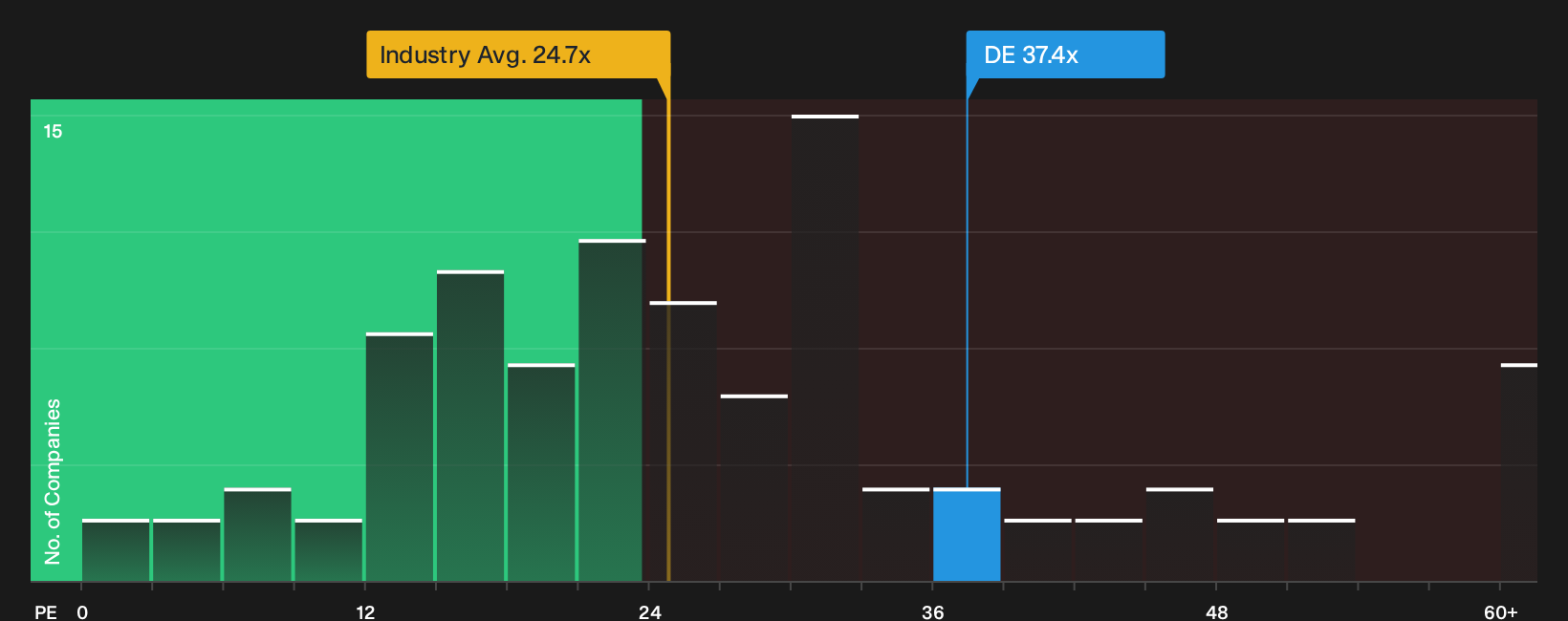
P/E is a useful sanity check for Deere because earnings for an equipment maker tend to move more closely with what shareholders ultimately own than revenue or book value alone. Deere currently trades on a P/E of about 37.4x, which is above the Machinery group average of roughly 24.7x and also higher than the peer average of about 31.7x. So the market is clearly willing to put a richer tag on each dollar of Deere’s earnings than on the typical industry peer.
The fair P/E ratio from the model sits near 37.9x, which is only a touch above where Deere trades now. That small gap suggests the current earnings multiple already reflects the company’s profile, including its margins, scale and risk, without stretching too far in either direction. Deere therefore neither screens as a glaring bargain nor as an extreme outlier on this earnings yardstick.
On the P/E measure, Deere looks roughly fairly valued compared with what the model suggests is a reasonable earnings multiple.
See what the numbers say about this price — find out in our valuation breakdown.
The Deere Narrative: What Would Justify Today's Price?
Narratives for Deere pick up where this valuation puzzle leaves off by spelling out which paths for growth, profitability and earnings would need to play out for the stock to be worth materially more or less than where it trades today on Simply Wall St's Community page. Each one links its figure to a specific view on how Deere's growth, margins and risk profile might shift, giving you something concrete to track as fresh numbers come through.
Community views on Deere split sharply, with one camp leaning into a tech heavy farm recovery story and the other fixated on cycle and pricing risks.
Bull case: roughly fairly valued
"Rapid adoption of Deere's precision agriculture and automation solutions is driving higher value product sales and increased software engagement globally, positioning Deere to benefit from shifts toward high efficiency, technology enabled farming…"
Read the full Bull Case to see why Deere could be undervalued
Bear case: 32% overvalued
"High equipment prices supported by recent price realization in several segments could be harder to maintain as competitors layer in price increases and incentives…"
Read the full Bear Case to see why Deere could be overvalued
Do you think there's more to the story for Deere? Head over to our Community to see what others are saying!
The Bottom Line
Deere screens as modestly undervalued on a Discounted Cash Flow (DCF) view, with an intrinsic value estimate that sits above the current price, while the P/E workup indicates the market already prices the business roughly in line with its peer-adjusted earnings power. That disconnect reflects a gap between what Deere’s cash generation could support over time and what investors are currently willing to pay based on sector sentiment and growth expectations.
For anyone weighing Deere today, the key question is whether farm machinery demand and precision agriculture adoption evolve in a way that turns that DCF discount into a genuine opportunity rather than compensation for cycle and pricing risk.
This article by Simply Wall St is general in nature. We provide commentary based on historical data and analyst forecasts only using an unbiased methodology and our articles are not intended to be financial advice. It does not constitute a recommendation to buy or sell any stock, and does not take account of your objectives, or your financial situation. We aim to bring you long-term focused analysis driven by fundamental data. Note that our analysis may not factor in the latest price-sensitive company announcements or qualitative material. Simply Wall St has no position in any stocks mentioned.
Have feedback on this article? Concerned about the content? Get in touch with us directly. Alternatively, email editorial-team@simplywallst.com