
Jones Lang LaSalle (JLL) Stock May Be Below Fair Value Even As Earnings Look Fair
Jones Lang LaSalle stock has logged a strong 3 year run, yet both an intrinsic value estimate and market multiples still flag the shares as cheap relative to the underlying cash flows. With the Discounted Cash Flow (DCF) model pointing to a sizeable gap to intrinsic value, the question is how much of that discount is truly justified by business risk.
- Jones Lang LaSalle has gained about 125.0% over 3 years, which means anyone looking at the chart alone could easily assume the easy money has already been made.
- The valuation story hinges on how consistently the company can turn its real estate services platform into dependable cash generation, while investors remain alert to any downturn in transaction volumes that could pressure fee income and profitability.
- The broader checks lean cheap, with the company screening as undervalued on 6 of 6 valuation tests, which lines up with the intrinsic value estimate implying the stock trades at a steep discount.
The stock's next move may depend on whether Jones Lang LaSalle is genuinely priced at a discount to its cash flow potential or whether the recent gains have already captured most of that value.
Scan beyond Jones Lang LaSalle and compare its valuation gap to a curated group of 31 high quality undervalued stocks that pair strong fundamentals with discounted market prices.
Does Jones Lang LaSalle Look Undervalued on Cash Flow?
The Discounted Cash Flow (DCF) approach values Jones Lang LaSalle on the cash it is expected to generate for shareholders over time. The model starts from the latest twelve-month free cash flow of about $1.13b and assumes that cash generation grows from here rather than shrinking, then discounts those future streams back to today using the 2 Stage Free Cash Flow to Equity framework.
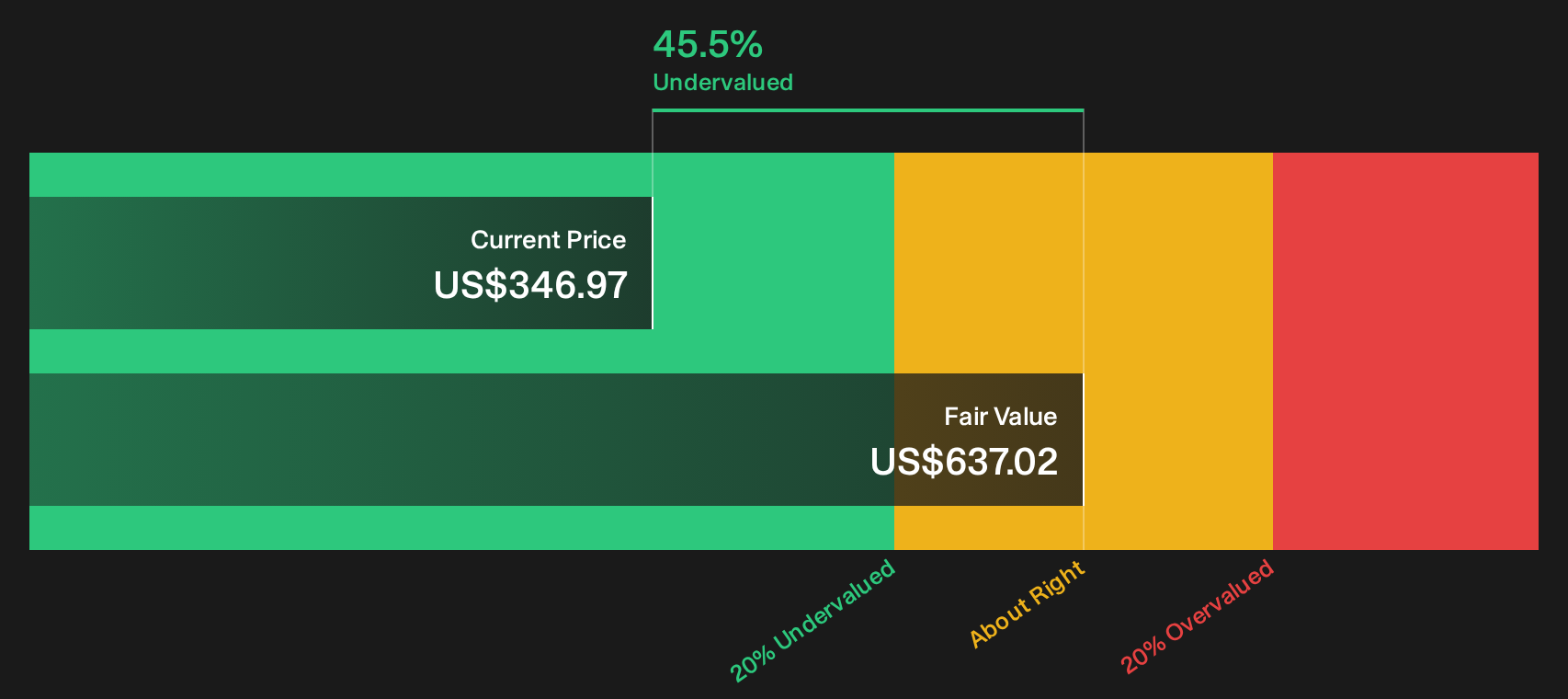
On these assumptions, the DCF model arrives at an estimated intrinsic value of about $637 per share. Compared with the current market price, that implies the stock trades at roughly a 45.5% discount to the cash flows the business is projected to produce. The gap suggests investors are pricing in a fair amount of execution and cycle risk around Jones Lang LaSalle’s transaction-driven real estate services model.
On this cash flow view, Jones Lang LaSalle stock currently appears undervalued.
Our Discounted Cash Flow (DCF) analysis suggests Jones Lang LaSalle is undervalued by 45.5%. Track this in your watchlist or portfolio, or discover 31 more high quality undervalued stocks.
Does Jones Lang LaSalle Look Undervalued on Earnings?
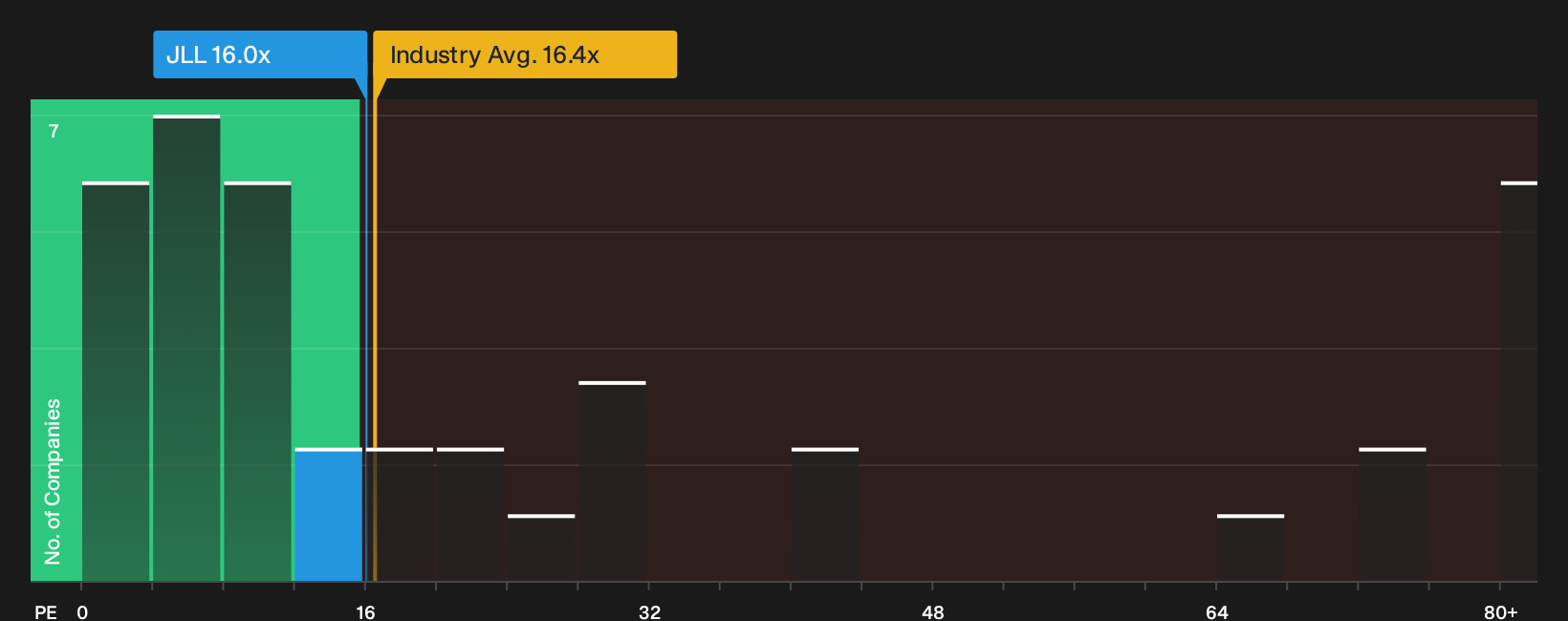
P/E fits Jones Lang LaSalle because earnings are a key yardstick for fee based service businesses where profits track deal activity and ongoing management income. On this measure, the stock trades on about 16.0x earnings, which is close to the broader real estate sector average of roughly 16.4x.
The more tailored fair P/E ratio is estimated at 25.0x once factors such as the company’s scale, margin profile and risk mix are included. That is well above the current 16.0x, and the gap suggests the market is valuing Jones Lang LaSalle’s earnings stream at a discount to what this framework implies.
On the P/E test, Jones Lang LaSalle stock appears undervalued relative to the earnings multiple implied by its fundamentals.
See what the numbers say about this price — find out in our valuation breakdown.
The Jones Lang LaSalle Narrative: What Would Justify Today's Price?
Simply Wall St Narratives for Jones Lang LaSalle pick up where the valuation gap leaves off and outline which paths for future growth, margins and earnings would need to occur for the stock to be worth materially more or materially less than today’s price on the Community page. Each scenario treats fair value as a thesis about how Jones Lang LaSalle's business might evolve over time, so you can see how that view holds up as new information arrives.
The community is split on Jones Lang LaSalle, with one camp leaning into the digital and sustainability upside while the other worries that office and capital markets risks are still being underpriced.
Bull case: 31% undervalued
"JLL's project management business is poised for exponential growth due to the global shortage of top-tier, energy-efficient buildings…"
Read the full Bull Case to see why Jones Lang LaSalle could be undervalued
Bear case: 6% overvalued
"The persistent structural shift toward remote and hybrid work is expected to continue reducing long-term demand for corporate office space…"
Read the full Bear Case to see why Jones Lang LaSalle could be overvalued
Do you think there's more to the story for Jones Lang LaSalle? Head over to our Community to see what others are saying!
The Bottom Line
The Discounted Cash Flow (DCF) work suggests Jones Lang LaSalle trades at a wide intrinsic value discount, and the market-multiple checks point in the same undervalued direction. The gap will only close if investors gain more confidence that its cash generation can hold up through real estate cycles rather than swinging sharply with transaction volumes. That is the crux of the debate. The key question from here is whether the current markdown reflects excess caution on deal activity or a fair buffer against the risk that fees and profitability prove more fragile than the optimistic scenarios assume.
This article by Simply Wall St is general in nature. We provide commentary based on historical data and analyst forecasts only using an unbiased methodology and our articles are not intended to be financial advice. It does not constitute a recommendation to buy or sell any stock, and does not take account of your objectives, or your financial situation. We aim to bring you long-term focused analysis driven by fundamental data. Note that our analysis may not factor in the latest price-sensitive company announcements or qualitative material. Simply Wall St has no position in any stocks mentioned.
Have feedback on this article? Concerned about the content? Get in touch with us directly. Alternatively, email editorial-team@simplywallst.com