
Is Capital One Financial (COF) Stock Still Reasonable At Today’s Price?
Capital One Financial now trades after a multi year run that more than doubled the share price, yet the Excess Returns intrinsic value estimate and earnings based checks both still frame the stock as undervalued on current information.
- Over the past 3 years, Capital One Financial has delivered a total return of 108.9%, which puts recent share weakness into the context of a strong longer term climb.
- For this credit focused bank, investor expectations around future credit losses can support the valuation if they remain contained, while any sustained rise in charge offs or funding costs may pressure the earnings power that underpins today’s pricing.
- The broader checks lean cheap, with Capital One Financial scoring 5 out of 6 on valuation tests that compare the share price to intrinsic value estimates and market based multiples.
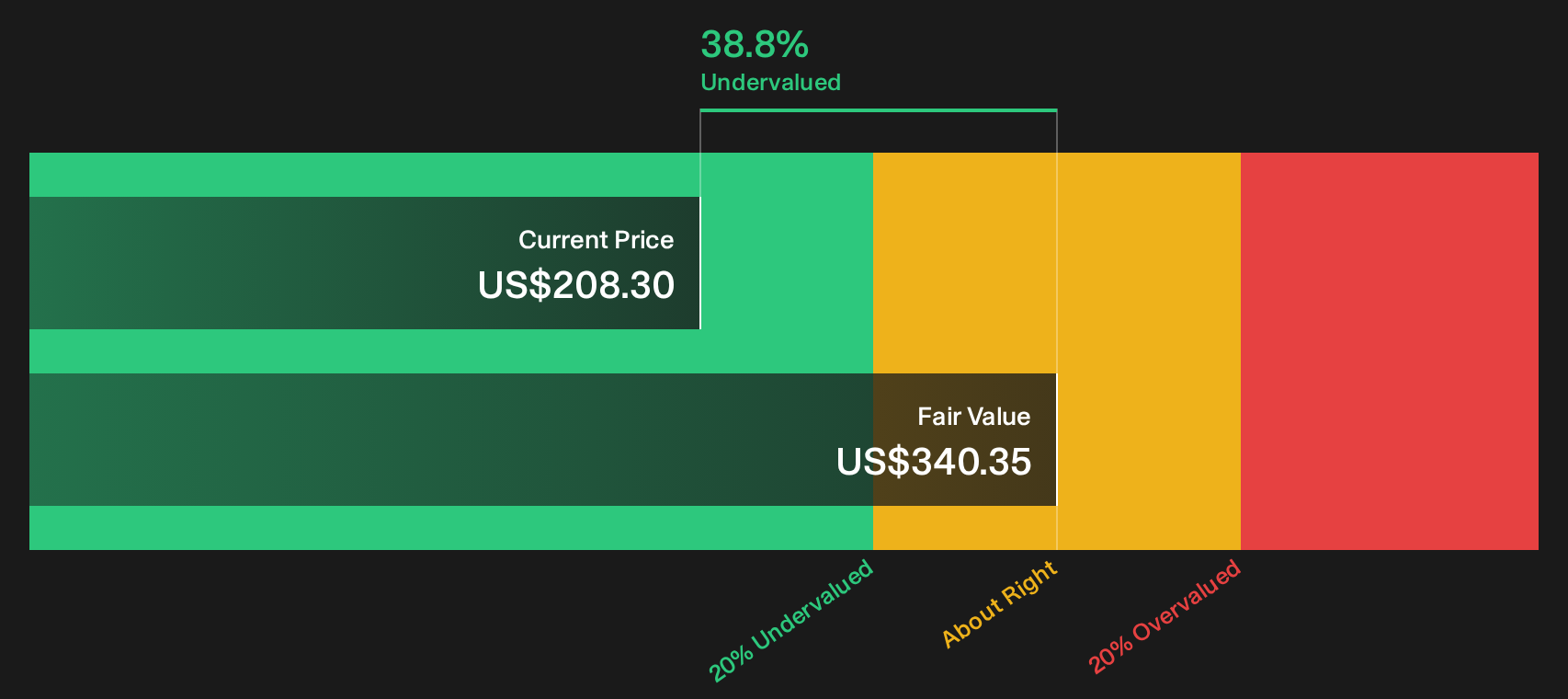
The issue now is whether that apparent discount, including the intrinsic value estimate sitting about 38.8% above the recent US$208.30 share price, offers enough cushion for investors given the risks in a cyclical lending business.
Scan beyond Capital One Financial and compare its valuation gap with 31 high quality undervalued stocks, which also pairs discounted pricing with stronger balance sheet support.
Is Capital One Financial a Bargain on Excess Returns?
Excess Returns evaluates what Capital One Financial can earn on its equity above its own funding cost and then capitalizes that gap. For a lender this approach keeps the focus on return on equity and the pace at which book value can compound over time.
The model uses a Book Value of $167.86 per share and a Stable Book Value estimate of $198.13 per share, supported by an Average Return on Equity of 12.03%. Against a Cost of Equity of $16.94 per share, the framework estimates an Excess Return of $6.90 per share and a Stable EPS of $23.83 per share. Those inputs are used to derive an Excess Returns intrinsic value of about $340 per share, which is roughly 38.8% above the recent share price of $208.30.
On these Excess Returns assumptions, Capital One Financial appears undervalued relative to its modeled intrinsic value.
Our Excess Returns analysis suggests Capital One Financial is undervalued by 38.8%. Track this in your watchlist or portfolio, or discover 31 more high quality undervalued stocks.
Is Capital One Financial Still Cheap on Earnings?
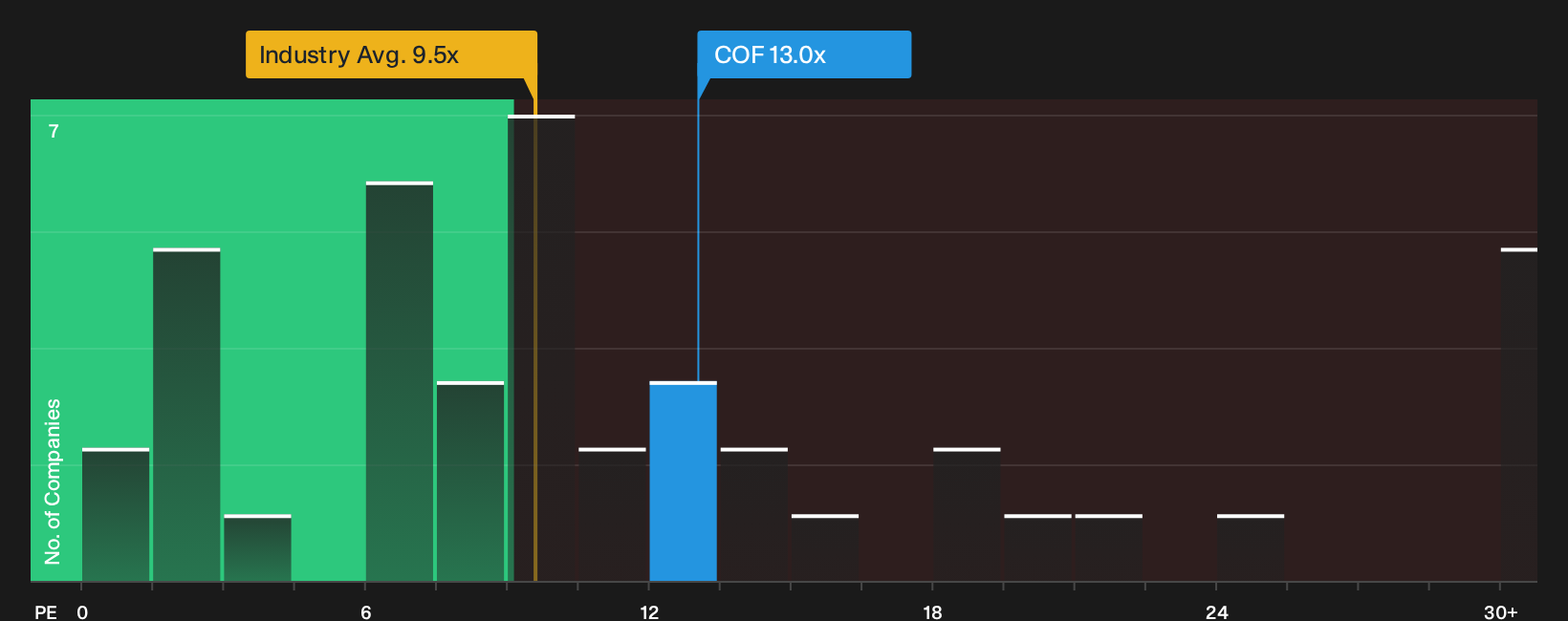
P/E works well for Capital One Financial because earnings are a core focus for a mature lender where profitability drives long term value. On this yardstick, the stock trades at about 13.0x earnings, which is above the consumer finance industry average near 9.5x but below the broader peer group at roughly 17.4x.
The tailored fair P/E multiple for Capital One Financial is estimated at about 20.4x. That is meaningfully higher than the current 13.0x, which indicates a sizeable discount even after allowing for the risks that come with a cyclical credit business.
On the P/E multiple, Capital One Financial appears undervalued relative to the earnings level implied by this fair ratio benchmark.
See what the numbers say about this price — find out in our valuation breakdown.
The Capital One Financial Narrative: What Would Justify Today's Price?
Simply Wall St Narratives for Capital One Financial pick up where the valuation gap above leaves you. They spell out which assumptions on growth, profitability and earnings would need to hold for the stock to be worth materially more or materially less than today’s price. Each Narrative treats fair value as a hypothesis about Capital One Financial's business that you can track over time rather than a single static number, and they live on the company’s Community page.
One of the top community narratives on Capital One Financial: 31% undervalued
"Capital One’s acquisition of Discover positions the company to leverage the ongoing shift towards digital payments and e-commerce, providing access to a global payments network and over 100 million customers…"
Read one of the top narratives on Capital One Financial
Do you think there's more to the story for Capital One Financial? Head over to our Community to see what others are saying!
The Bottom Line
Capital One Financial screens as undervalued on both the Excess Returns intrinsic value work and the P/E based comparison, which points in the same direction and keeps the message simple. The gap exists because the market is pricing in meaningful risk that earnings power proves less durable than the models assume for a cyclical lender. What matters now is whether credit losses and funding costs stay contained enough for that earnings base to hold, or whether the current discount ends up looking more like a value trap than an opportunity.
This article by Simply Wall St is general in nature. We provide commentary based on historical data and analyst forecasts only using an unbiased methodology and our articles are not intended to be financial advice. It does not constitute a recommendation to buy or sell any stock, and does not take account of your objectives, or your financial situation. We aim to bring you long-term focused analysis driven by fundamental data. Note that our analysis may not factor in the latest price-sensitive company announcements or qualitative material. Simply Wall St has no position in any stocks mentioned.
Have feedback on this article? Concerned about the content? Get in touch with us directly. Alternatively, email editorial-team@simplywallst.com