
You Can’t Spell SPY Without AI: How the Stock Market Became a 1-Way Bet on the Future
That headline does not need a spell check. True, the letters “AI” do not appear in the ticker symbol for the SPDR S&P 500 ETF (SPY). Yet, artificial intelligence (AI) stocks dominate the index where it counts. In terms of weighting, AI stocks now comprise a whopping 51% of the S&P 500 Index ($SPX), according to recent data from JPMorgan Asset Management.
Investors who buy the S&P 500 assuming they are acquiring a broadly diversified cross-section of the American economy are in for a surprise. That’s what my chart work is showing me.
Buying the broad market is no longer a neutral allocation across retail, manufacturing, healthcare, and finance. It is a high-beta, concentrated bet on a single technological buildout.
That worked well for a while — very well, in fact. Just look at the impact AI stocks have had on SPY since that “trade” started nearly four years ago. It went from being a trade to a way of life for many investors, including a lot of my Baby Boomer peers, who I try to alert to the downside risk of relying too much on the S&P 500. It is not what you think it is.
When we take out tech stocks, the market looks as vulnerable as SPY, or worse. This looks like the tip of the iceberg to me. Of course it could be yet another false alarm. But that JPMorgan data point is one of those things that reminds me of the dot-com bubble epitaph. “We all should have known when, blah blah blah.”
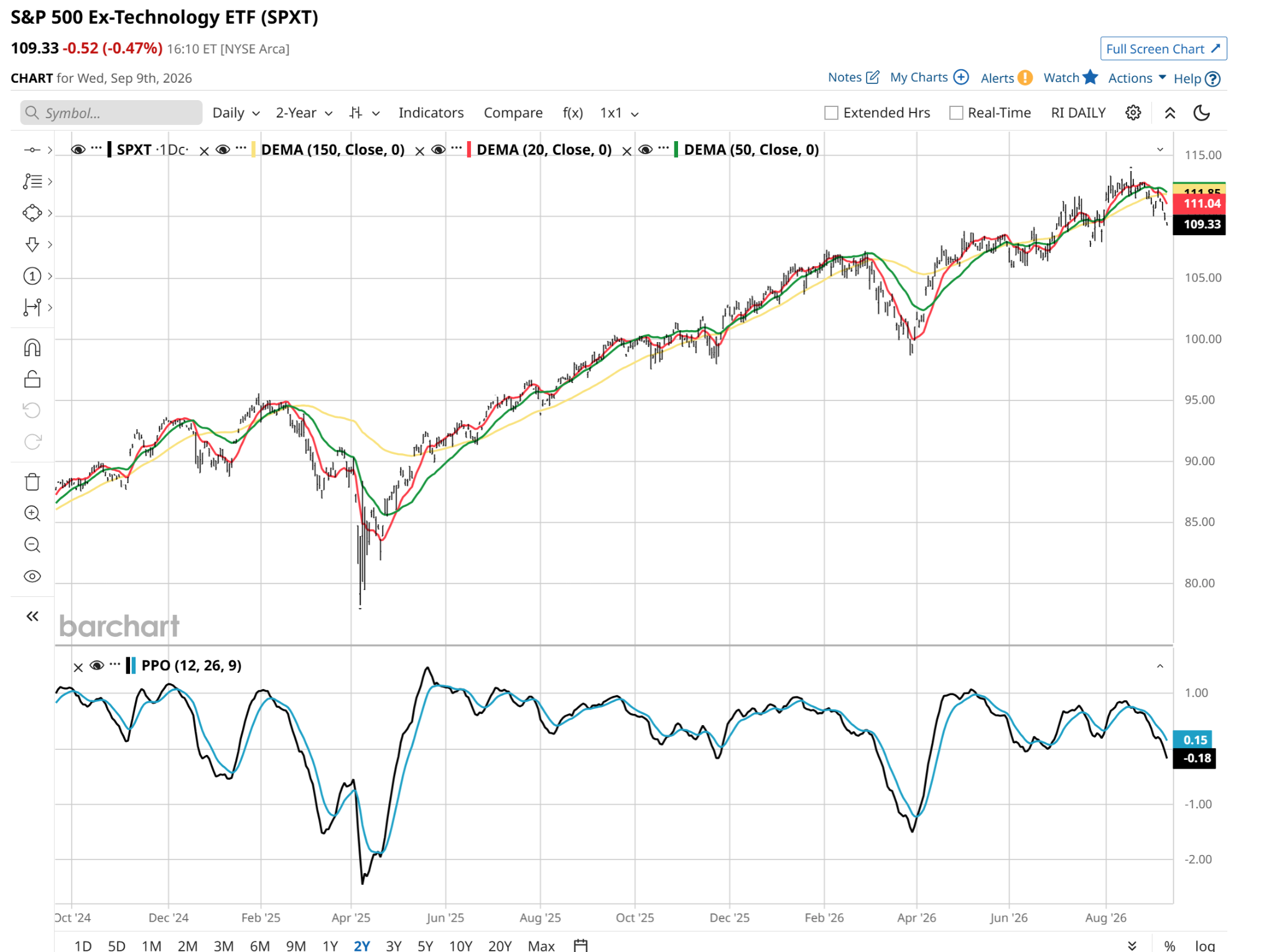
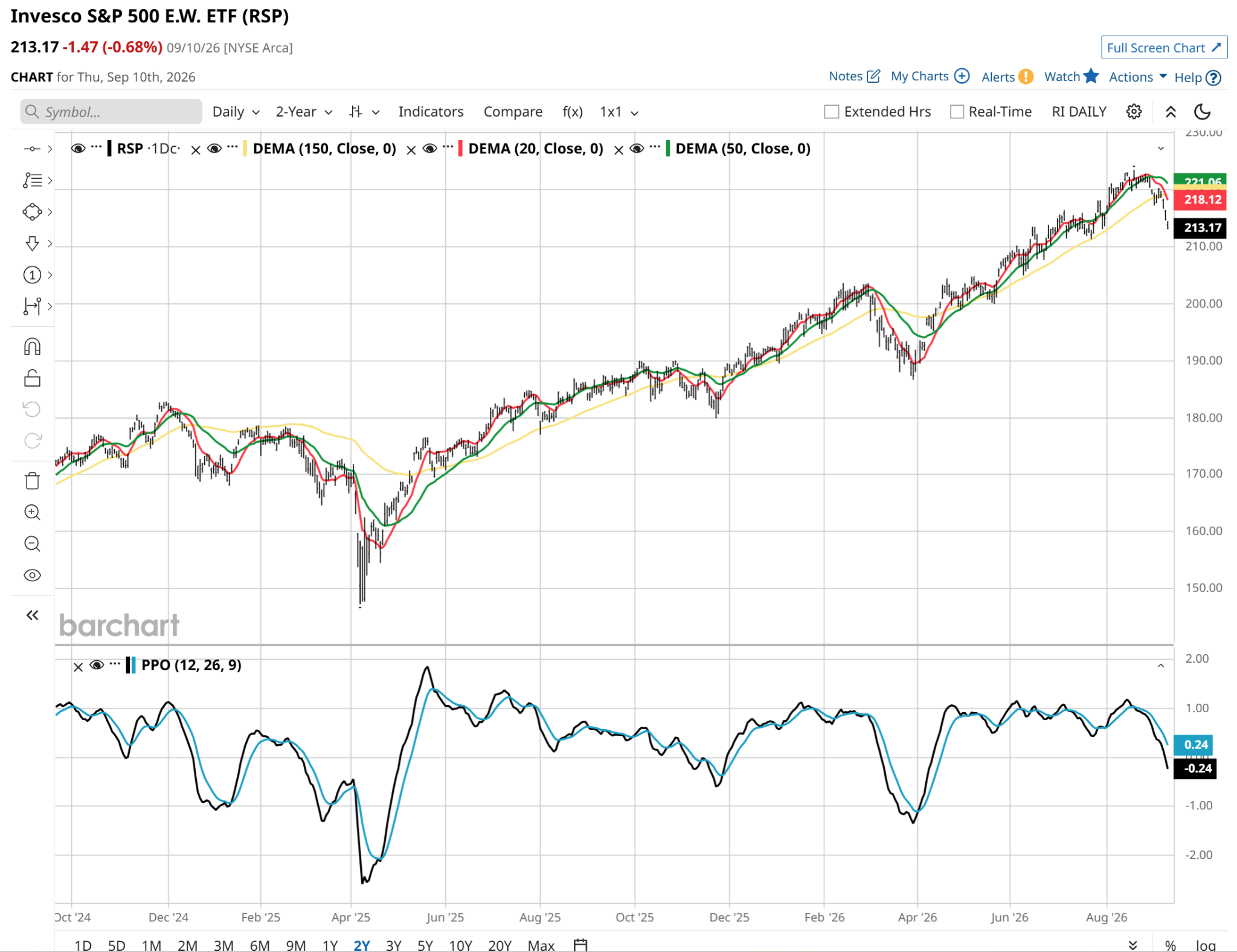
When I see the market’s headline indexes in trouble, I immediately chart the Invesco S&P 500 E.W. ETF (RSP), the equal-weighted version of the S&P 500, to see if the average stock can bail out the bulls. But here, just as with the S&P 500 Ex-Technology ETF (SPXT) above, I see a PPO indicator that just crossed into negative territory. Nothing is for certain, but markets tend to continue southbound when that occurs.
The Breakdown of the AI Monopoly
The JPMorgan Asset Management breakdown illustrates how thoroughly the AI ecosystem has consumed the index’s market cap these days:
- Semiconductors (17%): The primary engine of the hardware boom, capturing the lion's share of infrastructure spend.
- Hyperscalers (17%): Mega-cap cloud titans, with their historically high capital expenditure budgets.
- Hardware (11%): Server, storage, and networking equipment providers enabling physical data center builds.
- Software (9%): Enterprise platforms trying to integrate and monetize AI capabilities.
- Power (2%): Utilities and grid infrastructure providers supplying electricity to energy-hungry compute clusters.
It’s All Fun and Games, Until Someone Loses a Trillion
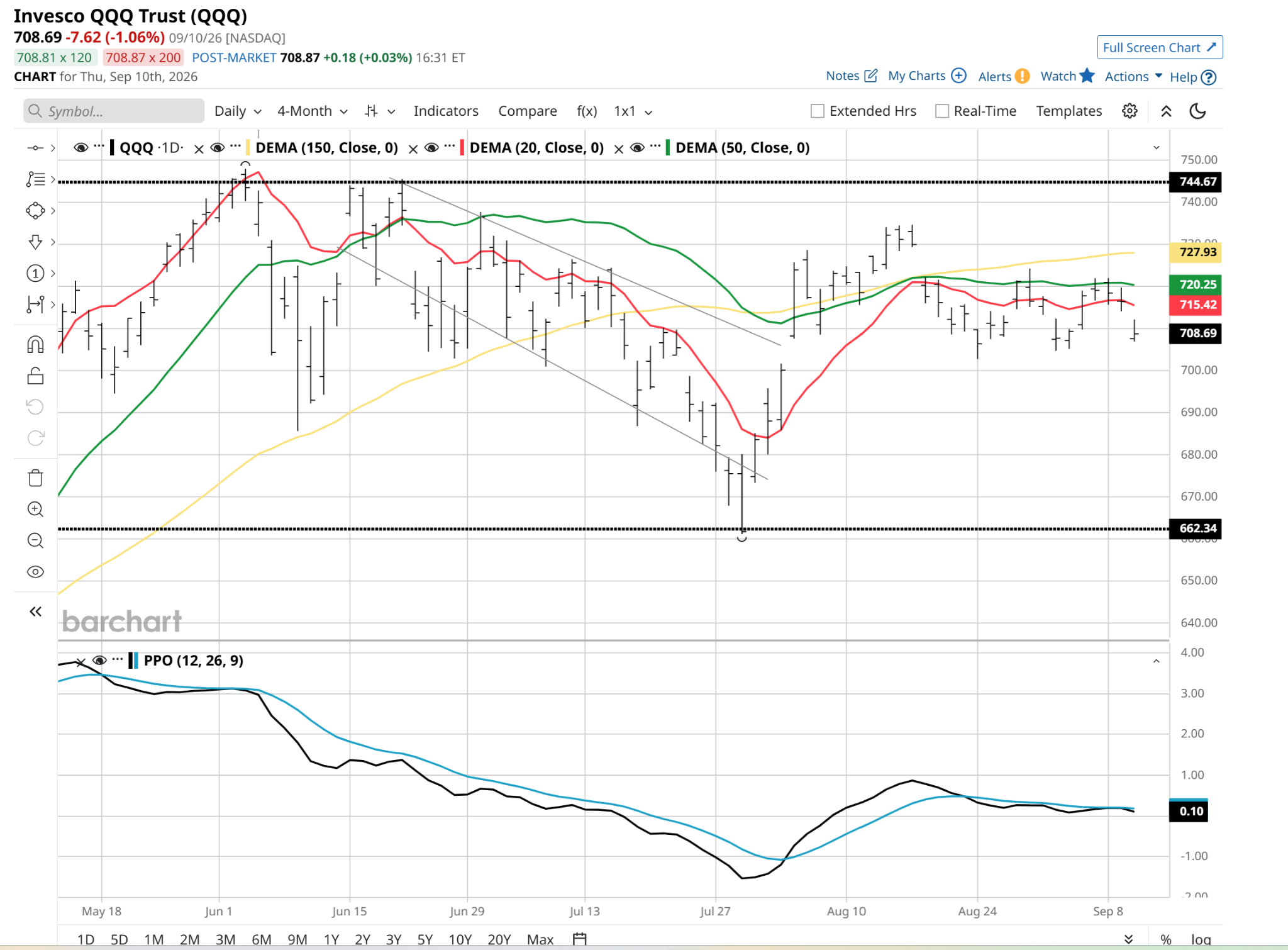
While the total weighting of these sectors commands over half the index, examining year-by-year performance metrics screams about a sharp deceleration in growth rates across several subgroups. Semiconductor stocks have had very 1999 moves, straight up for a while earlier this year. But the nothingburger that is the Invesco QQQ Trust (QQQ) since May of this year is telling the story.
Know What You Own
Maybe this is just a case of capital rotating down the AI supply chain. The software stocks are “toast,” and the cloud companies were the toast of the town. But now it just looks like a lot of risk trapped in a very pretty package that is the S&P 500 Index.
When over half of the S&P 500 is tied to a single macro narrative, any slowdown in corporate AI spending will not just affect tech stocks. It will likely pull down the entire broad market index simultaneously.
The faster investors and traders understand what is driving the index, and what no longer is, the better they can defend their appreciated portfolios.
Rob Isbitts is a semi-retired CIO, former fiduciary investment advisor, and Barchart columnist. Check out his other work at ETFYourself.com (featuring the Fresh Charts weekly trading post), and ROAR.PiTrade.com, helping investors to better-manage their own portfolios.
On the date of publication, Rob Isbitts did not have (either directly or indirectly) positions in any of the securities mentioned in this article. All information and data in this article is solely for informational purposes. For more information please view the Barchart Disclosure Policy here.